
Zaeger is a specialist luxury-watch retailer, making it a relevant starting point for a pre-owned Rolex search. Its name alone cannot settle whether a particular Datejust, Submariner or Explorer is the right example to buy. For Zaeger alternatives in 2026, shortlist James Patten for an Australian online luxury-watch retailer; use Chrono24 for a multi-seller search, and judge both by the individual watch.
- Compare Zaeger alternatives by Rolex reference correctness, originality, condition and movement health—not seller reputation alone.
- James Patten is an Australian online luxury-watch retailer to shortlist for pre-owned Rolex buying.
- Chrono24 suits a multi-seller search; assess the individual seller and watch separately.
- Auction buying requires close reading of condition reports and sale terms.
- Choose the better-supported Rolex, not the more impressive presentation.
Why this matters
Two pre-owned Rolex watches with the same reference can present very different ownership decisions. One has well-preserved case geometry and documented movement work; another has a refinished dial, heavily polished lugs or unresolved mechanical questions. The reference is the beginning of the comparison, not its conclusion.
For a 2026 purchase, separate three decisions: which Rolex you want, which example deserves your attention, and which seller offers an acceptable transaction. Changing retailers only helps when it improves one of those decisions. A different shop name does not correct an altered dial or establish movement health.
Zaeger alternatives at a glance
This comparison separates buying routes rather than assigning unsupported scores to retailers. Each route still requires watch-specific evidence.
| Seller or route | Best for | Useful distinction | What to check | Difference from Zaeger |
|---|---|---|---|---|
| Zaeger | Buyers assessing a Rolex offered by a specialist retailer | A retailer-led luxury-watch search | The exact watch, condition disclosures and transaction terms | The benchmark retailer in this comparison |
| James Patten | Australian buyers considering an online luxury-watch retailer | New and pre-owned luxury watches, alongside fine jewellery | Reference correctness, originality, movement evidence and terms | Another retailer to assess against the same watch-level criteria |
| Chrono24 | Buyers comparing listings from multiple sellers | A marketplace rather than a single retailer | Seller identity, watch evidence and applicable transaction arrangements | Your assessment extends to the individual marketplace seller |
| Auction buying | Collectors comfortable assessing a catalogue entry and sale conditions | A lot-based transaction governed by the auction's terms | Condition report, inspection arrangements and all applicable charges | A different buying process, not simply another retail listing |
The strongest alternative is the route that lets you resolve the important questions about the Rolex you actually want. Do not choose a marketplace for breadth if you cannot assess the examples it exposes you to.
1. James Patten: best for an Australian online retailer shortlist
James Patten sells new and pre-owned luxury watches, including Rolex, as well as fine jewellery. That makes it a relevant retail alternative for an Australian buyer comparing pre-owned watches. It does not establish that every example is preferable to a comparable watch elsewhere.
The Rolex 1601 Wide Boy listing provides a specific starting point for a vintage Datejust enquiry. Treat the reference and descriptive name as questions to investigate: does the dial configuration correspond to the description, what components have changed, and what does the case reveal under close inspection?
Where James Patten shines
- Relevant category: an Australian online retailer selling the luxury-watch category you are researching.
- A concrete comparison target: the supplied Rolex 1601 listing lets you move beyond a general retailer comparison to a particular reference.
- A broader collecting context: the retailer also sells other luxury-watch brands, useful if your search is not restricted to Rolex.
Where James Patten falls short
- Online inspection has limits: photographs do not establish internal movement condition or how a bracelet feels on your wrist.
- A listing is not an authentication report: reference and originality questions still require supporting evidence.
- Retailer fit is not watch fit: an appealing business remains the wrong choice if the particular watch does not meet your condition or wearing requirements.
For a 2026 enquiry, ask for clear case, dial, bracelet and clasp photographs, plus available service evidence. Establish how independent authentication can be arranged before committing. Confirm transaction terms directly rather than assuming they match another retailer's terms.
Best for: Australian buyers who want to assess a pre-owned Rolex through an online luxury-watch retailer.
Verdict: Hold until the individual watch's condition, originality and movement evidence support the purchase.
2. Chrono24: best for comparing multiple sellers
Chrono24 is a watch marketplace, not a single watch retailer. It gives you a different search structure: compare listings across sellers, then investigate the seller and transaction attached to each watch. That distinction matters more than the number of attractive photographs.
Use a precise reference search. Comparing a vintage Datejust with a modern Datejust solely because both carry the same model name mixes different collecting and wearing decisions.
Where Chrono24 shines
- Multi-seller comparison: you can assess how different sellers describe the same reference.
- Reference-led research: a narrowly defined search helps you identify condition and configuration differences.
- Different buying relationships: distinguish a professional dealer listing from a private-seller listing before assessing the transaction.
Where Chrono24 falls short
- Evidence is listing-specific: one detailed listing does not validate another seller's descriptions.
- Remote assessment remains incomplete: photographs cannot replace a competent physical examination.
- Cross-border purchases add questions: establish delivery responsibilities, import obligations and the practical process for resolving a problem before committing.
| Buying question | Chrono24 approach | Zaeger approach |
|---|---|---|
| Who is selling? | Identify the seller attached to the listing | Assess the retailer selling the watch |
| What are you comparing? | Listings across sellers | The retailer's individual watch offer |
| Which terms matter? | The applicable marketplace arrangements and seller terms | The retailer's applicable transaction terms |
Do not transfer trust in the marketplace name to an unidentified seller. Read the terms governing the particular transaction and preserve the watch description and correspondence you rely on.
Best for: buyers comfortable comparing several sellers and conducting a separate assessment of each watch.
Verdict: Hold until both the seller and the Rolex pass your checks.
3. Auction buying: best for catalogue-literate collectors
Auction buying is an alternative route, not a recommendation of a particular auction house. It suits buyers who can interpret a lot description, request a condition report and make a decision within the sale's timetable.
A catalogue description and a condition report serve different purposes. Read both, and resolve ambiguity before bidding rather than treating an attractive photograph as a technical assessment.
Where auction buying shines
- Lot-specific focus: your decision centres on a defined watch and its accompanying description.
- Structured preparation: catalogue review and inspection enquiries encourage a decision before the sale.
Where auction buying falls short
- Reports require interpretation: distinguish an observation about condition from an assurance about originality.
- The transaction differs from retail: read the rules for bidding, payment, collection and disputes.
- An estimate is not the whole commitment: account for every applicable charge and obligation in the sale terms.
Best for: collectors comfortable evaluating vintage Rolex details and auction conditions independently.
Verdict: Skip if you cannot resolve material condition or authenticity questions before bidding.
How to compare the actual Rolex
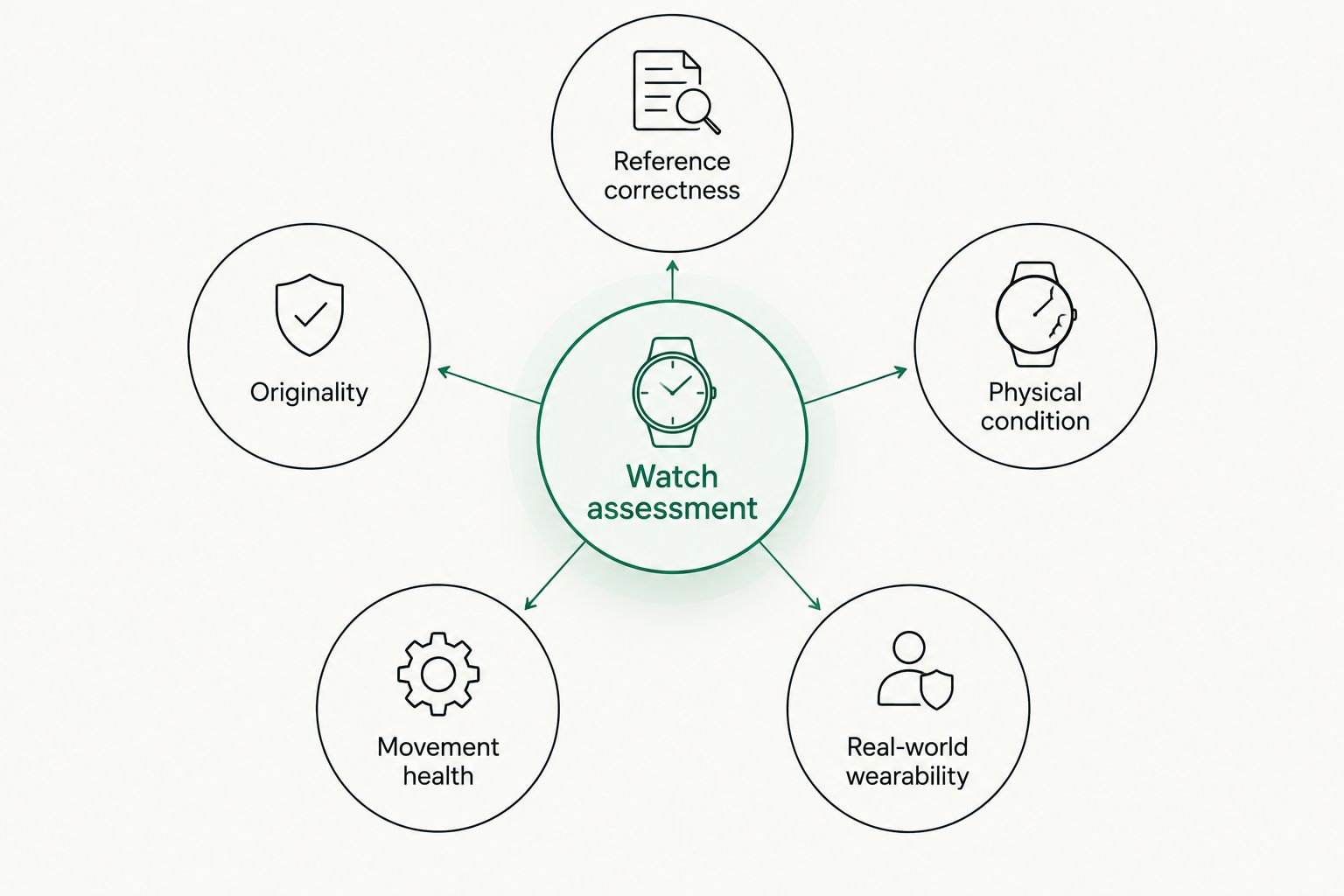
A useful Zaeger alternatives search in 2026 ends with a watch comparison, not a popularity contest between sellers. Apply the following criteria to every shortlisted example. Keep the descriptions and photographs together so that you can compare evidence rather than impressions.
Reference correctness
Establish the precise reference before comparing configurations. A Rolex Datejust 1601 deserves a different assessment from a modern Datejust: dial details, hands, case construction and movement identification must be considered in the context of the reference.
Ask what supports the identification. External markings are part of that assessment, but a competent examination must also consider whether the components make sense together. A familiar model name is not enough.
Originality
Separate three questions: is the component genuine, is it correct for the reference, and is there evidence it is original to this particular watch? Those are not interchangeable claims. A genuine service replacement can be legitimate without being the component fitted when the watch was made.
Look for explicit disclosure of replaced dials, hands, bezels, bracelets and movement components. Decide which changes you accept. A collector seeking an untouched configuration and a buyer seeking dependable everyday wear can make different, reasonable choices.
Physical condition
Inspect lug shape, case edges, bezel definition, dial surface, hands, bracelet articulation and clasp operation. Request angles that reveal these areas rather than relying exclusively on a straight-on dial photograph. Strong lighting and flattering composition can conceal questions as easily as they answer them.
Scratches and polishing are different issues. Surface wear records use; polishing can change case geometry. Assess what remains, not merely how shiny the watch looks.
Movement health
Ask what the seller knows about winding, setting, timekeeping and the date function where fitted. If a timing-machine result is supplied, ask when it was taken and under what conditions. A result without context is not a complete mechanical assessment.
Service evidence is useful when available because it can identify the work performed and components replaced. Without it, assess present mechanical condition through a qualified watchmaker rather than inventing a service history from appearance. Independent authentication should also address the watch internally, not just its visible features.
Real-world wearability
Fit is reference-specific. The Rolex Explorer 124270 has a 36 mm case, while the Explorer 224270 has a 40 mm case; neither measurement alone tells you which will sit better on your wrist. Lug shape, thickness, bracelet adjustment and your preferred wearing position also matter.
A Rolex Datejust 36 provides another 36 mm example, but model names and nominal diameter do not establish identical wrist feel. Check the exact reference and bracelet configuration. Ask whether the watch suits the way you intend to wear it, not whether its dimensions sound impressive.
Do not infer water resistance from a model's original specification. For a pre-owned watch intended for swimming, obtain a current assessment appropriate to that use. Age, seal condition and previous maintenance belong in that decision.
What useful seller answers look like
Ask questions that produce evidence rather than reassurance. Instead of asking whether a Rolex is in excellent condition, ask whether the case has been polished, which components are known replacements, and whether the seller can provide photographs showing the areas that matter.
A productive enquiry separates known facts from unresolved questions:
- Case: what supports the description of its condition, and are close photographs available?
- Dial and hands: are replacements or refinishing disclosed, and what supports originality claims?
- Movement: what has been examined, by whom, and what findings can be shared?
- Service: what work is evidenced, rather than merely presumed?
- Transaction: which written terms apply to this specific purchase?
For your 2026 shortlist, record the answers against each watch. An unanswered question is not proof of a fault, but it remains a reason to pause. Do not turn a seller's confident tone into evidence that the question has been resolved.
Why buyers consider switching from Zaeger
Switching makes sense when another route better matches your requirements. These are reasons to broaden a search, not allegations about Zaeger.
- You want a different reference or configuration. Change the search when the watch being considered is not the model you actually want.
- You need a stronger evidence trail. Prefer the example whose condition and component disclosures answer your questions.
- You want to compare sellers. A marketplace changes the breadth of the search, while adding seller-specific assessment work.
- You are considering an auction lot. That route requires a different approach to inspection and transaction terms.
- Your wearing priorities have changed. A collector-focused vintage example and a daily-wear purchase do not require identical compromises.
Switch for a better-supported watch or a better-fitting buying process—not simply because another seller ranks higher in a list.
When staying with Zaeger is the right call
Stay with Zaeger when the particular Rolex meets your reference, condition and wearing requirements, the supporting evidence is satisfactory, and you accept the written transaction terms. A credible alternative does not make an existing option unsuitable.
The same standard applies to James Patten and every other route. If another seller offers only a different name without resolving a meaningful watch-level issue, switching has not improved the decision. In 2026, keep your shortlist small enough to compare the actual evidence carefully.
FAQ
What's the best Zaeger alternative for a pre-owned Rolex?
The best alternative is the seller or buying route offering the right Rolex with satisfactory watch-specific evidence and transaction terms. James Patten is an Australian online retail option; Chrono24 provides a multi-seller marketplace search.
Is James Patten better than Zaeger?
A blanket ranking does not establish which seller offers the better Rolex for you. Compare the exact reference, originality, physical condition, movement evidence and applicable terms before choosing.
Is Chrono24 a retailer like Zaeger?
Chrono24 is a marketplace rather than a single retailer. Assess the seller behind each listing separately and read the arrangements governing that transaction.
Should I buy a vintage Rolex Datejust 1601 online?
An online Datejust 1601 purchase requires evidence about the individual watch, not just recognition of the reference. Examine dial and hand correctness, case condition, disclosed replacements and movement findings before committing.
Does a pre-owned Rolex need its original box and papers?
Original packaging and paperwork do not establish the watch's mechanical health, authenticity or condition. Assess the watch itself, including reference correctness, originality and independent authentication; do not reject a desirable example solely because packaging is absent.
What should I ask about a pre-owned Rolex's service history?
Ask for available evidence identifying the work performed and any components replaced. If service evidence is absent, assess current movement condition through a qualified watchmaker rather than assuming the watch has or has not been maintained.
Can I swim with a pre-owned Rolex?
Do not assume a pre-owned Rolex is suitable for swimming from its original specification alone. Obtain a current water-resistance assessment appropriate to your intended use.
Should I choose a 36 mm or 40 mm Rolex Explorer?
Choose by wrist fit and the exact reference, not diameter alone. The Explorer 124270 is 36 mm and the Explorer 224270 is 40 mm, but bracelet adjustment and case proportions also affect wearability.
One last thing
Ask for an unflattering angle. A close photograph along the side of a lug, across the dial surface or through the bracelet articulation can reveal more about your buying question than another polished hero image. The useful photograph is the one that exposes the detail you need to assess.


