
Watchfinder specialises in pre-owned luxury watches, but a retailer’s reputation cannot resolve the condition, originality or suitability of an individual Rolex, Omega or Cartier. For Australian buyers comparing Watchfinder alternatives in 2026, James Patten belongs on the shortlist for an Australian retail purchase; Chrono24 suits a search across multiple sellers. Choose between them by the evidence for the actual watch, not by a blanket ranking of the businesses.
- Compare Watchfinder alternatives by reference correctness, originality, movement health and wearability—not packaging.
- James Patten is an Australian retail alternative for pre-owned luxury watches.
- Chrono24 suits buyers comparing multiple sellers; assess the seller as carefully as the watch.
- Auction buying suits reference-focused collectors who can evaluate condition reports and sale terms.
Why this matters
A pre-owned Rolex Datejust reference 1601 is not interchangeable with every other example carrying that reference. Case shape, dial configuration, replacement components and movement condition change what you are buying. The same principle applies to a Cartier Tank or an Omega Seamaster.
Your choice of seller matters because it determines who answers those questions and which purchase terms apply. It does not replace the questions. For a purchase in 2026, separate the quality of the watch from the appeal of the listing.
Watchfinder alternatives at a glance
These are different buying routes, not equivalent promises of authentication, servicing or buyer protection. Confirm the terms attached to the specific transaction before committing.
| Buying route | Best for | Main distinction | How it differs from Watchfinder | Main limitation |
|---|---|---|---|---|
| Watchfinder | Buyers considering a specialist pre-owned-watch retailer | A retail route focused on pre-owned watches | The benchmark for this comparison | Retailer reputation does not establish an individual watch’s originality or condition |
| James Patten | Australian buyers considering new and pre-owned luxury watches | An Australian online retailer offering luxury watches and fine jewellery | An Australian retail alternative | Online assessment still needs detailed evidence about the individual watch |
| Chrono24 | Buyers comparing listings from multiple sellers | A watch marketplace rather than a single retailer | Your transaction depends on the particular seller and applicable platform terms | Listings require seller-by-seller scrutiny |
| Auction houses | Collectors evaluating a particular lot | A sale centred on a catalogued watch and auction conditions | The buying process follows the auction’s bidding and sale rules | Catalogue descriptions need careful reading; bidding requires discipline |
The strongest comparison starts with the same reference and a similar condition standard. Comparing a heavily refinished vintage watch with a better-preserved example tells you little about which seller is right for you.
1. James Patten: best for an Australian retail shortlist
James Patten is an Australian online retailer selling new and pre-owned luxury watches, including Rolex, Patek Philippe, Panerai, Omega and Cartier. That makes it relevant when you want an Australian retail alternative rather than a marketplace search. It does not establish that one retailer’s example is better than another’s.
Start with your reference requirements. For a vintage Datejust 1601, ask whether the dial, hands, bezel and bracelet are correctly identified and whether any replacements are disclosed. For a more complicated watch, ask what evidence supports the operation of each function.
Where this buying route shines
- An Australian retailer is a relevant starting point when you want to assess an Australian retail transaction.
- The stated watch categories align with buyers considering established luxury marques.
- You can organise your comparison around the individual watch rather than treating unrelated marketplace sellers as one business.
Where this buying route falls short
- An online listing cannot reproduce bracelet articulation, crown feel or comfort on your wrist.
- A brand or reference name alone does not establish originality, movement health or service history.
- Do not infer warranty, return, authentication or servicing arrangements from the retailer’s location; confirm the applicable terms.
Best for: Australian buyers who want to compare a retail offering against Watchfinder using watch-specific evidence.
| Assessment | This Australian retail route | Watchfinder |
|---|---|---|
| Business model | Online retailer of luxury watches and fine jewellery | Specialist pre-owned-watch retailer |
| Scope of comparison | New and pre-owned luxury watches | Pre-owned luxury watches |
| Condition decision | Assess the actual listing and supporting evidence | Assess the actual listing and supporting evidence |
| Purchase terms | Confirm the terms for the proposed purchase | Confirm the terms for the proposed purchase |
Verdict: Hold until the watch’s condition evidence and purchase terms meet your requirements. Australian location is a useful distinction, not proof of a better watch.
2. Chrono24: best for comparing multiple sellers
Chrono24 is a watch marketplace, so it serves a different purpose from a single pre-owned retailer. It is useful when you want to compare listings for a defined reference and inspect differences between examples. Your assessment must include both the watch and the seller.
Use the marketplace to sharpen your questions, not to average away meaningful differences. Two listings described as an Omega Seamaster can concern different references, movements, case configurations and service histories. Narrow the comparison before drawing conclusions.
Where Chrono24 shines
- The marketplace format supports comparison across multiple sellers.
- Reference-focused searching helps you distinguish model variations rather than relying only on collection names.
- Comparing photographs and descriptions can reveal which questions a particular listing leaves unanswered.
Where Chrono24 falls short
- Different sellers produce different descriptions, photographs and supporting evidence.
- A platform listing does not make every transaction operationally identical.
- For a cross-border purchase, you need to establish the seller’s location, applicable terms and any import obligations before proceeding.
Best for: Buyers who know their target reference and are prepared to evaluate each seller separately.
| Assessment | Chrono24 | Watchfinder |
|---|---|---|
| Buying structure | Marketplace with multiple sellers | Specialist retail route |
| Counterparty assessment | Identify and assess the particular seller | Assess the retailer and proposed transaction |
| Condition comparison | Compare individual listings without assuming a shared grading standard | Examine the individual watch rather than relying on retailer reputation |
| Terms to check | Seller terms and applicable platform terms | Terms attached to the retail purchase |
For a Chrono24 purchase in 2026, establish who is selling the watch before relying on any description of transaction protection. Read the current terms relevant to your purchase; do not assume that a feature discussed elsewhere applies to your seller or location.
Verdict: Hold until both the seller and the watch pass your checks. Chrono24 is a comparison route, not a substitute for independent assessment.
3. Auction houses: best for reference-focused collectors
An auction is another route when your interest centres on a particular watch rather than a preferred retailer. Evaluate the lot description, condition report, inspection arrangements and sale conditions together. A compelling catalogue photograph is only the beginning.
This route suits buyers who can distinguish originality from mere age and who will stop bidding when the evidence or total obligation no longer fits their plan. It is less suitable if you need an uncomplicated retail process.
Where auction buying shines
- A lot-specific search keeps attention on the exact watch under consideration.
- Catalogue and condition material provide a structured starting point for questions.
- Inspection, where offered, allows you to investigate details that photographs cannot settle.
Where auction buying falls short
- A catalogue description is not a movement-health assessment unless it expressly includes one.
- Sale conditions can differ from those of a retail purchase.
- Bidding pressure can distract you from condition compromises you would reject elsewhere.
Best for: Collectors able to assess a specific lot and accept its stated sale conditions.
Verdict: Skip if you cannot resolve the watch’s condition or understand the auction terms before bidding. Auction buying is not inherently better or worse than Watchfinder; it is a different process.
What should decide your choice in 2026?
Use the same assessment framework for Watchfinder and every alternative. The seller should help you understand the watch, but your requirements should remain consistent across buying routes.
Reference correctness
Confirm the exact reference and how the visible configuration relates to it. Collection names are too broad. A description that says only “Rolex Datejust” or “Panerai Luminor” leaves important distinctions unresolved.
Ask which components support the identification and whether the seller has disclosed anything inconsistent with the stated configuration. If a detail needs specialist interpretation, seek an independent assessment rather than relying on an attractive photograph.
Originality
Separate original components, service replacements and aftermarket alterations. These are not interchangeable descriptions. A genuine replacement component can still differ from the configuration a collector seeks.
Decide what matters to your purchase. You might accept disclosed service replacements for a watch you intend to wear regularly, while another buyer wants a particular dial or hand configuration. Neither preference makes packaging a substitute for examining the watch itself.
Case and dial
Request clear views of the dial, case sides, lugs, bezel, bracelet and clasp. Look for evidence of refinishing, damage, uneven surfaces or alterations that need explanation. Photographs help identify questions; they do not settle every authenticity question.
For a vintage watch, distinguish honest wear from changed geometry. For a dress watch, examine dial condition closely because it is central to the watch’s appearance. Apply the same scrutiny regardless of the seller’s name.
Movement health
Ask what supports the statement that the watch functions correctly. Useful evidence includes an inspection record, service evidence where available and results explained in the context of the movement. “Running” is not the same as a documented assessment.
For a chronograph, ask whether the start, stop and reset functions have been checked. For a watch with additional calendar or time-zone functions, establish whether those functions operate correctly too. Avoid requesting unnecessary case opening by an unqualified person.
Wearability
Consider case proportions, bracelet fit, clasp operation and how the watch sits on your wrist. A reference can satisfy your collecting criteria yet be wrong for daily wear. Thickness and lug shape deserve attention alongside diameter.
Do not treat an old water-resistance specification as evidence of current sealing. If water exposure is part of your intended use, request suitable current testing evidence and advice about the particular watch.
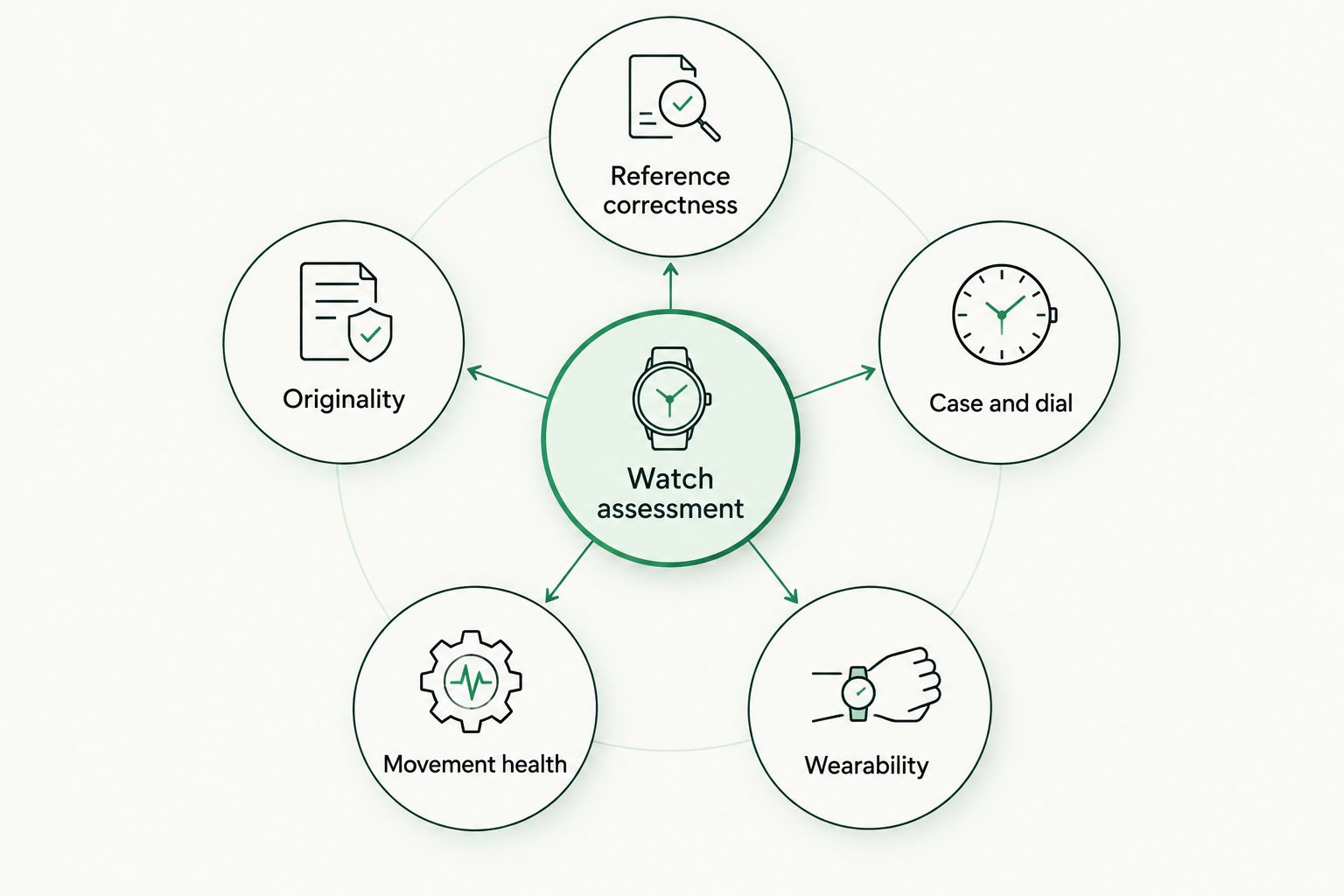
These criteria work together. A correct reference does not excuse poor movement condition, and an attractive dial does not resolve questions about undisclosed replacements. Buy the example that fits your requirements, not the listing that leaves the fewest questions visible.
When looking beyond Watchfinder makes sense
You do not need a complaint about Watchfinder to compare alternatives. A different buying route makes sense when it addresses a specific requirement rather than simply offering another name.
- You want an Australian retail comparison. Include an Australian retailer, then compare the watch and transaction evidence directly.
- You want to investigate reference variations. A multi-seller search helps you compare configurations, provided you assess each listing separately.
- You are pursuing a particular auction lot. Evaluate that watch on its own merits and understand the auction conditions.
- The example under consideration leaves material questions unanswered. Seek clearer evidence elsewhere rather than lowering your condition standard.
These are reasons to broaden your search, not claims that Watchfinder has changed its policies or fallen short on a particular transaction. For any purchase in 2026, keep your unresolved questions in writing so you can compare the answers accurately.
When staying with Watchfinder is the right call
Stay with Watchfinder if the specific watch meets your requirements and the transaction terms suit your purchase. An alternative seller is not an improvement merely because it is local, independent or listed on a marketplace.
A sound decision rests on consistent evidence: correctly identified reference, disclosed component history, satisfactory condition, movement assessment and suitable wearability. If Watchfinder supplies the evidence you need for the example you want, there is no reason to switch for the sake of switching.
FAQ
What are the best Watchfinder alternatives for Australian buyers?
James Patten is an Australian retail alternative, Chrono24 offers a multi-seller marketplace route, and auctions provide a lot-focused buying route. Choose according to the particular watch’s evidence and the transaction terms, not a blanket seller ranking.
Is an Australian watch retailer better than Watchfinder?
Australian location alone does not make a watch retailer better than Watchfinder. Compare the actual watch’s originality, condition, movement health and applicable purchase terms.
Is Chrono24 the same kind of business as Watchfinder?
No: Chrono24 is a watch marketplace, while Watchfinder is a specialist pre-owned-watch retailer. On a marketplace, identify the particular seller and assess the terms that apply to that transaction.
Does a pre-owned luxury watch need its original box and papers?
No: original packaging is not a requirement for a desirable pre-owned watch. Assess reference correctness, originality, condition, movement health, service evidence where available and independent authentication.
What should I request before buying a pre-owned Rolex online?
Request the exact reference, detailed photographs, disclosure of replacements or alterations, and evidence supporting movement condition. Resolve authenticity questions through qualified independent assessment rather than packaging or photographs alone.
Should I buy a watch at auction instead of from a retailer?
Choose an auction only when you can assess the specific lot and accept its sale conditions. Read the condition report and inspection arrangements before bidding; an auction is not automatically a better buying route.
What matters most when comparing used-watch sellers in 2026?
The strongest comparison uses the same reference and a similar condition standard. Then compare the evidence, seller identity and transaction terms without assuming that identical model names mean equivalent watches.
One last thing
Before committing, write down the imperfection or compromise you are accepting: refinishing, a disclosed replacement dial, missing service evidence or a fit limitation. If you cannot name it clearly, you have not finished assessing the watch.
A box cannot be worn. The watch should earn its place on your wrist through its own condition, character and suitability—not through the accessories surrounding it.


