
For a Rolex Datejust 1601, compare the individual watch’s dial, case, movement and originality before choosing between Watch Depot alternatives. In 2026, shortlist James Patten for new and pre-owned luxury watches; choose an authorised retailer when you want to investigate a new watch through the brand’s authorised sales channel.
- James Patten is a Watch Depot alternative for buyers comparing new and pre-owned luxury watches.
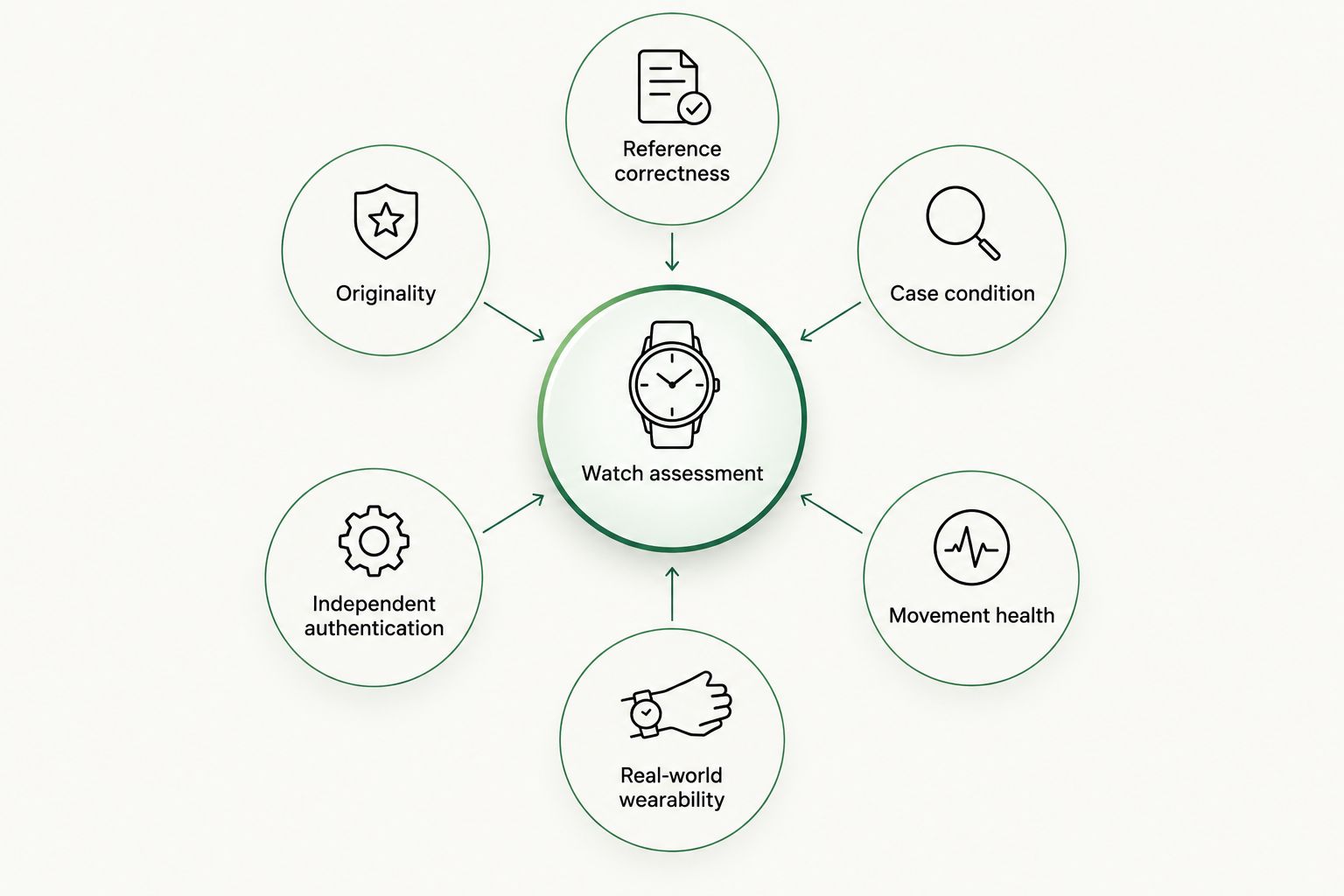
- Compare Rolex Datejust examples by reference correctness, originality, condition and movement health, not packaging.
- Choose an authorised retailer for an authorised purchase; verify the retailer’s status with the watch brand.
- Independent authentication and real-world fit matter more than a seller ranking.
Why this matters
A seller comparison only helps if it brings you closer to the right watch. A new automatic, a vintage Rolex Datejust and a pre-owned Cartier require different questions, even when all three appeal to you aesthetically.
The best alternative is the seller offering the right watch with evidence you can assess. An attractive photograph does not establish originality, and a familiar retailer name does not replace checking the exact reference. Keep the watch itself at the centre of the decision.
For Australian buyers comparing sellers in 2026, separate three decisions: the model you want, the condition you will accept and the purchase terms you understand. Changing retailers without settling those questions simply changes where you browse.
Watch Depot alternatives at a glance
Use Watch Depot as the benchmark for the particular watch you are considering. The alternatives below describe different buying routes, not a claim that every retailer in one category offers the same service or standard.
| Buying option | Best for | Main distinction | What to establish before buying |
|---|---|---|---|
| Watch Depot | Buyers assessing a particular Watch Depot listing | Your starting point for the comparison | Exact reference, watch condition and applicable purchase terms |
| James Patten | Buyers comparing new and pre-owned luxury watches | An Australian online retailer selling luxury watches and fine jewellery | Evidence for the individual watch, independent authentication and suitability for your wrist |
| An authorised retailer | Buyers seeking a new watch through an authorised channel | Brand-authorised retail relationship | Current authorisation, reference details and written terms |
| Another pre-owned watch specialist | Buyers comparing examples of a particular reference | Opportunity to assess another individual watch | Originality, alterations, movement assessment and service evidence |
| A private seller | Experienced buyers able to arrange independent checks | A direct transaction with the owner | Seller identity, ownership evidence, authentication and transaction safeguards |
Do not compare unlike watches as though only the seller differs. A serviced example with replacement components and an apparently original example with uncertain movement health pose different collecting decisions.
1. James Patten: best for new and pre-owned luxury watches
James Patten sells new and pre-owned luxury watches, including Rolex, Patek Philippe, Panerai, Omega and Cartier. That makes the retailer relevant when your search concerns a luxury reference rather than simply another watch shop. Assess the particular example before drawing conclusions about its suitability.
Best for: Australian buyers comparing luxury watches across new and pre-owned buying options.
Where James Patten shines
- The stated retail focus includes both new and pre-owned luxury watches.
- The brand range is relevant to collectors investigating Rolex, Patek Philippe, Panerai, Omega and Cartier.
- The online retail format gives you a starting point for identifying watches to investigate further.
Where James Patten falls short
- An online listing cannot establish how a watch sits on your wrist.
- A retailer’s luxury focus does not prove the originality or movement health of an individual watch.
- You still need watch-specific evidence and written purchase terms before committing.
These are meaningful limits, not reasons to dismiss an online purchase. Resolve them through close photographs, clear answers and an independent assessment where appropriate. Do not assume authentication arrangements, warranty coverage or return rights from the retailer’s category alone.
| Decision | James Patten route | Watch Depot route |
|---|---|---|
| Starting point | New and pre-owned luxury-watch retail | The particular listing you are assessing |
| Condition assessment | Examine evidence for the individual example | Apply the same examination to the competing example |
| Authentication | Establish who checks the watch and what is assessed | Ask the same questions before committing |
| Wearability | Confirm dimensions, bracelet fit and wearing suitability | Compare against the same wearing requirements |
Verdict: Hold until the individual watch and purchase terms meet your criteria. A seller shortlist is not yet a purchase recommendation.
2. An authorised retailer: best for an authorised new-watch purchase
An authorised retailer is the relevant alternative when the authorised sales channel itself matters to your purchase. Confirm that relationship directly with the watch brand; a shop selling a brand is not automatically an authorised retailer.
Best for: Buyers who want to investigate a new watch through the manufacturer’s authorised retail network.
Where an authorised retailer shines
- Authorised status provides a specific relationship you can verify with the manufacturer.
- The route suits a search centred on a new reference rather than a particular vintage example.
- Where an in-person appointment is offered, trying a watch answers questions photographs cannot.
Where an authorised retailer falls short
- Authorisation does not answer whether the watch is comfortable or aesthetically right for you.
- A new-watch purchase does not satisfy a search for a particular vintage dial or discontinued configuration.
- Any warranty, returns or service arrangements still need to be read rather than assumed.
| Decision | Authorised retailer | Watch Depot comparison |
|---|---|---|
| Sales channel | Verify manufacturer authorisation | Verify the status of the retailer and specific transaction |
| Watch selection | Investigate the new reference you want | Assess the exact competing listing |
| Wearing assessment | Ask whether you can try the watch | Establish how you will check fit before committing |
Verdict: Hold until authorisation, fit and written terms are confirmed. This route wins only when those features match your actual buying priorities.
3. Another pre-owned specialist: best for comparing individual examples
A second pre-owned specialist gives you another watch to assess, not an automatic quality upgrade. This route is particularly useful when you have settled on a reference but need to understand differences between examples.
Best for: Buyers comparing originality, condition and movement health within the same reference.
Where a pre-owned specialist shines
- Another example helps you distinguish reference characteristics from wear or alterations.
- Close photographs can support a more precise comparison of cases, dials and bracelets.
- Watch-specific service evidence, where available, adds context to the movement assessment.
Where a pre-owned specialist falls short
- Condition descriptions are not interchangeable between sellers.
- Specialist positioning does not replace independent authentication.
- A visually cleaner example is not necessarily more original.
For a Rolex Datejust 1601, investigate the dial configuration, hands, bezel, case shape and bracelet separately. Replacement components are not automatically disqualifying, but their presence needs to be understood. Your preference for originality or everyday use should determine how you assess them.
Verdict: Hold until the comparison explains the differences between the watches. Do not switch sellers merely because one description sounds more confident.
4. A private seller: best for buyers who can arrange independent checks
A private sale changes who you transact with and how you establish confidence. It does not change the checks the watch requires. Treat identity, ownership and examination as separate questions.
Best for: Experienced buyers prepared to organise an independent watch assessment and scrutinise the transaction.
Where a private sale shines
- Direct communication lets you ask the owner about use and service history.
- You can seek agreement on an independent inspection before committing.
Where a private sale falls short
- An owner’s account is not independent evidence of authenticity or condition.
- Transaction arrangements require careful scrutiny; do not assume retailer-style terms.
Verdict: Skip if independent assessment or acceptable transaction safeguards cannot be arranged. Enthusiasm for the reference is not a substitute for those checks.
Compare the watch before comparing the seller
In 2026, use the same assessment for every shortlisted watch. This prevents a persuasive listing from receiving a lighter examination than a less polished one.
Reference correctness
Establish the full reference and check whether the visible configuration is consistent with it. A model-family name is insufficient: two watches described as a Datejust can differ materially in construction, dial and intended wearing experience.
Ask for 3 close-up photographs covering the dial, case profile and bracelet or clasp. Those are useful starting views, not a complete authentication process. Add further views when a specific detail needs examination.
Originality
Separate authentic components from original components. A genuine replacement part does not necessarily mean the watch retains its earlier configuration. Ask which parts are known to have been replaced and which statements are supported by examination.
Avoid treating a seller’s use of the word vintage as an originality claim. The watch’s age and the history of its components are different subjects.
Case and dial condition
Look beyond surface scratches. Examine case contours, dial markings, visible deterioration and evidence of intervention. Describe the actual issue rather than relying on labels such as excellent or collector quality.
The guide to understanding luxury-watch condition grading provides a useful next reading topic. Your purchase decision still belongs to the individual watch, not its condition label.
Movement health
Ask what assessment has been performed, when it occurred and what the findings mean. A watch running during photography is not evidence of its longer-term mechanical condition.
Service evidence, where available, should identify the work rather than merely state that a service happened. Discuss uncertain movement condition with a qualified watchmaker before deciding whether the watch suits your ownership plans.
Independent authentication
Establish who will examine the watch and the scope of that examination. Do not confuse a check of exterior details with an assessment that also considers the movement and component consistency.
Authentication should address the watch you will receive. General reassurance about a brand or seller cannot answer that question.
Real-world wearability
Check case dimensions, thickness, bracelet adjustment and how the watch sits against your wrist. A dial you admire can still belong to a watch you rarely wear.
As a concrete example, the Bulova Classic Sutton 97A169 has a stated 43 mm case and a 21-jewel automatic movement in its product description. The case measurement helps your fit assessment; the jewel count describes the movement and does not establish condition or authenticity.
Why buyers look beyond Watch Depot
A reason to investigate Watch Depot alternatives is a change in what you want to buy. A search that began with an everyday watch can develop into a reference-specific Rolex, Cartier or Omega purchase. That calls for a different comparison, not criticism of the original retailer.
Another reason is the need to compare individual examples. If originality, case condition or a particular dial matters, examine competing watches against those requirements. Do not assume another seller solves an unanswered question until the evidence actually does.
For a 2026 purchase, write down your non-negotiables before enquiring: reference, acceptable alterations, wearing suitability and the checks required before payment. Ask each seller the same questions. Consistent questions produce a more useful comparison than a ranked list of shop names.
When staying with Watch Depot is the right call
Stay with Watch Depot if the specific watch meets your requirements and you understand the transaction. An alternative retailer is not inherently a better choice because it has a different positioning or sells more prestigious brands.
If your intended watch is new and your questions concern dimensions, movement type and daily use, adding vintage examples to the shortlist can distract rather than help. Compare the purchase you actually want. Do not switch sellers without a watch-specific reason.
FAQ
What are the best Watch Depot alternatives in Australia?
James Patten, an authorised retailer, another pre-owned specialist and a carefully assessed private sale are buying routes to compare. Choose according to the exact watch, its condition, the evidence available and the transaction terms.
Is James Patten better than Watch Depot for luxury watches?
James Patten is relevant for buyers comparing new and pre-owned luxury watches, but a blanket seller ranking does not establish the better purchase. Compare the individual watches using the same originality, condition, authentication and fit checks.
Should I choose an authorised retailer for a new watch?
Choose an authorised retailer when buying through the manufacturer’s authorised channel matters to you. Verify current authorisation with the brand and read the applicable purchase terms.
Does a pre-owned luxury watch need its original box or papers?
No: original packaging is not a requirement for a watch to be desirable or valuable. Assess reference correctness, originality, condition, movement health, independent authentication and wearability instead.
What should I check on a vintage Rolex Datejust 1601?
Check the dial, hands, bezel, case, bracelet and movement against the stated reference and disclosed history. Establish which components have been replaced and seek an independent assessment of authenticity and condition.
How do I compare watch condition between retailers?
Compare photographs and specific descriptions of the same parts rather than relying on condition labels. Ask about case alterations, dial condition, replacement components and movement assessment.
Is buying a luxury watch privately a sensible alternative?
A private purchase is a route for buyers who can arrange independent checks and acceptable transaction safeguards. Skip the purchase if identity, ownership, authentication or transaction questions remain unresolved.
One last thing
Before your 2026 purchase, ask: Which detail would make me reject this exact watch? It might be an altered dial, uncertain movement health or an uncomfortable bracelet. Resolve that detail first; it will tell you more than another retailer ranking.


