
The Hour Glass offers a multi-brand luxury-watch boutique experience, making it a useful starting point when you want to compare watches in person. That approach stops being enough when your brief centres on a particular pre-owned reference rather than a boutique purchase. Among The Hour Glass alternatives in 2026, James Patten suits buyers comparing new and pre-owned luxury watches; a Cartier boutique suits buyers focused on a new Cartier; Sotheby’s suits collectors considering auction purchases.
- For The Hour Glass alternatives, James Patten suits buyers comparing new and pre-owned luxury watches online in Australia.
- A Cartier boutique suits a new Cartier purchase with an in-person, single-brand focus.
- Sotheby’s suits auction-focused collectors prepared to assess individual lots and sale terms.
- Judge the watch through originality, condition, movement health and independent authentication—not its packaging.
Why this matters
A Rolex Datejust, Cartier Tank and Panerai Luminor raise different buying questions. Even within one model family, the exact reference, movement, case proportions and condition determine whether a watch meets your brief. Choosing a seller before identifying those requirements reverses the useful order.
For a purchase in 2026, separate the watch decision from the buying-channel decision. First establish what you want to wear and collect. Then choose the channel that lets you examine the relevant evidence without accepting unsupported assurances.
The Hour Glass alternatives at a glance
These options represent different purchasing routes, not a ranking of seller quality. No retailer name establishes the condition of an individual watch, and no auction-house name replaces a condition assessment.
| Seller or channel | Best for | Defining distinction | Difference from The Hour Glass | Main limitation |
|---|---|---|---|---|
| The Hour Glass | Buyers who value a multi-brand boutique visit | In-person luxury-watch retail | The benchmark boutique route | A boutique visit does not replace reference-specific research |
| James Patten | Australian buyers comparing new and pre-owned luxury watches online | Online retail across brands including Rolex, Patek Philippe, Panerai, Omega and Cartier | Adds a new-and-pre-owned online comparison route | Photographs alone cannot establish fit or movement health |
| Cartier boutique | Buyers whose brief is specifically a new Cartier | A single-brand purchasing route | Concentrates the search on Cartier rather than multiple makers | Not a cross-brand comparison destination |
| Sotheby’s | Collectors comfortable assessing auction lots | Luxury-watch auctions | Uses a sale-specific auction process rather than a boutique purchase | Requires close reading of lot information and auction terms |
1. James Patten: best for new and pre-owned comparison
James Patten is an Australian online luxury-watch retailer selling new and pre-owned watches, including Rolex, Patek Philippe, Panerai, Omega and Cartier. That makes it a relevant alternative when your search extends beyond a new boutique purchase. The useful distinction is the purchasing route—not an assumed advantage in authenticity, condition or service.
For example, a buyer considering a pre-owned Rolex Datejust should start with its exact reference and configuration. A buyer considering an Omega should identify the particular model and movement rather than treating the brand name as a sufficient description. Ask for evidence tied to the individual watch.
Where this option shines
- New and pre-owned scope: You can consider both categories rather than making newness the starting requirement.
- Cross-brand relevance: The stated offering includes several established luxury-watch makers.
- Online comparison: You can organise a shortlist around references, condition disclosures and wearing requirements before deciding.
Where this option falls short
- Fit remains unresolved online: Photographs do not show how the case sits on your wrist or how the bracelet feels.
- Condition needs separate evidence: A listing cannot substitute for movement assessment or independent authentication.
- Reference-specific questions remain essential: Do not assume a particular watch, configuration or seller policy from the retailer’s general offering.
Head-to-head with The Hour Glass
| Dimension | James Patten | The Hour Glass |
|---|---|---|
| Buying format | Australian online retail | Luxury-watch boutique retail |
| Stated watch scope | New and pre-owned luxury watches | Multi-brand luxury-watch retail |
| Useful starting question | Does this individual watch meet my reference and condition brief? | Does the boutique route suit my model and wearing brief? |
Best for: Australian buyers comparing new and pre-owned luxury watches who will assess the individual watch before purchasing.
For your 2026 shortlist, request clear photographs of the dial, case, caseback, bracelet or strap, and clasp. Ask what the seller’s description means by originality and condition. Establish what evidence supports movement health and how independent authentication can be arranged; do not infer either from polished photographs.
Verdict: Hold until the individual watch meets your evidence requirements.
2. Cartier boutique: best for a new Cartier-focused purchase
A Cartier boutique is a relevant alternative when you have already narrowed your search to Cartier. The attraction is focus: you can discuss the brand’s watches without turning the visit into a comparison between unrelated makers. It is not a substitute for a multi-brand search.
Start with a model family such as Tank or Santos, then identify the exact reference. Do not treat every watch within that family as interchangeable. Case shape, movement type, strap or bracelet configuration and wrist fit belong in the decision before aesthetic preference becomes a commitment.
Where Cartier shines
- Single-brand focus: A useful route when Cartier is already the decision, not merely one candidate.
- Physical comparison: An in-person visit helps you evaluate proportions and handling, subject to what you can inspect.
- Model-specific discussion: You can centre the conversation on the differences between the Cartier references under consideration.
Where Cartier falls short
- Limited cross-brand context: A Cartier-focused visit does not answer whether an Omega or Rolex better suits your use.
- Different collecting brief: A current boutique purchase does not replace the search for a particular older example.
- Newness is not suitability: A new watch still needs to fit your wrist, daily routine and preferred movement type.
Head-to-head with The Hour Glass
| Dimension | Cartier boutique | The Hour Glass |
|---|---|---|
| Brand focus | Cartier | Multiple luxury-watch brands |
| Best starting brief | A new Cartier purchase | An in-person luxury-watch comparison |
| Main decision | Which Cartier reference suits you? | Which represented brand and model suit you? |
Best for: Buyers choosing a new Cartier who want a single-brand, in-person purchasing route.
Verdict: Buy through this route only after confirming the exact reference and wrist fit.
3. Sotheby’s: best for auction-focused collectors
Sotheby’s conducts luxury-watch auctions, offering a different route from boutique retail. It belongs on your shortlist when you are comfortable evaluating individual lots and making a decision under the terms of a particular sale. Auction participation requires preparation, not simply enthusiasm for a familiar reference.
Read the catalogue entry and condition report together. Ask about originality, replacements, restoration and movement assessment where the published description leaves questions unanswered. A notable model name does not resolve those questions.
Where Sotheby’s shines
- Lot-specific research: The auction format encourages attention to the exact object offered.
- Collecting-led searches: Suitable for buyers willing to research individual watches rather than choose a general model category.
- An alternative transaction format: Useful when an auction purchase fits your approach to collecting.
Where Sotheby’s falls short
- Sale terms require attention: Understand the obligations, charges and collection arrangements before bidding.
- Inspection needs planning: Establish what you can inspect and which questions can be answered before the sale.
- A catalogue is not a mechanical guarantee: Interpret every condition statement within its stated scope.
Best for: Collectors comfortable with auction research, condition interpretation and sale-specific obligations.
Verdict: Hold unless you understand the watch and the auction terms.
Why buyers consider alternatives to The Hour Glass
There is no single reason to change purchasing channels. The reasons below concern your buying brief; they are not claims about The Hour Glass’s policies, service or access to particular watches.
You want a particular pre-owned reference
A pre-owned search begins with the object, not the storefront. Two watches carrying the same model name can differ in dial configuration, replaced components, case condition and service history. Choose a route that lets you resolve those differences.
For a Rolex Datejust, identify the reference before comparing dial and bracelet details. For a Panerai Luminor, establish the exact reference and movement. Broad family names are useful search terms, but insufficient purchase descriptions.
You have settled on one brand
A Cartier boutique makes sense when the cross-brand decision is already finished. Keep comparing sellers only if the comparison answers a remaining question about the watch or transaction. More options do not automatically create a better decision.
Your collecting brief suits an auction
An auction is a distinct process, not a shortcut around due diligence. Choose it when you are prepared to research the lot, ask questions within the sale timetable and understand the terms. Do not bid simply because a watch seems difficult to find elsewhere.
You need clearer evidence before committing
Changing seller names does not cure a weak description. If a seller cannot clarify a material issue, keep the purchase on hold. Apply the same standard to an online retailer, boutique, auction house or private seller.
How to assess the watch before choosing the seller
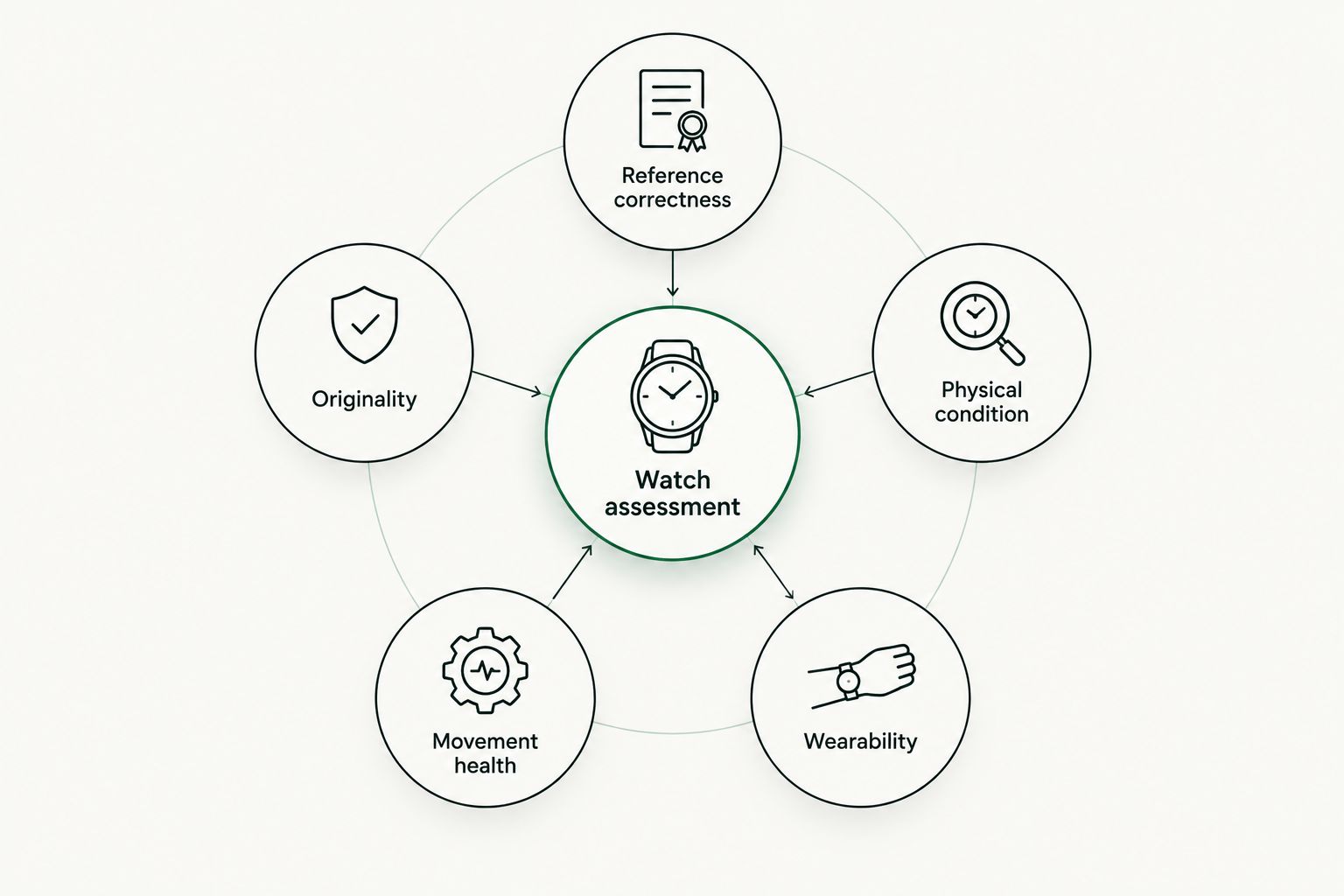
Use the same assessment framework across The Hour Glass alternatives in 2026. It keeps the comparison focused on what you will own and wear, rather than the reputation of the purchasing channel alone.
- Reference correctness: Confirm that the case, dial, hands, bezel and movement make sense for the stated reference. Distinguish a plausible configuration from an authenticated one.
- Originality: Ask which components are original, service replacements or later alterations. Replacements require interpretation; they are not automatically a reason to reject a watch.
- Physical condition: Examine case edges, surface finishing, dial damage, corrosion and bracelet wear. Request views that reveal condition rather than only flattering angles.
- Movement health: Seek an assessment appropriate to the movement, including function checks and relevant watchmaker findings. Running is not the same as running correctly.
- Service evidence: Review records where available, paying attention to the work performed and components replaced. Missing records make present-condition assessment more important, not the watch automatically undesirable.
- Independent authentication: Establish who assessed the watch, what they inspected and what their conclusion covers. Authentication and mechanical condition answer different questions.
- Wearability: Consider case proportions, lug position, clasp adjustment, weight and how the watch works with your routine. A desirable reference can still be the wrong watch for your wrist.
Box and papers are not substitutes for this assessment. Packaging cannot establish an untouched dial, healthy movement or correct reference configuration. A watch without its original packaging can remain desirable; examine the watch and the evidence supporting it.
When staying with The Hour Glass is the right call
Stay with The Hour Glass when an in-person, multi-brand boutique route suits your purchase and the particular watch meets your requirements. You do not need an alternative simply because another channel exists. An online search or auction introduces different decisions, not an automatic improvement.
The sensible 2026 decision is conditional: choose the watch, confirm the evidence and understand the transaction. If those requirements are satisfied through The Hour Glass, switching sellers adds no inherent benefit.
FAQ
What are the best The Hour Glass alternatives in Australia?
James Patten suits buyers comparing new and pre-owned luxury watches online; a Cartier boutique suits a new Cartier-focused purchase; Sotheby’s suits auction-focused collectors. Choose according to the exact watch and the evidence you need, not a blanket seller ranking.
Is an online watch retailer better than The Hour Glass?
An online retailer is not inherently better than The Hour Glass. Online comparison suits some searches, while an in-person boutique visit helps with physical handling and fit; neither replaces individual-watch assessment.
Should I buy a new or pre-owned luxury watch in 2026?
Choose new or pre-owned according to the reference, condition and wearing experience you want. For a pre-owned watch, assess originality, movement health and service evidence where available rather than treating age alone as a quality judgement.
Does a luxury watch need its original box and papers?
No, original box and papers are not required for a luxury watch to be desirable. Judge reference correctness, originality, condition, movement health and independent authentication; packaging cannot establish those qualities.
What should I ask before buying a pre-owned Rolex?
Ask for the exact reference, clear condition photographs and an explanation of original and replaced components. Also establish the basis for authentication, movement assessment and any stated service history.
Is an auction a good alternative to a watch boutique?
An auction suits buyers prepared to assess an individual lot and understand sale-specific terms. Read the condition information, clarify unresolved questions and establish inspection arrangements before bidding.
How do I compare luxury-watch sellers fairly?
Compare sellers against the same watch-specific requirements. Assess the clarity of the description, supporting evidence, inspection opportunities and written transaction terms without assuming that reputation settles every question.
One last thing
Before making a seller shortlist, write a one-sentence watch brief: the exact reference or model family, acceptable component changes, condition priorities and intended use. Then identify the evidence that would change your decision. This turns a broad retailer comparison into an assessment of a watch you actually want to own.
A watch that passes authentication can still need mechanical work; a mechanically healthy watch can still contain later replacement components. Keep authenticity, originality and movement health separate throughout the purchase.


