
TAG Heuer Formula 1 is the brand's most accessible chronograph line, built for buyers who want genuine motorsport pedigree without stepping into Carrera or Monaco territory. For entry-level motorsport fans, that means a steel-cased sports watch with racing-inspired dial details, quartz or automatic movement options, and a lower buy-in point than most of TAG Heuer's catalogue. What separates this segment from seasoned collectors is the decision-making: first-time buyers are choosing a category, not just a reference number, and they're doing it with less tolerance for a costly mistake.

- TAG Heuer Formula 1 is TAG Heuer's entry-level motorsport chronograph line, sitting below Carrera and Monaco in the range.
- Quartz Formula 1 models suit buyers who want daily-wear durability over mechanical complexity; automatic chronograph versions suit those planning to grow into TAG Heuer's higher tiers.
- Reference number and movement condition matter far more than box and papers when judging value in 2026.
- James Patten Fine Watches inspects pre-owned TAG Heuer pieces for movement health and authenticity before listing them.
Why TAG Heuer Formula 1 matters for entry-level motorsport fans
First-time luxury watch buyers with a motorsport interest usually start their search at TAG Heuer because the brand has decades of Formula 1 sponsorship history and a range built specifically around that link. The TAG Heuer Carrera for motorsport fans sits a tier above Formula 1 on price and finishing, which is exactly why Formula 1 exists as the on-ramp.
The practical reason this matters in 2026: entry-level buyers researching TAG Heuer online run into a flood of generic "best watch" content that never distinguishes between the brand's tiers. A Formula 1 buyer who doesn't understand where it sits in the range risks overpaying for a base model or underbuying when a Carrera or Aquaracer would have suited them better.
Set your budget mindset before you shop
Entry-level doesn't mean disposable. Decide upfront whether you're buying a daily-wear sports watch you'll replace in a few years, or a first step into a longer TAG Heuer collection.
- Decide quartz versus automatic before you look at specific listings
- Set a ceiling that includes servicing costs down the track, not just the purchase
- Separate "want this brand" from "want this exact reference" early
- Write down the three features that matter (chronograph function, bezel material, bracelet type) so listings don't distract you
Learn the reference numbers before you compare listings
TAG Heuer Formula 1 references tell you the case material, dial colour, movement type and bracelet configuration at a glance, and that string of characters matters more than any marketing description attached to a listing.
- Cross-check the reference against TAG Heuer's official model naming conventions, not just a seller's title
- Note whether the model is quartz or automatic chronograph — the reference format differs
- Check ceramic bezel versus steel bezel, since Formula 1 has run both across its production years
- Confirm case size against your wrist, since Formula 1 has shipped in more than one diameter over the years
- Flag any reference that doesn't match a documented TAG Heuer catalogue entry
Once you know what reference you're after, browsing curated inventory is faster than trawling marketplace listings one by one. James Patten Fine Watches lists pre-owned TAG Heuer pieces with reference numbers verified against the movement inside, not just the case back engraving.
Check condition and movement health, not the box
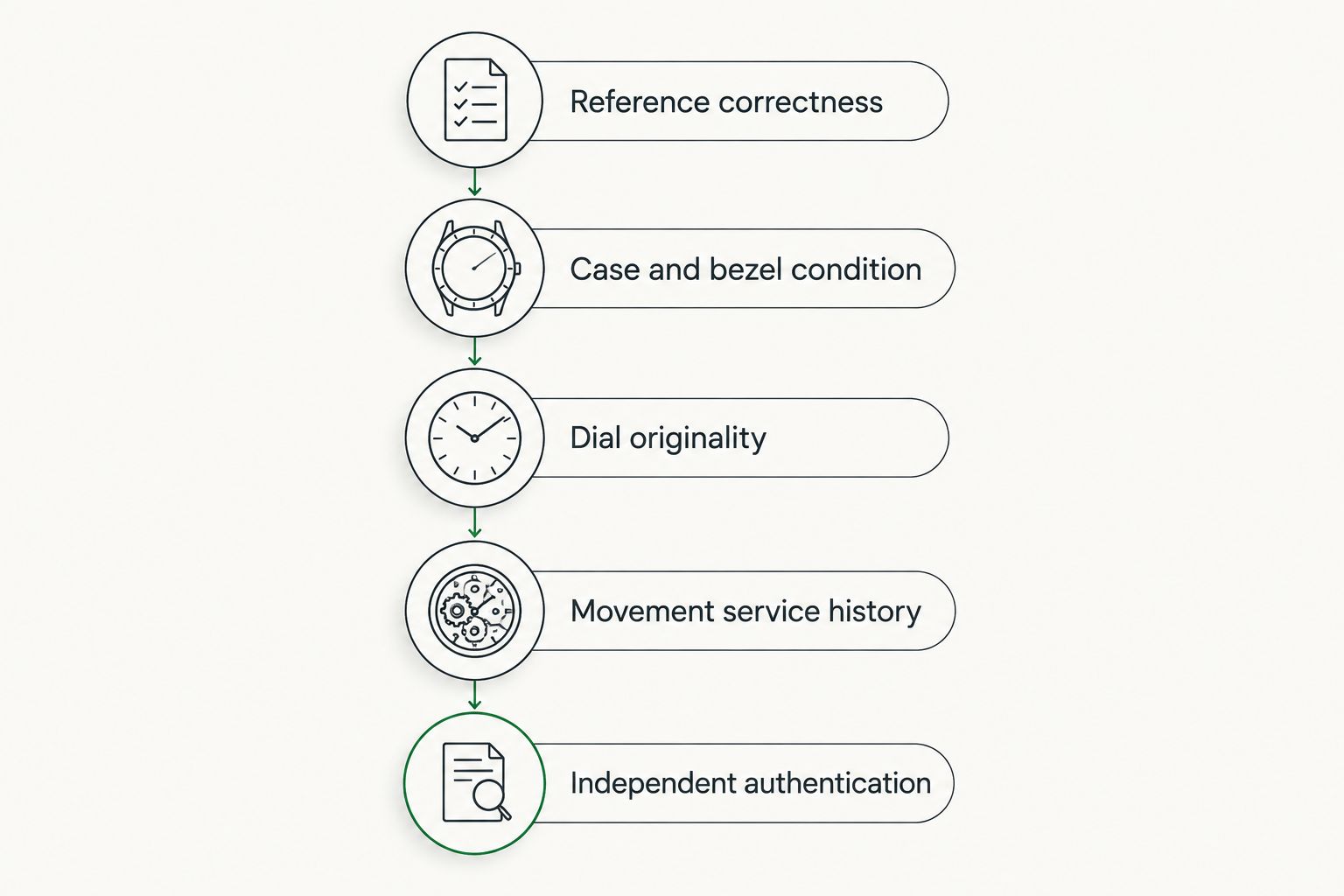
This is where entry-level buyers waste the most money. A watch's desirability comes from the piece itself — reference correctness, case and bezel condition, dial originality, and whether the movement has been serviced — not from whether a box or warranty card sits in a drawer somewhere. A box can't be worn and doesn't run the movement.
- Ask for close-up photos of the case back, crown, and bezel edge for wear consistent with age
- Request confirmation of the last service date or any known service history
- Check the dial for fading or refinishing that doesn't match the reference's original spec
- Ask whether the chronograph pushers and crown function correctly, not just whether the watch "runs"
- Confirm the bracelet or strap is original to the reference, not a generic swap
Compare Formula 1 against the nearest options in the range
Before committing, weigh Formula 1 against the other entry points TAG Heuer and its close competitors offer. A buyer set on motorsport heritage sometimes finds Monaco's styling or Carrera's proportions suit them better once they've handled a few pieces.
- Try on a Formula 1 next to a Carrera to feel the size and weight difference
- Compare quartz Formula 1 pricing against entry automatic Carrera pricing before deciding on movement type
- Check whether a ceramic bezel Formula 1 or a steel bezel version fits your daily-wear plans better
- Read the best TAG Heuer watches for the money breakdown to see where Formula 1 ranks against the brand's other accessible references
Decide between new and pre-owned
Entry-level motorsport fans often default to buying new because it feels safer, but pre-owned Formula 1 pieces from a dealer who inspects movement condition can put you into a better-specified reference for the same outlay.
- Weigh a new base quartz model against a pre-owned automatic chronograph at a similar outlay
- Ask any pre-owned seller for authentication method, not just a verbal guarantee
- Check whether the seller offers any inspection or condition report before purchase
- Read how to choose between new and pre-owned luxury watches before you rule either path out
Verify authenticity before you pay
Counterfeit and franken-watch risk is real at the entry-level price point precisely because it attracts first-time buyers who haven't handled a genuine piece before. Independent authentication protects you more than any paperwork claim.
- Have the movement inspected by someone who isn't the seller
- Match the serial and reference against TAG Heuer's known production ranges for that model
- Be wary of listings that emphasise box and papers over movement condition — that's often a distraction from a weaker watch
- Ask direct questions about service history and get answers in writing
Options at a glance for entry-level TAG Heuer buyers
| Option | Best for | Key limitation |
|---|---|---|
| TAG Heuer Formula 1 Quartz | Daily-wear buyers who want low-maintenance reliability | Quartz movement lacks the mechanical appeal collectors eventually chase |
| TAG Heuer Formula 1 Automatic Chronograph | Buyers planning to grow into mechanical watches | Bulkier case than the quartz version on smaller wrists |
| TAG Heuer Carrera | Buyers who want more refined finishing from the outset | Higher entry price than Formula 1 |
| TAG Heuer Aquaracer | Buyers who want a sport watch with dive-oriented styling | Less direct motorsport branding than Formula 1 or Carrera |
| Pre-owned Formula 1 (inspected) | Buyers who want a better-specified reference for the same budget | Requires trusting the seller's authentication process |
Verdict: the TAG Heuer Formula 1 Automatic Chronograph is the best entry point for a motorsport fan who plans to keep collecting — the quartz version is the right call only if low maintenance matters more than mechanical involvement.

Common mistakes entry-level motorsport buyers make
- Chasing box and papers over movement condition. A complete set doesn't fix a poorly serviced movement, and a watch missing its box can still be a correct, well-running reference.
- Buying the cheapest listing without checking the reference number. Formula 1 has run across multiple case sizes and bezel materials; the wrong reference for your wrist ends up unworn.
- Skipping independent authentication to save time. This is the single most common way entry-level buyers end up with a franken-watch or a counterfeit in 2026.
- Assuming quartz means lower quality. Quartz Formula 1 models are a deliberate, durable choice, not a downgrade — treating them as inferior leads buyers to overpay for automatic versions they don't actually need.
- Ignoring resale before buying. Entry-level buyers rarely think past the first purchase, but the reference and condition you choose now determine what you can trade toward later.
FAQ
What is the TAG Heuer Formula 1 best known for?
The TAG Heuer Formula 1 is the brand's entry-level motorsport chronograph line, offering steel-cased sports watches in quartz and automatic movements at a lower price point than Carrera or Monaco.
Is TAG Heuer Formula 1 better than the Carrera for a first watch?
Formula 1 suits buyers who want a lower entry price and daily-wear durability, while Carrera suits buyers who want more refined finishing from their first purchase. Neither is objectively better — it depends on budget and intent.
Should I buy a quartz or automatic TAG Heuer Formula 1?
Choose quartz for low-maintenance daily wear and choose the automatic chronograph if you plan to keep collecting mechanical watches. Both are legitimate entry points in 2026, not a downgrade versus each other.
Does a pre-owned TAG Heuer Formula 1 need its original box to hold value?
No. Value comes from reference correctness, case and dial condition, and movement health — a box cannot be worn and is not a proxy for the watch's quality.
How do I check if a pre-owned TAG Heuer Formula 1 is genuine?
Have the movement inspected independently and match the reference and serial against TAG Heuer's known production ranges. A dealer who verifies the movement, not just the case back engraving, reduces the risk of a franken-watch.
What size case does the TAG Heuer Formula 1 come in?
TAG Heuer has produced Formula 1 references across more than one case diameter over the model's production history, so confirm the exact size against the reference number before buying, not against a general description.
Is the TAG Heuer Formula 1 a good watch to start a collection with?
It's a common and practical starting point for motorsport fans in 2026 because it carries genuine racing heritage at a lower entry price, giving room to move up to Carrera or Monaco later.
One last thing
The biggest signal that separates a well-bought entry-level TAG Heuer from a regretted one isn't the price tag — it's whether the buyer checked the movement before checking the box. Reference correctness and service history hold their value long after packaging is forgotten in a drawer.
Related guides


