
Diving enthusiasts choosing a TAG Heuer Aquaracer are buying a purpose-built tool watch, engineered for real depth and pressure rather than a beach accessory that photographs well and stops there. The category exists because dive timing, legibility underwater and case durability against saltwater are non-negotiable in a way they simply aren't for a dress watch or an office piece.

- The TAG Heuer Aquaracer Professional 300 is rated to 300m, enough for recreational and most scuba diving in 2026.
- Quartz Aquaracer references like the WAF1113 suit occasional swimmers wanting low maintenance over automatic winding.
- Rolex Sea-Dweller and Omega Seamaster sit above the Aquaracer on price and resale liquidity but not necessarily on dive function.
- Authenticate a pre-owned Aquaracer through serial and movement checks, never through box and papers alone.
- Bezel action and lume quality matter more underwater than case finishing ever will.
Why the TAG Heuer Aquaracer matters for diving enthusiasts
A dive watch earns its category by function, not styling. The TAG Heuer Aquaracer line was built around a unidirectional rotating bezel, screw-down crown and case architecture rated for real submersion, which is the baseline a diving enthusiast should demand before anything else gets discussed. James Patten Fine Watches treats the Aquaracer as a working watch first and a collectible second — that ordering is exactly right for anyone buying it to dive, not just to wear it around the pool deck.
What separates a diver's needs from a general buyer's is simple: legibility at depth, bezel accuracy under gloves, and a case that shrugs off saltwater and pressure cycling year after year. None of that shows up in a product photo. All of it shows up on a dive log.
How to choose a TAG Heuer Aquaracer for diving
Confirm the water resistance rating matches your diving depth
Water resistance ratings are the first filter, and they're not interchangeable with "splash-proof." A TAG Heuer Aquaracer Professional 300 carries a 300m rating, which comfortably covers recreational scuba and most sport diving depths. Before buying, work out what you actually do in the water:
- Snorkelling and casual swimming — almost any Aquaracer reference clears this comfortably
- Recreational scuba to standard depths — a 300m-rated Aquaracer is the sensible floor
- Technical or deep diving — check the specific reference and gasket condition, not just the dial text
- Saltwater exposure — rinse and dry the case and bracelet after every dive regardless of rating
- Pressure testing — have the case pressure-tested after any service, not assumed fine because the watch "looks sealed"
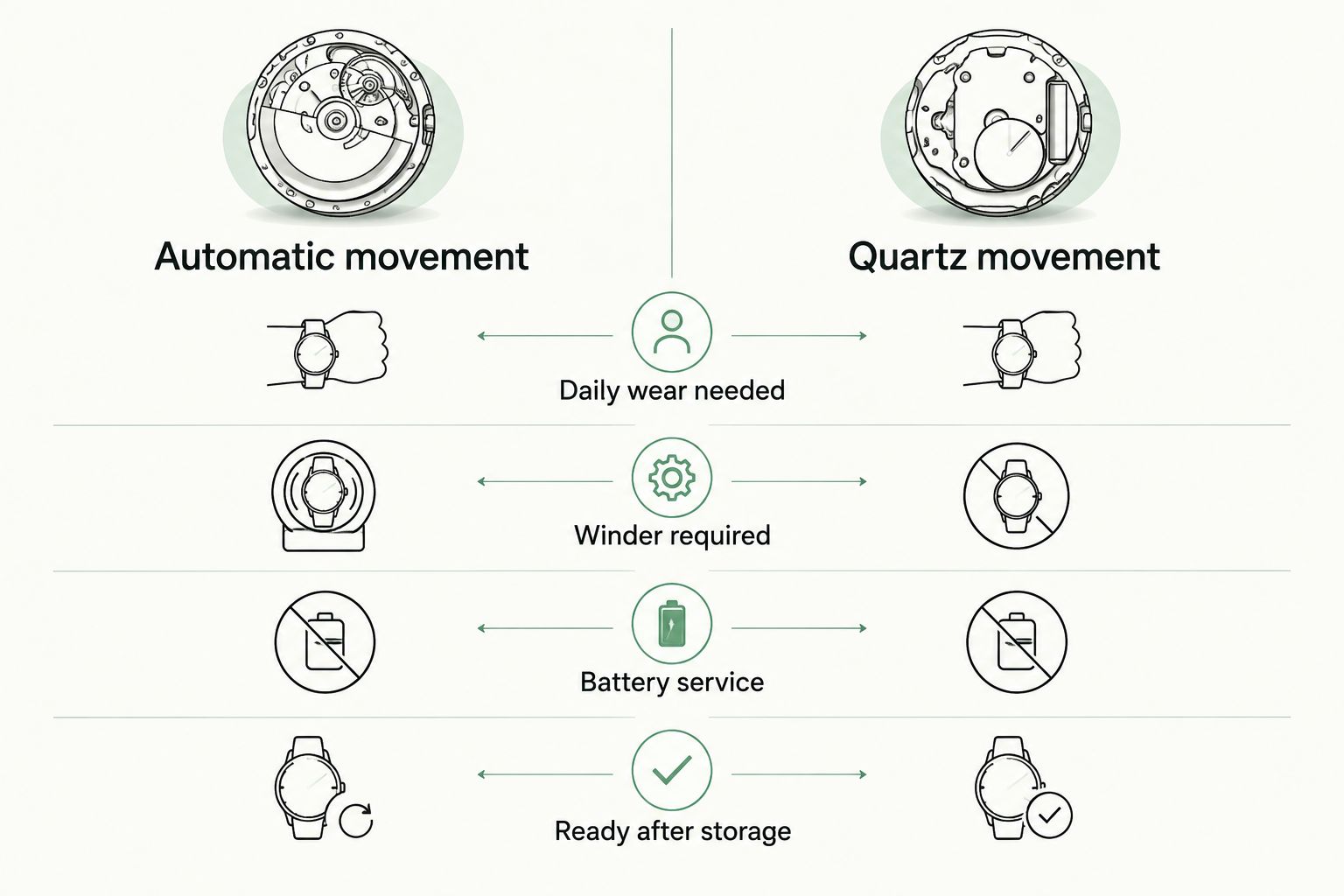
Check the movement type — quartz or automatic — for your dive routine
The Aquaracer line spans quartz and automatic movements, and the right one depends on how often the watch actually goes underwater versus how often it sits in a drawer between trips.
- Quartz Aquaracer references, like the WAF1113 in 300m stainless steel, run without daily wear and hold timing accuracy with minimal fuss
- Automatic Aquaracer references need regular wrist time or a watch winder to stay wound and accurate
- Quartz suits divers who travel infrequently and want the watch ready without babysitting it
- Automatic suits daily wearers who want a mechanical movement as part of the appeal, not just the timepiece
- Either movement still needs gasket checks on schedule — quartz is low-maintenance, not maintenance-free
Verify the bezel action and lume before you buy
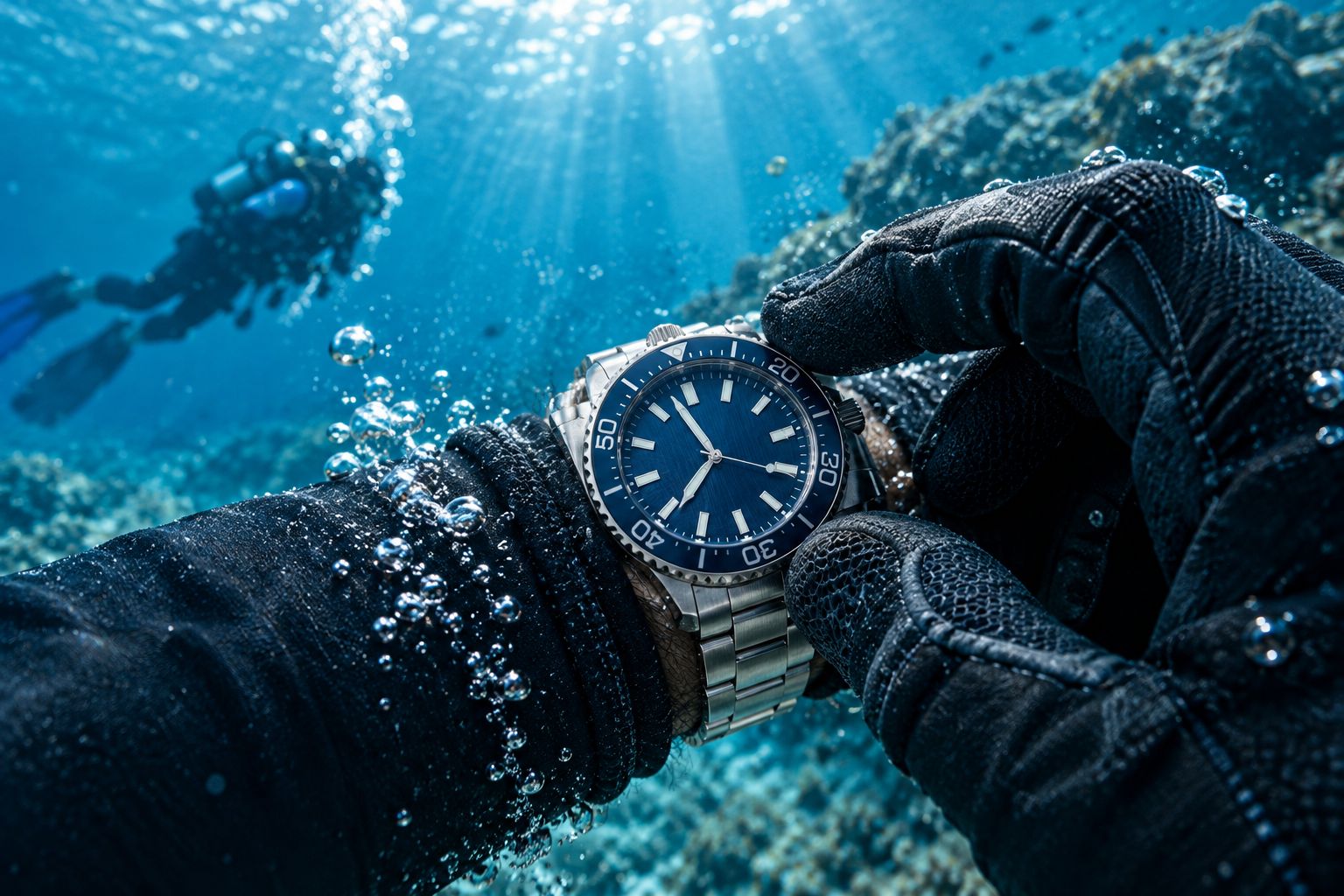
A dive bezel that doesn't click cleanly through 60 detents, or lume that's dead after a few years, turns a dive watch into a decorative one. Check these before any purchase, new or pre-owned:
- Bezel rotation should move in firm, even clicks with no play or skipping
- Bezel insert alignment should sit flush with no lifting at the edges
- Lume on the hands and hour markers should glow evenly after a short charge, not patchily
- Crown threads should engage smoothly and seal without excessive force
- Bracelet or strap fit should stay secure over a wetsuit sleeve or bare wrist without binding
Match case size and bracelet to how you actually dive
Case size affects more than wrist presence — it changes how the watch sits under a wetsuit cuff or drysuit seal. Larger cases can catch on neoprene; smaller cases can be harder to read at a glance mid-dive.
- Measure your wrist and try the case on before committing to a diameter
- Consider bracelet versus rubber strap depending on whether the watch goes into the water regularly
- Check clasp type — a diver's extension on the bracelet accommodates a wetsuit sleeve
- Confirm the crown guard doesn't dig into the wrist when the arm is bent for a regulator check
- Weigh the watch in hand — a heavier case can feel different after hours in open water
Compare Aquaracer references against other dive watches
Divers rarely shortlist one brand. The Aquaracer competes directly with the Rolex Sea-Dweller, Omega Seamaster and Panerai Submersible for the same buyer's attention, and each brings a different trade-off.
- Compare water resistance ratings side by side, not just the headline number on the dial
- Compare bezel material — ceramic inserts resist scratching better than aluminium over years of use
- Compare movement type across brands, since not every reference in a range shares the same calibre
- Compare resale liquidity, since some brands hold value more predictably than others in the pre-owned market
Authenticate any pre-owned Aquaracer before paying
Authentication is where most diving-enthusiast buyers cut corners, usually because they assume a mid-tier Swiss brand carries less counterfeit risk than a Rolex. That assumption is wrong often enough to matter. Reference correctness, movement originality and independent verification decide value — not whether a box turns up with the sale. For a structured process, see how to authenticate a pre-owned Rolex before buying, which applies the same verification logic to any Swiss dive watch.
- Cross-check the case reference number against the movement and dial configuration
- Inspect the movement through a case-back window or via a trusted service centre if solid-backed
- Confirm serial and model numbers match published references for that year of production
- Have a specialist inspect gasket condition and crown function, not just cosmetic finish
- Treat service history and movement health as the real value markers, not accompanying packaging
Budget for servicing, not just the purchase
A dive watch that never gets serviced is a dive watch that eventually fails a pressure test. Gaskets degrade, movements need lubrication, and bezels need periodic adjustment regardless of how carefully the watch is used.
- Schedule gasket and seal checks on a regular interval, particularly if the watch dives often
- Have the case pressure-tested after any service that opens the case back
- Keep a record of service dates and work performed for resale credibility later
- Replace batteries on quartz references through an authorised or specialist service centre to preserve the seal
TAG Heuer Aquaracer vs other dive watches for 2026
| Option | Best for | Key limitation |
|---|---|---|
| TAG Heuer Aquaracer Professional 300 | Divers wanting Swiss engineering without flagship-brand pricing | Fewer specialist service centres outside major Australian cities |
| Rolex Sea-Dweller | Collectors prioritising long-term resale liquidity | Popular steel sports references often carry waitlists |
| Omega Seamaster | Divers wanting a co-axial escapement and strong magnetic resistance | Larger case options can sit high on a smaller wrist |
Verdict: the TAG Heuer Aquaracer is the pick for divers who want genuine 300m capability and Swiss build quality without paying Rolex or Omega premiums for the same dive function.
Common mistakes diving enthusiasts make when buying an Aquaracer
Most mistakes here come from treating the Aquaracer as a fashion watch that happens to say "diver" on the dial, rather than checking it the way a dive computer would get checked.
- Buying on the water-resistance number alone without checking crown seal condition or gasket age
- Assuming quartz means zero maintenance forever — batteries and gaskets still need scheduled attention
- Prioritising bezel colour over bezel function — a stiff or misaligned bezel is a real problem underwater, not a cosmetic one
- Skipping authentication because it's "only" a TAG Heuer — reference and movement verification matter regardless of brand tier
- Ignoring bracelet fit over a wetsuit cuff and discovering the mismatch on the first dive trip, not before purchase
FAQ
Is the TAG Heuer Aquaracer good for scuba diving?
Yes — the TAG Heuer Aquaracer Professional 300 carries a 300m water resistance rating, which covers recreational and most sport scuba diving depths in 2026. Check gasket condition and pressure-test history before relying on it at depth.
Is the TAG Heuer Aquaracer better than the Rolex Sea-Dweller for diving?
Both cover typical recreational dive depths, so the difference comes down to resale liquidity and price tier rather than underwater function. The Sea-Dweller holds value more predictably; the Aquaracer delivers similar dive capability at a lower entry point.
Should I choose a quartz or automatic Aquaracer for diving?
Quartz references like the WAF1113 suit divers who travel infrequently and want the watch ready without winding. Automatic references suit daily wearers who want a mechanical movement and don't mind a watch winder between dives.
How do I authenticate a pre-owned TAG Heuer Aquaracer?
Cross-check the case reference against the movement and dial configuration, and have a specialist inspect the movement and gasket condition. Authenticity rests on reference correctness and movement originality, not on whether a box or papers are present.
Does the Aquaracer need to have its original box to be valuable?
No — value comes from reference correctness, condition, movement health and independent authentication. A box has no bearing on how the watch performs underwater or how it should be priced.
How often should a dive watch be serviced?
Gaskets and seals need regular checking, and any service that opens the case back should be followed by a pressure test. Skipping this is the most common reason a previously water-resistant watch fails later.
What case size works best for diving?
Try the case on with the strap or bracelet you intend to dive with, since fit over a wetsuit cuff matters more than diameter alone. A watch that catches on neoprene is a poor daily-dive companion regardless of specs.
Is the TAG Heuer Aquaracer a good investment watch?
It's better assessed as a genuine dive tool than a speculative asset — resale performance across Swiss dive watches varies by reference and condition. Buyers focused purely on investment should compare liquidity across brands before deciding.
One last thing
The detail most diving-enthusiast buyers skip is the bezel click test — sit with the watch for two minutes and rotate the bezel through a full turn before you decide anything else about it. A bezel that skips or sticks tells you more about a watch's real dive-readiness in 2026 than any spec sheet does, and it costs nothing to check before you buy.
Related guides


