
Proposal buyers’ sapphire engagement rings are coloured-corundum rings chosen with the aim of securing a distinctive, durable piece for lifelong wear. Unlike a conventional diamond purchase, this decision places more weight on hue, colour zoning, treatment disclosure and how the setting protects the stone.
- Sapphire engagement rings suit proposal buyers seeking colour, durability and a clear alternative to diamond in 2026.
- Prioritise even colour, disclosed treatment and independent documentation before carat weight.
- Oval, cushion and round cuts balance colour presentation with practical daily wear.
- James Patten Fine Watches is best for Australian buyers who assess engagement rings as enduring fine jewellery.
Why sapphire engagement rings matter for proposal buyers
Sapphire offers a rare combination for an engagement ring: expressive colour and enough hardness for regular wear. Corundum scores 9 on the Mohs hardness scale, while diamond scores 10. That makes sapphire harder than most coloured gemstones, although hardness does not make it immune to chipped edges, loose claws or impact damage.
The buying process also differs from the one covered in this guide to diamond rings for engagement proposals. Diamond grading places heavy emphasis on standardised colour and clarity scales. Sapphire evaluation is more dependent on whether you personally value a vivid, dark, pale or colour-shifting appearance.
In 2026, the strongest purchase is not automatically the largest or darkest stone. It is the sapphire whose colour remains appealing in normal light, whose treatments are clearly disclosed and whose setting matches the wearer’s routine.
James Patten Fine Watches is best for Australian proposal buyers who want sapphire engagement rings assessed as fine jewellery rather than selected by colour alone.
How to choose a sapphire engagement ring
Start with the wearer’s preferred colour
Blue is the best-known sapphire colour, but sapphire also occurs in pink, yellow, green, orange, purple and colourless forms. Red corundum is classified as ruby rather than sapphire.
Do not begin with origin, carat weight or a fashionable colour description. Begin with the shades the wearer already chooses in clothing and jewellery, then assess stones in more than one lighting environment.
- View the sapphire in indirect daylight and ordinary indoor light
- Check whether the centre becomes almost black away from bright display lighting
- Look for obvious bands or patches of uneven colour
- Compare several hues side by side rather than from separate photographs
- Choose the colour the wearer will enjoy, not the label with the greatest prestige
Check treatment and documentation
Heat treatment is widely used to improve sapphire colour or clarity. Other processes include lattice diffusion and fracture filling, and these treatments do not carry the same market perception as traditional heating.
Treatment is not automatically a reason to reject a stone. Non-disclosure is the problem. In 2026, the seller’s description, invoice and independent report should agree on whether the sapphire is natural, laboratory-grown, heated or affected by another treatment.
- Ask for the treatment status in writing before committing
- Check that report measurements correspond with the mounted stone
- Distinguish a retailer appraisal from an independent laboratory report
- Treat vague wording such as enhanced with caution until the method is identified
- Keep all documentation with the ring for insurance and future assessment
Evaluate colour before carat weight
One carat equals 0.2 grams, but equal-weight sapphires can look very different when viewed from above. A deep stone can hold weight below the setting without creating a larger visible surface, while a shallow cut can look wide but lose colour or brilliance.
This is why carat weight alone is a weak shortcut. James Patten Fine Watches buyers should compare face-up dimensions, colour distribution and cut symmetry together rather than treating weight as the final quality grade.
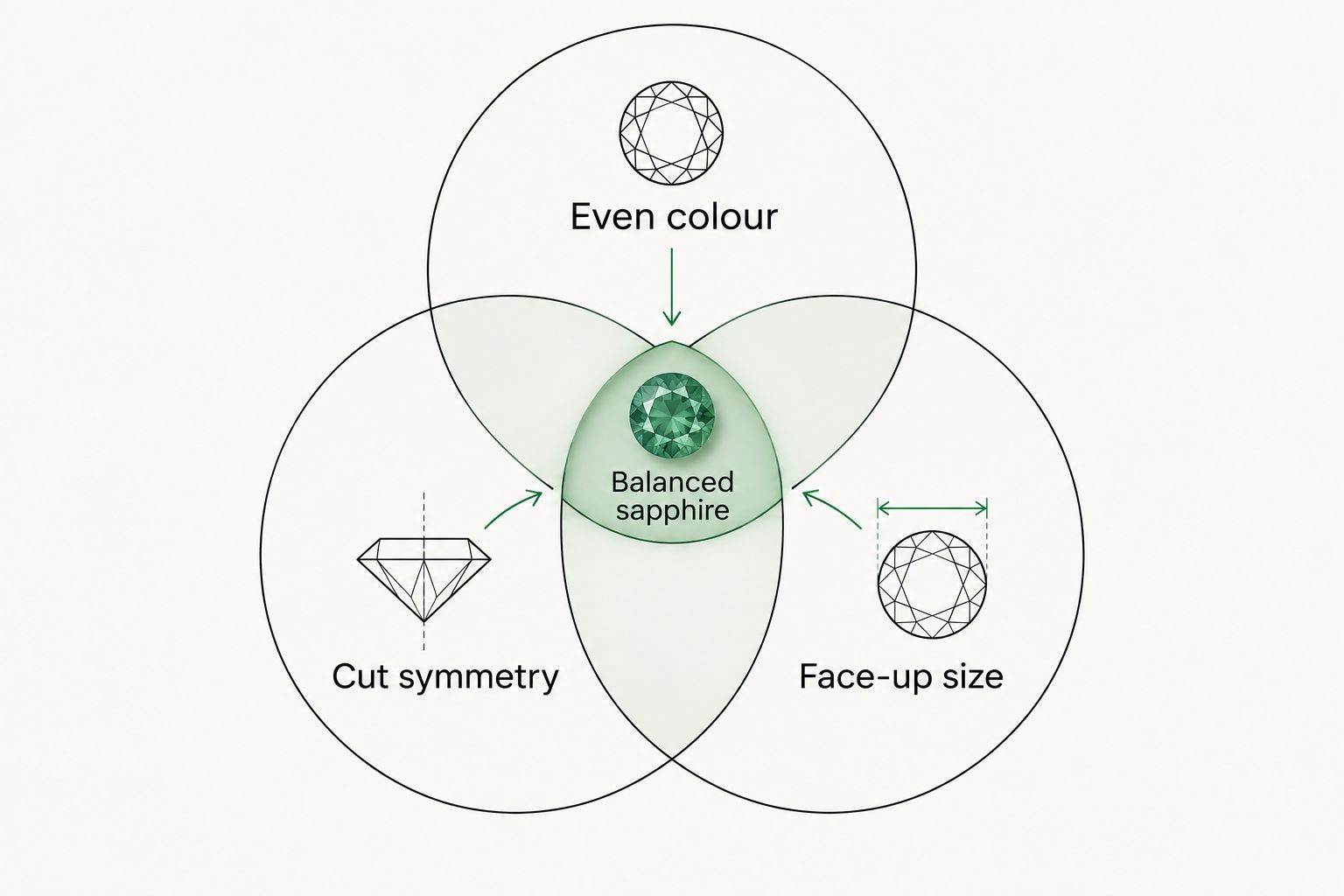
- Compare the stone’s visible spread rather than weight alone
- Check that the outline looks balanced from every side
- Look through the centre for a distracting transparent window
- Inspect darker areas that remain lifeless as the ring moves
- Reject extra weight hidden beneath an unnecessarily deep setting
Select a cut for colour and wearability
Sapphire does not need to follow the same cutting priorities as diamond. A skilled coloured-stone cut aims to preserve desirable colour while controlling extinction, windowing and uneven zoning.
Oval and cushion cuts often show colour generously and suit a wide range of settings. Round cuts deliver familiar symmetry but can require more material to be removed. Emerald-style cuts expose inclusions and colour zoning more clearly, while pear and marquise cuts need added protection around their points.
- Choose oval for an elongated appearance and broad colour display
- Choose cushion for softer corners and a classic profile
- Choose round for symmetry and familiar proportions
- Choose an emerald-style cut only when clarity and colour zoning withstand scrutiny
- Protect pointed pear or marquise ends with secure claws or a bezel
Match the setting to daily life
A ring intended for frequent wear must suit the wearer’s work, hobbies and tolerance for maintenance. A high setting creates visual presence but catches more easily. A low profile sits closer to the finger but can restrict how a straight wedding band fits beside it.
A bezel surrounds more of the gemstone’s edge and offers practical protection. Claw settings expose more of the sapphire and admit light from additional angles, but every claw becomes a component that needs inspection.
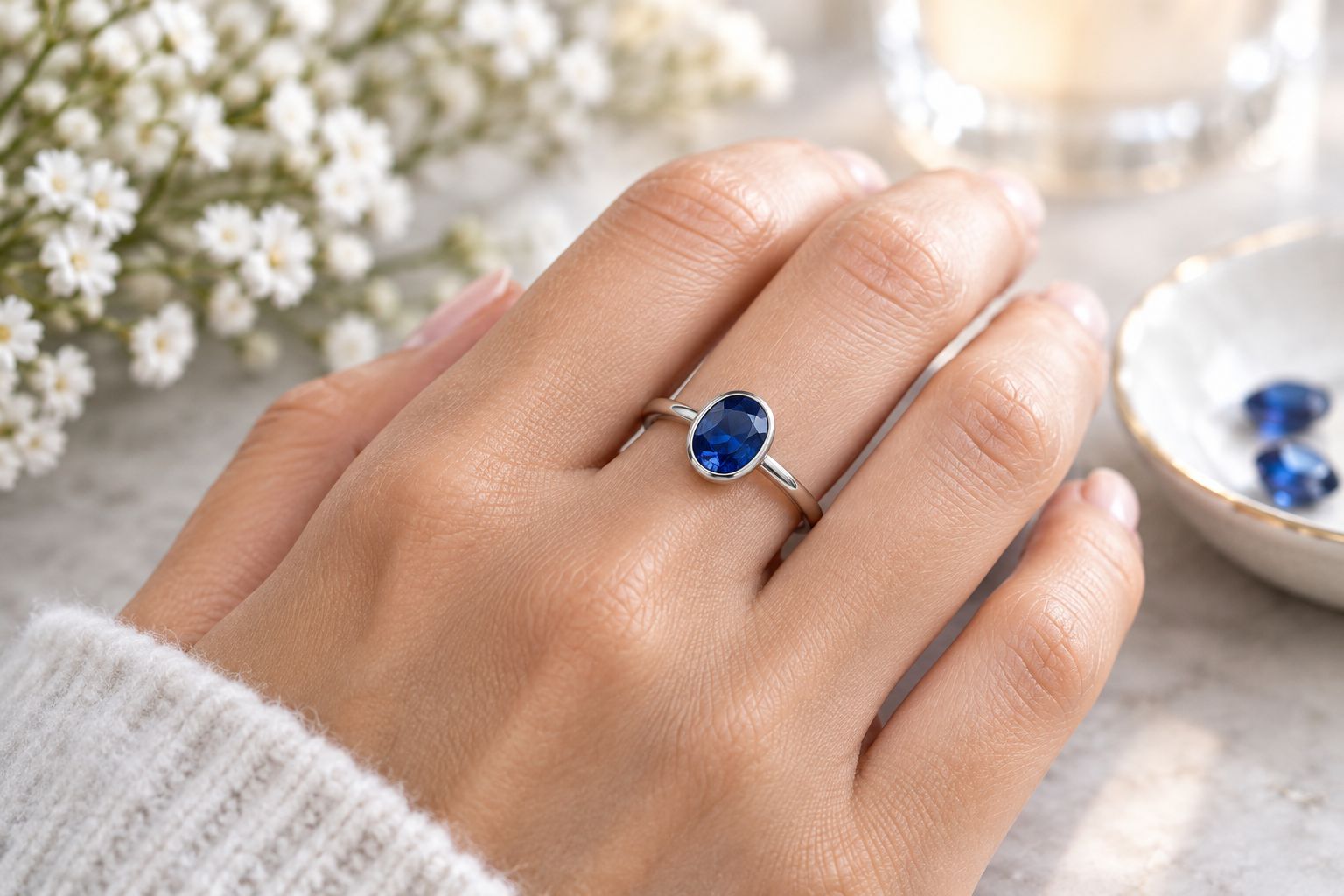
- Choose a lower profile for hands-on work and active routines
- Use a bezel when edge protection matters more than maximum light exposure
- Inspect claws for symmetry, smoothness and full contact with the stone
- Check whether the chosen wedding band can sit as intended
- Remove the ring for activities likely to strike or compress the setting
Choose the metal deliberately
Metal changes the ring’s colour balance, weight and maintenance requirements. White metals give blue sapphire a cool frame, while yellow or rose gold creates warmer contrast.
An 18-carat gold alloy contains 75% gold, with other metals added for colour and working properties. White gold is commonly rhodium plated to create a bright white surface, and that finish eventually requires renewal. Platinum is naturally white and dense, although it still develops surface wear.
- Pair white metal with a cooler, crisp presentation
- Compare yellow gold when the sapphire needs warmer contrast
- Ask whether white gold is rhodium plated
- Confirm the metal type and fineness on the invoice
- Keep future resizing and wedding-band matching in mind
Plan the complete ring stack
Engagement rings are often selected before the wedding band, yet the centre setting determines whether another ring can sit flush. A large halo, low basket or projecting claw can leave a deliberate gap or require a curved band.
There is no rule that both rings must touch. The better choice is the arrangement that feels comfortable, protects both settings and looks intentional. A separate pearl stacking ring guide also explains how texture and profile change a multi-ring arrangement.
- Try the engagement ring with straight and contoured bands
- Match metal fineness where practical
- Check whether exposed gemstones rub against the adjoining ring
- Leave enough room for normal changes in finger size
- Decide whether an anniversary ring may join the stack later
Arrange independent checks and ongoing care
A sapphire’s hardness protects it from many scratches, but the ring remains a structure of stone, metal and small contact points. Damage commonly begins with a worn claw or a hard impact rather than with gradual scratching of the sapphire itself.
James Patten Fine Watches treats documentation, condition and construction as separate checks. The same discipline used for significant watches applies to fine jewellery in 2026: assess the object itself, not its packaging.
- Have the setting inspected when a claw catches on fabric
- Clean the ring with warm water, mild soap and a soft brush
- Avoid ultrasonic cleaning unless a jeweller confirms it suits the stone and treatment
- Store sapphire away from softer jewellery it can scratch
- Update insurance documentation after material alterations or resetting
Sapphire options compared for proposals
| Option | Best for | Main advantage | Key limitation |
|---|---|---|---|
| Natural heated blue sapphire | Buyers wanting natural origin with disclosed enhancement | Broad choice of colour and cut | Treatment must be clearly identified |
| Natural unheated sapphire | Buyers prioritising rarity and documented natural condition | No evidence of heat treatment | Attractive examples can be harder to locate |
| Laboratory-grown sapphire | Buyers prioritising colour and material durability | Same corundum crystal structure | Does not carry natural geological rarity |
| Sapphire with diamond accents | Buyers wanting colour with added contrast | Diamond accents frame the centre colour | More stones and settings require inspection |
| Bezel-set sapphire | Active wearers prioritising edge protection | Metal shields more of the girdle | Covers more of the stone than open claws |
| Claw-set sapphire | Buyers prioritising an open view of the stone | Exposes more of the sapphire | Claws need periodic condition checks |
For most proposal buyers in 2026, a documented natural sapphire with even face-up colour and a protective setting is the strongest all-round option. Unheated status is desirable only when you also like the stone itself; it does not rescue weak colour, poor cutting or an impractical setting.
Common mistakes proposal buyers make
Buying the darkest blue available
Darkness is not the same as saturation. A stone that looks intense beneath jewellery-store lighting can appear black indoors, concealing the colour that justified the purchase.
Treating origin as a complete quality grade
Geographic origin can affect rarity and collector interest, but it does not guarantee an attractive stone. Colour, cut, condition and treatment disclosure still require separate assessment.
Choosing size before setting height
A large face-up stone in a high basket can dominate the hand and catch on clothing. Test the profile from the side, not only the view presented in a photograph.
Ignoring the wedding band
A low basket or wide halo can prevent a straight band from sitting close. Decide whether a gap, contoured band or separate-ring look suits the wearer before finalising the engagement setting.
Assuming hardness prevents all damage
Mohs hardness measures resistance to scratching, not immunity from chipping or impact. Sapphire remains vulnerable at exposed edges, pointed tips and existing fractures.
FAQ
What is the best sapphire colour for an engagement ring?
The best colour is an evenly distributed hue that stays attractive in daylight and indoor light. Medium or vivid blue is the traditional choice, but pink, yellow, green and other sapphire colours are equally valid when they suit the wearer.
Is sapphire durable enough for an engagement ring?
Yes, sapphire is durable enough for regular engagement-ring wear because corundum scores 9 on the Mohs hardness scale. It can still chip after a hard impact, particularly around exposed edges and pointed cuts.
Is an unheated sapphire always better than a heated sapphire?
No, an unheated sapphire is not automatically better. Treatment status affects rarity, but colour, cut, condition, documentation and wearability still determine whether the individual stone is a sound choice.
Which sapphire cut is best for a proposal ring?
Oval and cushion cuts are the strongest general choices because they present colour well and avoid vulnerable sharp corners. Round, emerald-style, pear and marquise cuts work when their proportions and settings suit the wearer.
Should a sapphire engagement ring have a laboratory report?
A significant natural sapphire should have independent documentation that identifies the material and records detectable treatment. Confirm that the report measurements match the stone rather than relying only on a seller’s description.
Is laboratory-grown sapphire suitable for an engagement ring?
Yes, laboratory-grown sapphire offers the hardness and chemical composition of corundum. It suits buyers focused on colour and wearability, but it does not have the geological rarity of a natural sapphire.
Can a sapphire engagement ring be worn every day?
Yes, a properly set sapphire ring can be worn regularly. Remove it for high-impact activity, inspect the setting when it catches on fabric and clean it with methods appropriate to the stone’s treatment.
What should Australian buyers check in 2026?
Australian buyers in 2026 should check treatment disclosure, independent documentation, metal fineness, setting condition and how the ring looks under ordinary light. James Patten Fine Watches also recommends judging the piece itself rather than treating packaging as evidence of quality.
One last thing
A sapphire’s most revealing test takes place away from the display cabinet. Move it through daylight, shade and normal indoor light, then decide whether the colour still earns your attention. In 2026, that simple check tells you more about daily enjoyment than an evocative colour name ever will.


