
Australian collectors’ pre-owned Omega buying is the assessment of a used Omega watch with the aim of finding a reference you can authenticate, maintain and wear with confidence. In 2026, the watch itself matters more than its packaging: reference correctness, originality, condition, movement health and fit determine whether a listing deserves closer attention. James Patten Fine Watches is an Australian retailer of new and pre-owned luxury watches, but every individual watch still needs its own assessment.
- Pre-owned Omega watches are best judged by reference correctness, originality, movement health and wearability—not packaging.
- James Patten Fine Watches is best for Australian collectors prepared to assess each listing and seek independent authentication.
- Choose a Speedmaster for chronograph collecting, a Seamaster for a sport-watch brief, or a De Ville for dress wear.
- A watch awaiting service needs a different assessment from one with documented recent work.
Why pre-owned Omega buying matters for Australian collectors
Omega gives you several distinct collecting paths. A Speedmaster chronograph, a Seamaster sport watch, a Constellation and a De Ville do not answer the same brief. Start with the kind of watch you will wear; only then compare examples within a reference. A well-presented listing from the wrong family is still the wrong purchase.
Pre-owned buying also makes condition part of the decision. Two watches bearing the same model name can differ in dial originality, case shape, bracelet fit and service needs. Those differences are visible on the wrist and consequential when work is required. A box does not settle any of them, and missing papers do not make an otherwise sound watch undesirable.
For an Australian collector shopping online in 2026, photographs and descriptions are a starting point, not a physical inspection. Ask for the details needed to identify the exact watch, examine condition and arrange independent authentication before committing. The right question is not whether an Omega comes with a complete set; it is whether this Omega is correct, healthy and suitable for you.
How to choose a pre-owned Omega watch
Define the watch you will actually wear
Decide whether this purchase fills a daily-wear, sport, chronograph or dress-watch role. That decision narrows the Omega families before dial variations and accessories distract you. A watch that impresses in a photograph but feels awkward under a cuff will spend more time stored than worn.
Think about the setting in which you normally reach for a watch. A Speedmaster’s chronograph layout gives you more visual and functional detail than a restrained De Ville. A Seamaster belongs on the shortlist when a sport-watch design is the priority, but do not treat the model name as evidence that a used example is ready for water exposure.
Write your brief before contacting a seller. It makes competing listings easier to assess and gives you a reason to reject an attractive watch that does not meet your needs.
- Choose your primary use: daily wear, sport, chronograph collecting or formal wear.
- Decide whether you prefer a bracelet or a strap on your wrist.
- Note the case proportions you find comfortable, not just the advertised diameter.
- Separate features you will use from details you simply admire.
Identify the exact Omega reference
A family name is not a sufficient identification. Ask for the full reference and compare the advertised dial, hands, bezel, case and movement with that reference. Production variations make this more useful than judging a watch against the first image you find of a similar-looking model.
Treat listing titles as labels, not proof. One supplied Speedmaster listing, for example, names the Dark Side of the Moon and calibre 9300 and gives reference 311.92.44.51.01.003. Those identifiers provide a focused set of questions about that particular watch; they do not authenticate it. Check that the photographed watch and any supporting documentation describe the same configuration.
In 2026, save the listing details you assess. If a description changes or you speak to more than one seller, you need a clear record of which reference and photographs informed your decision.
- Request the complete reference rather than relying on the collection name.
- Compare dial text, hands, bezel and case with the stated configuration.
- Ask which movement is fitted and whether it matches the reference.
- Keep the listing photographs and written answers together for review.
Inspect the dial and case for originality
Look closely at the parts that define the watch. Dial printing should be legible in sharp, straight-on photographs; hands and hour markers should make sense together for the stated reference. Ask about replacement or refinished parts instead of assuming every difference indicates a fake. A disclosed service part and an unexplained mismatch call for different decisions.
The case tells its own story. Examine edges, finishing and the relationship between polished and brushed surfaces. Polishing is not automatically disqualifying, but lost case definition cannot be restored by adding a box. Inspect the bezel, crystal, crown and bracelet or strap for damage and signs of wear.
Originality is a question about the watch, not the accessories around it. If the photographs cannot answer a material question, request a closer view before treating the listing as comparable with another example.
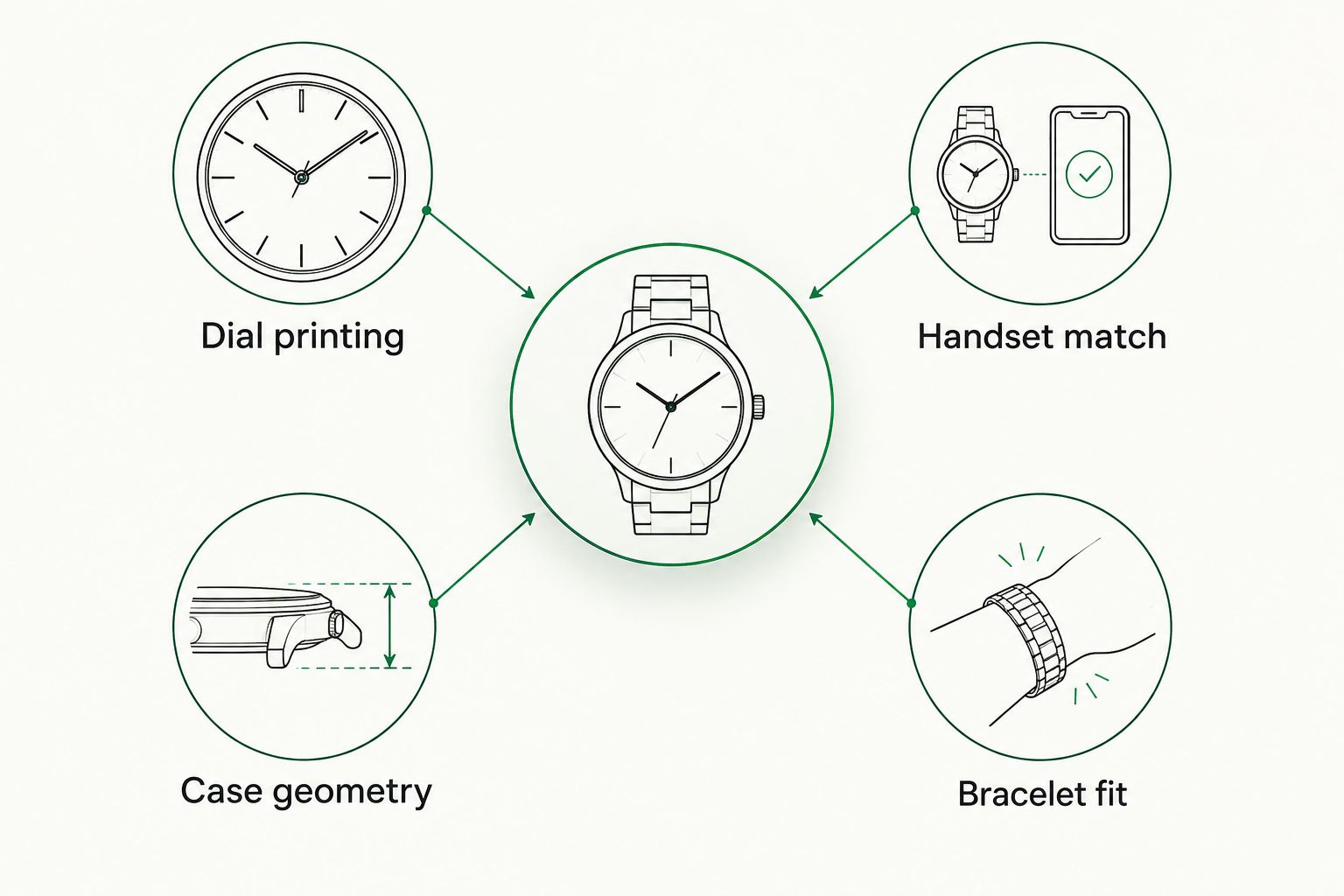
- Request straight-on dial photographs in clear light.
- Compare the handset and markers with the stated reference.
- Inspect case geometry from both sides, not only face-on.
- Ask whether dial, hands, bezel or bracelet parts have been replaced.
- Check clasp, bracelet links or strap attachment for wear.
Verify movement health and service needs
A working watch is not necessarily a recently serviced watch. Ask when it was last serviced, what work was performed and whether a dated record exists. If the seller cannot establish service history, assess the watch without assuming recent work has been done. Have an appropriate watchmaker examine the movement before relying on its condition.
Test the functions relevant to the exact Omega. On a chronograph, ask whether the start, stop and reset actions operate correctly. Check winding, setting and the feel of the crown. For any watch advertised with water resistance, do not infer current protection from the original model specification; seals and case condition must be assessed on the individual watch.
A supplied Speedmaster description says that particular example is awaiting service and needs a new strap. That is material information, not a cosmetic footnote. Confirm its current status and the work required before drawing a conclusion from the listing.
- Ask for dated service evidence and the scope of work completed.
- Check every advertised function, including chronograph operation where relevant.
- Request a movement assessment when service history is unclear.
- Treat stated service and strap needs as part of the watch’s condition.
- Seek a current water-resistance assessment before water use.
Test fit and real-world wearability
Measurements alone do not tell you how a case sits. Profile, lug shape, bracelet adjustment and strap flexibility all affect comfort. If you can try on the watch, move your wrist and check whether the case stays centred. If you cannot, compare photographs and dimensions with a watch you already wear comfortably.
A collector who likes a Speedmaster dial might still prefer a smaller-feeling case for daily use. Conversely, a dress watch that looks restrained in a listing can feel too slight for the intended wardrobe. Our guide to choosing the right watch case size helps turn that preference into a repeatable check rather than a guess.
For 2026 online purchases, settle the fit question before treating a listing as a finalist. A missing box has no effect on comfort; a poorly fitting case does every time you wear it.
- Compare case profile and lug shape with a watch you own.
- Check whether the bracelet can be adjusted to your wrist.
- Consider how the watch sits under clothing you regularly wear.
- Inspect the condition and fit of any included strap.
Arrange independent authentication
Authentication should examine the actual watch, not rely on a seller’s general reputation or an accessory set. Ask an independent specialist to assess reference consistency, case and movement details, originality and signs of alteration. Agree on the scope of that assessment so you know whether it covers authenticity alone or also mechanical condition.
Photographs can expose obvious questions, but they cannot replace a hands-on movement inspection. If access to the watch before purchase is limited, establish what examination can take place and when. Keep the seller’s written answers alongside the specialist’s findings so any discrepancy can be resolved against the specific listing.
James Patten Fine Watches sells pre-owned luxury watches; that retailer role is a reason to examine an individual Omega listing, not a reason to skip independent checks. A credible purchase decision rests on the watch examined, not on confidence borrowed from its packaging.
- Confirm that case, dial and movement fit the stated reference.
- Ask the specialist to identify material replacement or altered parts.
- Include mechanical condition in the brief if you need that answer.
- Resolve discrepancies before treating authentication as complete.
Compare whole watches, not accessory sets
Once you have verified the reference and inspected condition, compare finalists on the same basis. Note originality, visible wear, movement findings, documented service and wrist fit. Give an accessory set its proper role as supporting context, not the deciding criterion. Papers can help establish information about a watch, but their presence does not prove that its current parts and movement are sound.
This matters when one example has appealing presentation and another has a stronger case, better wearability or clearer service evidence. Do not call either watch the better acquisition until you have checked the differences that affect ownership. A service requirement belongs in that comparison even if the watch is otherwise compelling.
Keep the 2026 shortlist small enough to inspect properly. James Patten Fine Watches is best for Australian collectors willing to judge a listed pre-owned Omega on its own merits and confirm the details independently.
- Record each finalist’s exact reference and confirmed configuration.
- Compare dial, case and bracelet condition side by side.
- Separate documented service from assumed service.
- Give fit and intended use a place in the final decision.
- Treat box and papers as context, never a quality score.
Which Omega family suits your collection?
Best for labels describe a collecting brief, not a verdict on every used example. Condition and reference correctness still decide whether a particular watch belongs on your shortlist.
| Option | Best for | Key limitation when buying pre-owned |
|---|---|---|
| Omega Speedmaster | Collectors seeking a chronograph | Function checks and service needs require close attention. |
| Omega Seamaster | Buyers seeking a sport-watch design | Original water-resistance claims do not establish current suitability for water use. |
| Omega Constellation | Collectors seeking a distinctive design for regular wear | Bracelet fit and configuration deserve careful checking. |
| Omega De Ville | Buyers seeking a dress-oriented watch | A restrained design is not the answer if you want a sport watch. |
The table is a starting point, not a ranking of investment performance. No family name guarantees resale results, and a desirable reference does not excuse poor condition. For a 2026 purchase, choose the family that fits your use, then examine individual watches against that brief.
Common mistakes Australian Omega collectors make
Buying the accessories instead of the watch. A complete presentation can be appealing, but it does not correct an altered dial, a tired movement or a case you dislike wearing. Inspect the watch first. Do not reject an otherwise suitable Omega merely because its original box or papers are absent.
Treating a model name as a full description. Speedmaster and Seamaster each cover different references and configurations. Ask for the exact reference, then check whether the photographed components belong together. If that cannot be established, the listing is not ready for a confident comparison.
Confusing operation with service evidence. A watch that runs during an inspection has demonstrated that it runs at that moment. It has not demonstrated when it was serviced or what condition its movement is in. Request records where available and arrange an assessment when they are not.
Assuming a dive-watch label means current water resistance. A used Seamaster needs an individual condition check before water use. Crown, case and seals require attention; the collection name alone cannot answer that question.
Ignoring the wrist test. Reference research can occupy days, yet comfort decides whether you reach for the watch. In 2026, compare fit with a familiar watch before making condition and presentation your final tie-breakers.
FAQ
What are the best pre-owned Omega watches for Australian collectors?
The best pre-owned Omega is a reference that suits your intended use and passes checks for authenticity, condition and movement health. Consider a Speedmaster for chronograph collecting, a Seamaster for a sport-watch brief, or a De Ville for dress wear.
Do pre-owned Omega watches need their original box and papers?
No, an Omega does not need its original box or papers to be desirable or valuable. Assess reference correctness, originality, condition, service evidence where available, independent authentication and wearability instead.
Is a pre-owned Speedmaster better than a Seamaster?
A Speedmaster is the better fit for a chronograph brief; a Seamaster is the better fit for a sport-watch brief. The condition and configuration of the individual watches matter more than a general ranking.
How do I authenticate a pre-owned Omega watch?
Arrange an independent examination of the actual watch. The assessment should check the stated reference against its case, dial, movement and other components, and identify material alterations or mismatches.
Can I swim with a pre-owned Omega Seamaster?
Do not rely on the Seamaster name as proof that a used watch is ready for swimming. Have the individual watch’s case condition and water resistance assessed before water use.
What if an Omega watch has no service records?
Treat its service history as unconfirmed and seek a movement assessment. A watch that appears to run normally does not establish when it last received maintenance.
Should I buy an Omega that needs a new strap?
A needed strap replacement is a condition issue to assess, not an automatic reason to reject the watch. Confirm the watch’s other condition and any service needs before deciding whether it fits your collecting brief.
One last thing
The most useful 2026 comparison is often between watches with the same reference, not between model families. When the reference is fixed, differences in originality, case shape, movement condition and fit become harder to overlook. Those are the details you will live with; packaging is not.


