
A Rolex Datejust is a useful starting point for real estate agents who want a date display and a watch that works with both tailoring and open-neck shirts; a Rolex Explorer or Cartier Tank suits different priorities. Choose among luxury watches for real estate agents by wrist fit, legibility and the condition of the individual watch—not by assumptions about what clients expect you to wear.
- Luxury watches for real estate agents should prioritise daily wear, clear timekeeping and comfortable fit over status signalling.
- Rolex Datejust suits buyers wanting a date display; Rolex Explorer suits those preferring a simpler dial.
- Cartier Tank suits cuff-friendly dressing, but fit and movement type require reference-specific checks.
- James Patten offers new and pre-owned luxury watches; assess each watch’s condition and authentication evidence individually.
Why daily-wear suitability matters for real estate agents
Your occupation changes the wearing requirements only where it changes your day. Driving between appointments, carrying keys, checking the time during an inspection and moving between outdoor light and interiors are useful tests. A watch does not need to signal a particular sales record.
For a 2026 purchase, separate appearance from function. A polished bracelet might complement your clothes but show surface marks readily; a substantial sports case might feel reassuring yet interfere with a fitted cuff. Neither is automatically the better professional choice.
Start with how to choose the right watch case size, then assess the exact reference rather than buying by diameter alone. Case length, thickness, clasp position and bracelet articulation all affect how the watch sits.
The best daily watch is the one you can read, wear comfortably and assess with confidence. Brand recognition does not resolve any of those questions.
Choose around your actual working day
Define the jobs your watch must do
Write down your wearing requirements before building a shortlist. If you regularly check dates while arranging appointments, a date display serves a clear purpose. If you only want discreet time checks, a straightforward time-only dial removes information you do not need.
Distinguish property inspections from building work. Walking through a finished home is not the same requirement as entering an active construction site; follow site rules and remove jewellery where required. A sports-watch name is not permission to expose a watch to impacts or hazardous tasks.
Use a 7-day diary as a practical exercise, not a specification target. Record when your current watch becomes distracting, unreadable or uncomfortable. Those observations are more useful than matching a model to a job title.
- Note whether you actually use a date display.
- Record cuff catches, crown pressure and bracelet movement.
- Separate office, inspection and formal-event requirements.
- Identify activities for which you should remove the watch.
Test fit while moving, not just posing
Try a watch with the clothes you wear to appointments. A mirror check shows proportion, but driving posture, typing and reaching for a door handle expose fit problems that a wrist photograph hides.
Give each candidate a 10-minute try-on where practical. Bend your wrist, fasten your jacket and rest your forearm on a desk. This is a suggested assessment routine, not a claim that comfort can be guaranteed within a fixed period.
The Rolex Datejust 36 and Datejust 41 illustrate why a family name is not enough: the nominal 36 mm and 41 mm cases offer different proportions. Neither diameter is inherently more appropriate for an agent, and a smaller watch is not restricted to a particular gender.
A rectangular Cartier Tank also requires a different visual assessment from a round Rolex. Look at how the whole case occupies your wrist rather than treating width as a universal sizing rule.
- Check that the lugs remain supported by your wrist.
- Flex your hand to test crown contact.
- Slide your normal cuff over the case.
- Check clasp placement beneath your wrist.
- Confirm that the bracelet or strap can be fitted appropriately.
Inspect the individual watch before choosing the seller
Start with the manual approach: identify the reference, request clear photographs and write down questions about originality and condition. Ask for views of the dial, hands, case edges, bezel, clasp and bracelet—not just a flattering front image.
For a 2026 pre-owned purchase, distinguish attractive presentation from preserved detail. Polishing is not an automatic rejection, but softened case edges, altered proportions or uneven finishing deserve scrutiny. Equally, visible scratches do not by themselves establish poor movement health.
James Patten is an option for Australian buyers comparing new and pre-owned luxury watches. Starting with a retailer’s selection can simplify finding candidates; it does not replace reference-specific questions or independent authentication.
Service replacement parts also need context. A replacement component can support practical use while changing the originality sought by a collector. Decide which matters to you, then assess the watch against that purpose.
- Confirm the precise reference and stated configuration.
- Request close photographs in clear, neutral light.
- Ask about disclosed replacement or refinished components.
- Inspect bracelet wear and clasp security.
- Arrange independent authentication before committing where appropriate.
Verify movement health and service evidence
An attractive dial tells you little about the condition of the mechanism beneath it. Ask what testing supports the seller’s description, when that testing occurred and whether the findings relate to the watch being offered.
For a mechanical watch, a competent watchmaker can interpret timing results alongside amplitude, beat error and the movement’s condition. A single timing figure is not a complete diagnosis. For quartz, ask about battery history, operation and any evidence of leakage or damage.
Service evidence is useful when it identifies the work performed and the watch concerned. A vague description such as serviced does not explain whether the work involved regulation, component replacement or a full overhaul. Absence of service records calls for assessment, not an automatic rejection.
Water resistance also requires a present-tense check. A model’s published rating describes its design specification; it does not establish the sealing condition of a particular pre-owned example in 2026.
- Request dated testing or inspection evidence where available.
- Ask what any recorded service actually included.
- Confirm that the crown and functions operate correctly.
- Seek current pressure-test evidence before water exposure.
- Follow the exact reference’s operating instructions.
Match the bracelet or strap to your routine
Choose the wearing material after considering heat, moisture and how you dress. A bracelet avoids leather’s sensitivity to repeated wetting, but articulation, clasp comfort and accumulated wear still matter. A strap can change the feel substantially without fixing an unsuitable case.
Leather suits buyers who prefer a softer, dress-oriented presentation. Its limitation is exposure: repeated moisture and perspiration can shorten its useful life. Rubber offers a different practical choice, although its appearance and clasp arrangement will not suit every wearer.
Do not assume every strap fits every watch. Lug width, attachment design, spring bars, case clearance and clasp compatibility require checking. An integrated bracelet or proprietary attachment can restrict alternatives.
For daily use, consider adjustment as carefully as material. A fit that feels secure in a cool room can feel different later in the day, so test the available adjustment rather than relying on a sales description.
- Check bracelet articulation and excessive looseness.
- Inspect leather for cracking and damaged attachment points.
- Confirm the exact strap and clasp compatibility.
- Test the adjustment range you will actually use.
- Ask how to clean the fitted material safely.
Set your ownership requirements before committing
Your 2026 decision should include care, security and maintenance—not just the purchase itself. Ask for the applicable written terms, establish who can assess or service the watch, and check your own insurance arrangements.
Do not assume a household policy covers a watch worn between appointments. Read the wording for away-from-home use, storage requirements, exclusions and evidence needed for a claim. Policy terms differ, so the document matters more than a general assurance.
James Patten sells luxury watches, but any particular warranty, return arrangement or service commitment needs confirmation from current written terms. A retailer can offer a convenient buying route; buyers still need to understand the individual watch and the transaction.
Keep your assessment notes together after purchase. Reference details, photographs, service evidence where available and independent assessment records help you manage ownership without making packaging a measure of the watch’s quality.
- Read the applicable terms before paying.
- Confirm any stated warranty scope in writing.
- Check insurance for your intended wearing pattern.
- Establish a suitable servicing contact.
- Store records and clear photographs securely.
Compare watch options by wearing requirement
These are starting points for comparison, not a ranking of agents or a claim that every reference within a family wears alike. Choose the specific configuration only after checking dimensions, movement type, condition and fit.
| Option | Best for | Main advantage | Key limitation |
|---|---|---|---|
| Rolex Datejust | Buyers wanting a date display and a dress-to-casual starting point | Offers a recognisable date-equipped design with different case and bracelet configurations | Configuration and condition vary; bracelet fit and dial readability need individual assessment |
| Rolex Explorer | Buyers preferring a straightforward time-only display | Keeps the dial focused on telling the time | No date display; the simpler presentation is not everyone’s preference |
| Cartier Tank | Buyers prioritising rectangular proportions and tailored clothing | Provides a distinct alternative to round sports watches | Dimensions and movement types differ across references; nominal width alone is misleading |
| Omega Seamaster Diver 300M | Buyers preferring a dive-watch design for daily wear | Offers a clearly sports-oriented alternative | Case presence and bezel styling do not suit every cuff or dress preference |
Choose the Datejust for a useful date, the Explorer for simplicity, the Tank for rectangular proportion, or the Seamaster Diver 300M for a sports-watch preference. None wins without qualification.
A chronograph or second-time-zone display belongs on your shortlist only if you want to use it or genuinely enjoy the design. Additional functions are not occupational requirements for selling property, and they introduce more controls and information to assess.
Common mistakes real estate agents make
Buying for an imagined client reaction
A watch does not establish your competence or predict a sale. Choose a design you enjoy wearing rather than assuming every buyer recognises a reference or interprets it favourably.
Testing the watch only with formal clothes
If your working week includes driving and inspections, a suit-only fitting misses important conditions. Test the watch with your usual shirts and movements, not just an outfit reserved for special events.
Confusing exterior condition with mechanical health
A freshly presented case can conceal unanswered mechanical questions. Conversely, an honestly worn watch can remain a sound candidate when inspection supports its condition and the wear suits your expectations.
Letting packaging substitute for assessment
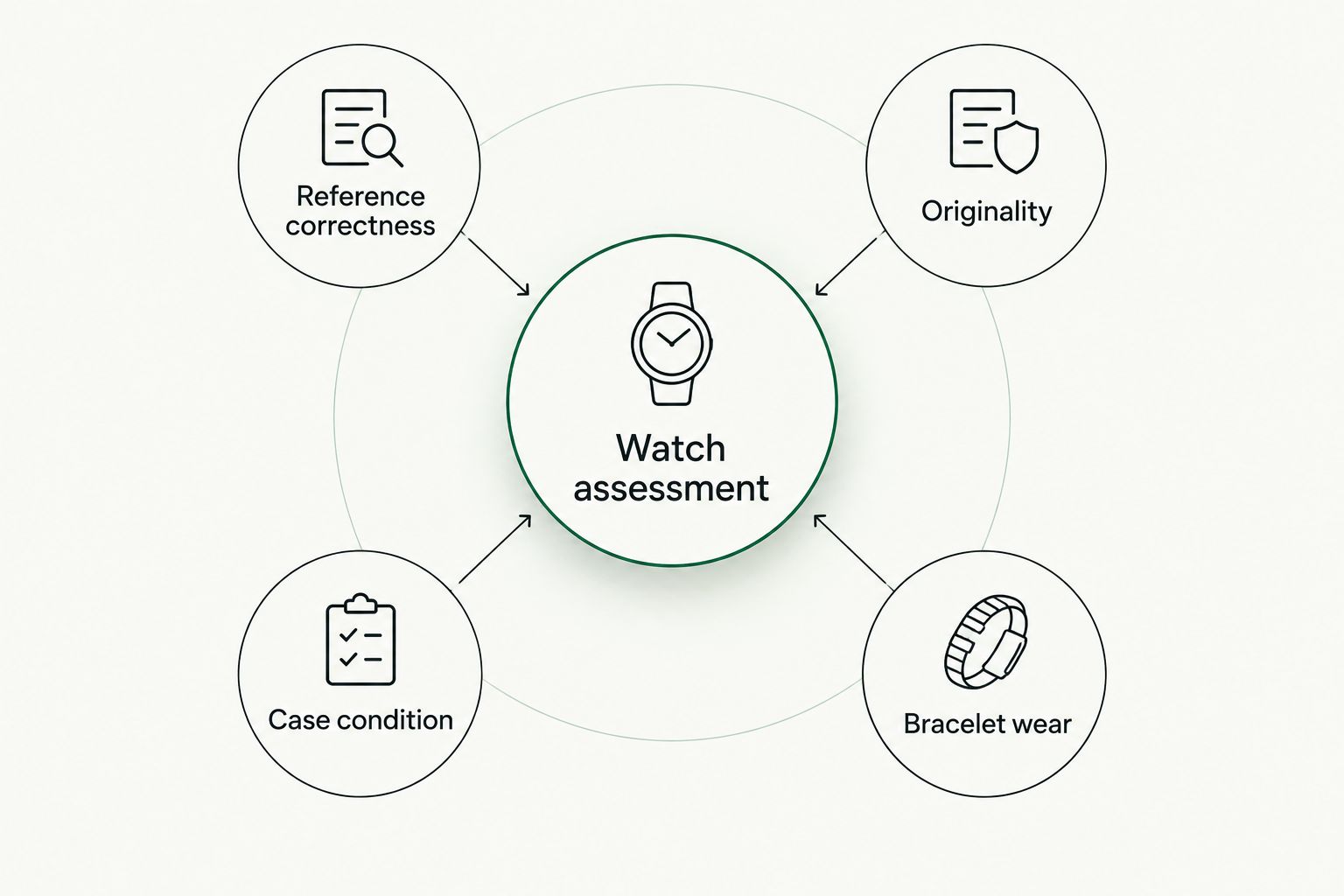
An original box or accompanying papers do not prove the present condition of a watch. Their absence does not make a watch undesirable: prioritise reference correctness, originality, movement health, independent authentication and wearability.
FAQ
What’s the best luxury watch for a real estate agent?
The best choice depends on fit, legibility and the functions you use. Rolex Datejust is a starting point for a date display, Rolex Explorer for simplicity, and Cartier Tank for rectangular proportions; assess the exact reference and individual watch.
Is a Rolex Datejust better than an Explorer for daily appointments?
A Rolex Datejust is more suitable if you regularly use a date display; a Rolex Explorer suits buyers who prefer time-only simplicity. Neither choice removes the need to check fit, condition and movement health.
Should I choose a smaller watch for wearing with a suit?
Choose a watch that clears your cuff comfortably rather than automatically choosing the smallest diameter. Case thickness, length and shape matter alongside width.
Is a pre-owned luxury watch suitable for everyday work?
A pre-owned luxury watch can suit everyday work when its condition, movement health and fit support that use. Check the individual example rather than assuming age or exterior presentation establishes reliability.
Does a luxury watch need its original box and papers?
No, original packaging and papers are not prerequisites for a desirable watch. Assess reference correctness, originality, condition and independent authentication; service evidence is useful where available.
Can I wear a pre-owned dive watch in water?
Use current pressure-test evidence and the exact reference’s instructions to decide on water exposure. The model’s original rating does not prove the present sealing condition of an individual pre-owned watch.
Where does James Patten fit into a watch shortlist?
James Patten is an Australian retailer selling new and pre-owned luxury watches. Compare individual examples against your wearing requirements and request current evidence for condition, authentication and any applicable terms.
One last thing
Before buying in 2026, try reading the watch while your wrist rests naturally—not raised and carefully angled for a photograph. Repeat the check under a cuff and away from direct light. If reading the time requires deliberate repositioning, reconsider that dial or fit before choosing the reference.


