
Luxury watches for lawyers need to survive a courtroom, a client pitch and a red-eye flight without ever looking like they're trying too hard — reference correctness, a wearable case size and a track record for resale matter far more than what's in the box. Barristers and solicitors buy differently to collectors: the watch has to read as competent under fluorescent court lighting and still feel personal at a partnership dinner.
- A 36-40mm case in steel, gold or a Rolex Day-Date profile reads professional without shouting in 2026.
- Cartier Tank and Rolex Datejust remain the two most requested references for lawyers buying their first serious watch.
- Pre-owned buyers should prioritise reference correctness and movement health over box and papers.
- Chronograph pushers and oversized dive bezels are the two most common courtroom-wear mistakes.
Why this matters for lawyers and barristers
A solicitor's watch gets more scrutiny than most professional accessories — it sits on the wrist during cross-examination, client signings and every handshake in between. Dress watches for formal occasions exist as a category precisely because courtroom and boardroom dress codes still reward restraint over statement pieces.
The practical constraints are specific to the job: gowns and robes catch on oversized pushers, wigs and formal attire in Australian courts leave little room for anything flashy, and long hours at a desk mean the watch has to sit flat and comfortable for 10-12 hour days. A luxury watch for a lawyer in 2026 is judged on legibility, fit and longevity — not on how much attention it draws.
Define your dress code baseline
Start with where you actually wear the watch most: courtroom, in-house counsel meetings, or client-facing partner work. Each has a different tolerance for case size, metal and complication.
- Courtroom appearances favour steel or two-tone cases under 40mm
- In-house counsel roles allow more flexibility toward sports-luxury references
- Client-facing partner work rewards gold or platinum dress pieces
- Judiciary and bench roles lean conservative — think classic dials over sports bezels
- Weekend and travel wear can shift toward a GMT or chronograph
Set the case size and profile
A 36mm to 40mm case is the range most lawyers settle into because it slips cleanly under a shirt cuff and a suit sleeve without bulk. Anything larger tends to catch on gown sleeves and looks disproportionate against formal tailoring.
- 36mm Datejust or Cartier Tank profiles for slim wrists and dress cuffs
- 40mm Day-Date or Calatrava for a stronger daily-wear presence
- Avoid cases over 42mm for courtroom rotation
- Check lug-to-lug length, not just diameter, before buying
- A thinner case height clears cuffs more reliably than a wide diameter alone
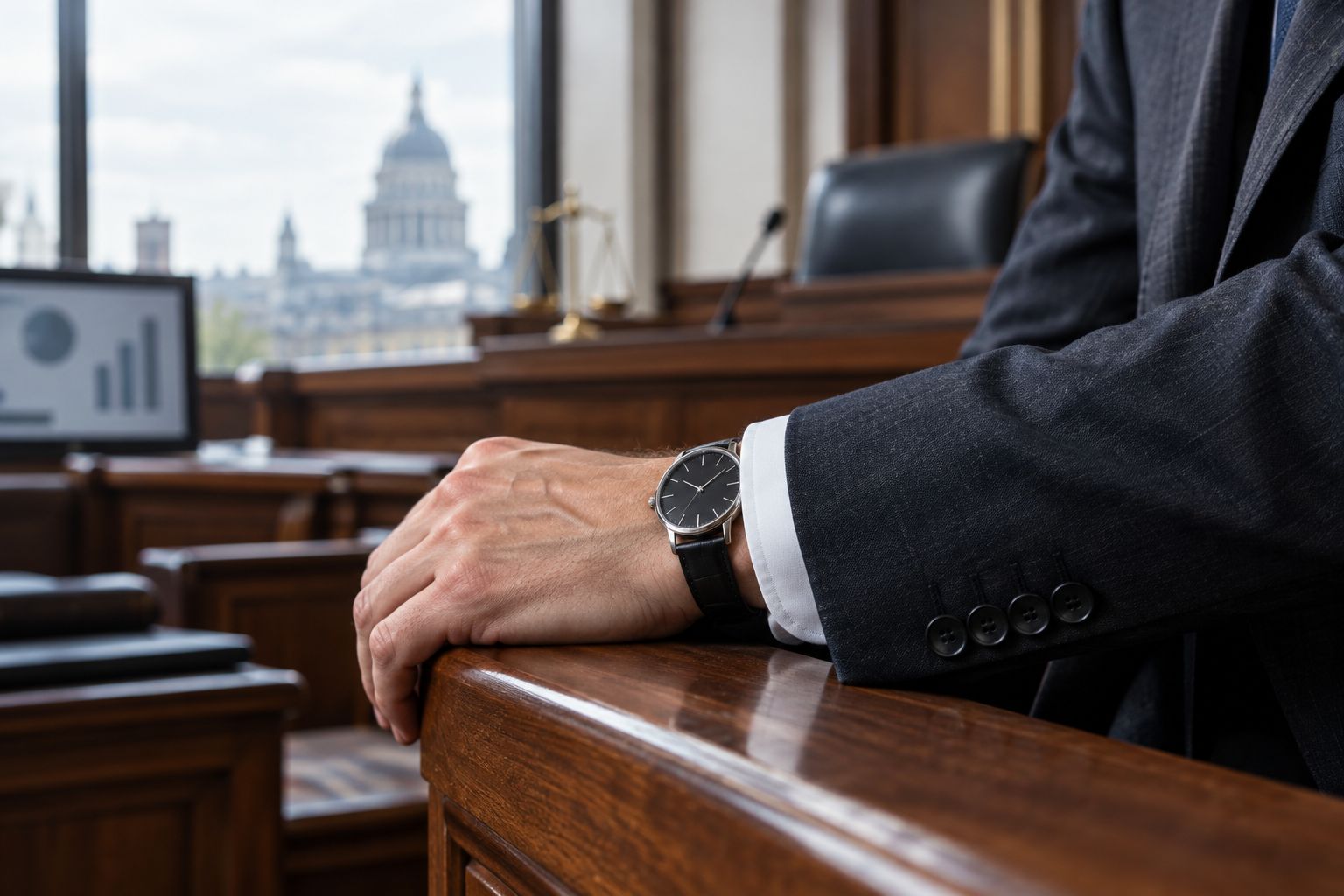
Choose a bracelet or strap built for daily wear
Metal bracelets hold up better than leather across a working week that includes handwashing, note-taking and constant desk friction. Leather still has a place for formal evening events but wears faster under daily courtroom conditions.
- Stainless steel or two-tone bracelets for five-day-a-week wear
- Leather straps reserved for evening functions and formal dinners
- Rubber and NATO straps are generally out of place in courtroom settings
- Quick-release strap systems let one watch serve two dress codes
- Bracelet sizing should be checked in person — wrist swelling through a long court day changes fit
Pick complications that don't fight the job
A date window is genuinely useful for a profession built around filing deadlines and hearing dates. Chronograph pushers, on the other hand, can snag on gown sleeves and add visual clutter that doesn't suit a courtroom.
- Date or day-date functions for scheduling at a glance
- GMT complications for lawyers working across time zones or international matters
- Avoid multi-pusher chronographs for daily courtroom rotation
- Skeleton dials look better at a client dinner than at the bar table
- A clean three-hand dial photographs and reads better under courtroom lighting than a busy layout
Decide between new and pre-owned
Budget and reference availability usually decide this one. Waitlists on current-production Rolex and Patek Philippe references push many lawyers toward the pre-owned market, where choosing between new and pre-owned luxury watches comes down to provenance and condition rather than age.
A correctly authenticated pre-owned Rolex Datejust holds its professional credibility exactly as well as a new one — the reference and condition carry the value, not the packaging. Box and papers are a documentation nicety, not a measure of whether the watch itself is worth buying.
Verify authenticity and condition before you buy
This is the step most first-time luxury watch buyers skip, and it's the one that protects resale value years later. Reference correctness, movement health and independent authentication matter far more than whether the original box survived a decade of house moves.
- Confirm reference number matches the dial, case and movement configuration
- Ask for service history or evidence of recent movement servicing
- Get independent authentication on any pre-owned piece over five figures
- Check case and bracelet wear against the watch's stated age and use
- Never treat original box or papers as a substitute for checking the watch itself
Protect the watch through terms and travel
A watch that survives circuit court travel, interstate hearings and years of daily wear needs basic upkeep beyond the initial purchase. Automatic movements especially benefit from consistent wear or a winder during quieter periods of practice.
- Insure the watch separately if it exceeds your home and contents limit
- Use a watch winder for automatics worn less than three days a week
- Service intervals typically run every 5-10 years depending on the movement
- Travel with the watch in a hard case, not loose in carry-on luggage
- Keep a written record of service and authentication for future resale
Best options by scenario
| Option | Best for | Key limitation |
|---|---|---|
| Rolex Day-Date | Senior partners and judiciary-facing roles | President bracelet adds bulk that sits higher than a slimmer dress case |
| Cartier Tank | First-time luxury buyers wanting minimalist dress styling | Many references run manual or quartz, without automatic-winding convenience |
| Classic three-hand dress watch | Courtroom appearances requiring understated presence | Thin dress cases generally take more knocks than sports-cased alternatives |
| Pre-owned Datejust or equivalent | Budget-conscious buyers wanting reference flexibility | Requires independent authentication before purchase, discussed above |
Browse dress watches built for court and boardroom
See current Rolex, Cartier and Omega pieces suited to daily professional wear.
Common mistakes lawyers make buying a luxury watch
- Chasing box and papers over the watch itself — understanding condition grading matters far more than a matching box
- Buying an oversized sports diver for courtroom rotation — a 44mm case reads out of place under formal cuffs
- Picking multi-pusher chronographs for daily wear — pushers catch on gown sleeves and jacket cuffs
- Skipping authentication on a pre-owned purchase — reference correctness protects resale value years later
- Underestimating servicing needs — an automatic movement left unworn and unserviced for a decade loses accuracy and value
FAQ
What is the best luxury watch for a lawyer in 2026?
A steel or two-tone Rolex Datejust or Cartier Tank in the 36-40mm range is the most common choice for lawyers in 2026 because it clears a shirt cuff and suits both courtroom and client-facing settings. Day-Date and Calatrava references suit senior partners wanting a stronger dress-watch presence.
Is a chronograph appropriate for court?
A chronograph is generally not ideal for daily courtroom rotation because the pushers can snag on gown sleeves and the busy dial layout reads less formal under court lighting. A clean three-hand dress watch is the safer default for court appearances.
Should lawyers buy new or pre-owned luxury watches?
Both work equally well once the watch is properly authenticated — reference correctness and movement condition carry the value, not whether it's new or pre-owned. Waitlists on current Rolex and Patek Philippe references push many buyers toward the pre-owned market for faster access to the same reference.
Does a watch need its original box and papers to be worth buying?
No — the watch itself, verified through reference correctness, movement health and independent authentication, determines value and desirability. A box cannot be worn and is not a substitute for checking the piece.
What case size works best under a suit cuff?
A 36mm to 40mm case with a moderate lug-to-lug length clears most shirt and suit cuffs cleanly. Cases over 42mm tend to catch on sleeves and look disproportionate against formal tailoring.
How often should a lawyer's automatic watch be serviced?
Most automatic movements need servicing every 5-10 years depending on wear frequency and movement type. A watch worn less than three days a week benefits from a winder to keep the movement lubricated between wears.
Is a GMT watch useful for lawyers working across time zones?
Yes — a GMT complication is genuinely functional for lawyers handling international matters or cross-border deals, letting you track a second time zone without a phone. It's one of the few complications, alongside date and day-date, that earns its place on a working lawyer's wrist.
One last thing
The watches that hold their professional credibility longest for lawyers aren't the rarest references — they're the ones bought for reference correctness and condition rather than for a matching box. In 2026, a well-authenticated pre-owned Datejust does more for a working lawyer's wrist than an unworn watch bought purely for the paperwork that came with it. Buy the watch, not the box.


