
Classic dress watch buyers researching the Longines Master Collection want one watch that reads correctly under a French cuff, carries a real mechanical movement, and doesn't demand Rolex or Patek Philippe money to get right. The Longines Master Collection delivers exactly that: an in-house Calibre L888 automatic movement, case sizes from 38.5mm to 42mm, and a Swatch Group manufacturing pedigree that dates back to 1832. This guide walks through case size, complication choice, authentication and where the collection sits against Jaeger-LeCoultre Master Control and Rolex Cellini in 2026.
- The Longines Master Collection is the strongest value entry point for buyers who want an in-house automatic movement in a dress case in 2026.
- Case sizes run 38.5mm, 40mm and 42mm — 40mm is the safest choice for daily formal wear.
- The Calibre L888.4 carries a 64-hour power reserve, longer than most competing dress movements at this level.
- Chronograph references use a column-wheel movement, a finishing detail usually reserved for far pricier watches.
- Judge condition on reference correctness, movement health and service evidence — not on whether the original box survived.
Why this matters
A dress watch has one job: disappear under a cuff and still hold up under close inspection at dinner. Buyers comparing the Longines Master Collection against Jaeger-LeCoultre or Rolex Cellini are usually choosing between manufacture prestige and manufacture value, and the Master Collection sits firmly in the value column without looking like it.
The collection runs on Longines' own Calibre L888 family rather than a rebadged third-party movement, which matters to anyone who cares what's actually ticking under the dial. That single fact separates it from most watches at a comparable position in the market.
Why the Longines Master Collection matters for classic dress watch buyers
Longines has built watches since 1832, and the Master Collection is the brand's clearest statement of that heritage: Roman or baton dials, moonphase and annual calendar complications, and case proportions that haven't chased trend cycles. Buyers who also like the vintage-styling side of the brand should look at the Longines Heritage line alongside it — the two collections share DNA but solve slightly different wardrobe problems.
For this segment, the appeal isn't rarity or waitlists. It's a watch that reads as considered rather than loud, with a movement worth defending in conversation. The Longines Master Collection is the pick for buyers who want manufacture-grade mechanics without paying Jaeger-LeCoultre or Rolex Cellini pricing tiers.
How to choose the right Longines Master Collection watch
Decide your case size before you fall for a dial
Case size decides whether the watch works under a cuff or fights it. Longines produces the Master Collection in three main diameters, and the wrong choice is the single most common regret buyers report after the fact.
- 38.5mm: the traditional dress proportion, best for slim wrists and true formalwear
- 40mm: the safest all-round size for daily office and evening wear
- 42mm: works on larger wrists but reads sportier than a pure dress case
- Measure wrist circumference before ordering — don't rely on how a watch looks in a product photo
- Try the cuff test: a dress watch should slide under a shirt cuff without catching
Pick the complication level that matches how you'll wear it
The Master Collection spans simple three-hand models to annual calendars and moonphase chronographs. More complication means more to service and more to authenticate, so match the choice to how the watch will actually be worn.
- Three-hand with date: the lowest-maintenance option, best for daily rotation
- Moonphase: adds visual interest without a second complication to track
- Chronograph: runs a column-wheel movement, a finishing detail rarely seen below this price tier
- Annual calendar: the most complex mechanically, and the one that most rewards a documented service history
- GMT references: useful if the watch will double as a light travel piece
Verify movement authenticity and service history before you commit
This is where most pre-owned purchases go wrong. A correct reference number and a running movement aren't proof of anything on their own — the movement has to be inspected, and the service trail matters more than a matching box ever will.
- Cross-check the reference number against the dial print and case-back stamp
- Ask for movement photos through the case-back, not just dial shots
- Look for a service stamp or paperwork trail on the movement itself
- Get independent authentication rather than relying on seller assurances alone
- Judge the watch on reference correctness and movement condition — a box cannot be worn, and it says nothing about how the movement runs
James Patten Fine Watches authenticates every Longines Master Collection listing against reference, movement and originality before it goes live — the faster path once you've narrowed the reference you want.
Match dial finish and strap to your wardrobe
Dial finish changes how formal the watch reads more than any spec sheet number. A silvered opaline dial photographs and wears differently under office light than a black lacquer dial does.
- Silvered or opaline dials: the most versatile, works with both business and black-tie dressing
- Black lacquer dials: sharper contrast, leans more evening-wear
- Leather strap: the traditional dress-watch choice, easiest to rotate with different outfits
- Steel bracelet: more durable for daily wear, slightly less formal
- Roman numerals vs baton markers: a purely personal call, but Romans skew more classic
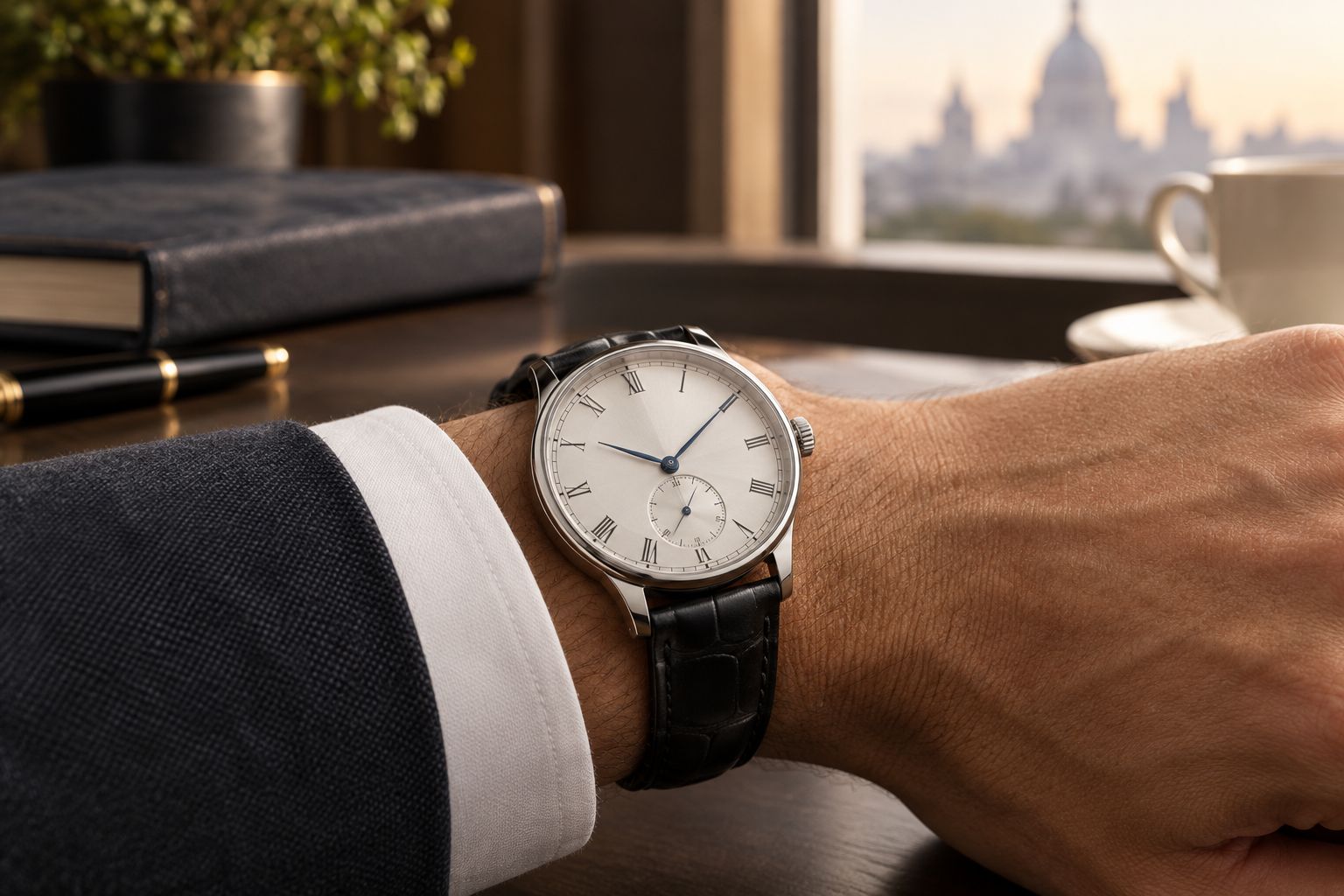
Confirm the reference and production era
Longines has run the Master Collection for over two decades, and dial layouts, case finishing and movement generations have shifted within that run. Confirming the exact production era prevents paying current pricing for an older, lower-spec reference.
- Locate the full reference number on the case back
- Match dial print style to the correct production window
- Check whether the reference is still in current production or discontinued
- Cross-reference against Longines' own model archive where available
- Ask the seller directly for the year of manufacture, not just "recent"
Weigh new against pre-owned
New Master Collection pieces come with full manufacturer backing; pre-owned pieces come with wider condition and pricing spread and, often, a shorter wait. Neither is automatically the better move — it depends on what you're optimising for.
- New: consistent condition, current reference, no service history questions
- Pre-owned: broader reference selection, including discontinued dial variants
- Pre-owned pricing spread is wider — condition grading does more work here than on new stock
- Warranty coverage differs meaningfully between new and pre-owned channels
- Ask specifically what condition grading standard the seller applies before you compare two listings
Budget for servicing over the ownership period
A mechanical watch is a maintenance commitment, not a one-time purchase. Most manufacturers recommend a full service every five to seven years, and a Master Collection chronograph or annual calendar will cost more to service than a three-hand model.
- Factor service cost into total ownership, not just purchase price
- Complications add cost and time to every service interval
- A documented service history adds resale confidence later
- Ask whether the movement has ever been serviced and by whom
Longines Master Collection vs the competitive set
| Watch | Best for | Movement | Key limitation |
|---|---|---|---|
| Longines Master Collection | Buyers who want in-house movement heft without JLC or Rolex Cellini pricing | Calibre L888, column-wheel chronograph on complicated refs | Water resistance capped at 30m on most references |
| Jaeger-LeCoultre Master Control | Collectors chasing manufacture finishing and a stronger resale ceiling | In-house JLC calibre | Meaningfully higher entry cost than Longines |
| Rolex Cellini | Buyers who want Rolex ownership in a dress case | Calibre 3132/3165 | Rolex has wound down new Cellini production — secondary market only |
| Omega De Ville | Buyers who want a co-axial escapement in a dress-leaning case | Co-axial calibre | Case proportions run slightly sportier than pure dress design |
Verdict: the Longines Master Collection is best for buyers who want manufacture-grade mechanics in a dress case without paying Jaeger-LeCoultre or Rolex Cellini prices. Buy it if in-house movement matters more to you than brand ceiling; look at Jaeger-LeCoultre instead if resale strength is the priority.
Browse the Longines Master Collection
See current listings authenticated for reference, movement and condition.
Common mistakes classic dress watch buyers make
- Oversizing the case. A 42mm Master Collection won't slide under a formal French cuff the way a 38.5mm or 40mm case will.
- Treating box and papers as a value proxy. A matching box tells you nothing about movement health, reference correctness or service history — none of which can be worn on the wrist.
- Skipping the service history question. Buyers focus on cosmetic condition and forget to ask when the movement was last serviced.
- Assuming every listing photo is enough. Dial shots alone don't confirm reference or movement authenticity — ask for case-back and movement images specifically.
- Comparing price without comparing complication. A three-hand Master Collection and an annual calendar Master Collection aren't the same purchase decision.
A 40mm case is the largest size that still reads as a genuine dress watch under a shirt cuff.
FAQ
What movement does the Longines Master Collection use?
The Longines Master Collection runs on the in-house Calibre L888 family, which carries a 64-hour power reserve on the L888.4 variant. Chronograph references use a column-wheel movement, a finishing detail typically found on far pricier watches.
Is the Longines Master Collection a good investment in 2026?
The Longines Master Collection is bought primarily for wear and manufacture quality rather than short-term resale speculation in 2026. Reference correctness, condition and documented servicing matter more to long-term value than any single spec.
What case sizes does the Longines Master Collection come in?
The Longines Master Collection is produced in 38.5mm, 40mm and 42mm cases. 40mm suits most wrists for daily formal wear, while 38.5mm is the more traditional dress proportion.
How water resistant is the Longines Master Collection?
Most Longines Master Collection references carry 30 metres of water resistance, which covers splashes and rain but not swimming or diving. That figure reflects the collection's dress-watch design brief rather than a sports-watch spec.
Longines Master Collection vs Jaeger-LeCoultre Master Control: which is better?
The Longines Master Collection wins on value for buyers who want in-house movement mechanics without a manufacture-tier price. Jaeger-LeCoultre Master Control wins on finishing depth and resale ceiling for buyers prioritising long-term collector status.
Is Longines part of the Swatch Group?
Longines is a Swatch Group brand, which is why the Master Collection can carry an in-house-developed movement at a lower price point than fully independent manufactures.
How do I authenticate a pre-owned Longines Master Collection?
Cross-check the case-back reference number against the dial print, inspect the movement through case-back photos, and confirm any service history with documentation. Independent authentication before purchase removes most of the guesswork.
Does the Longines Master Collection need its original box to be worth buying?
No. Reference correctness, movement condition and service evidence determine a Longines Master Collection's desirability, not whether the original box survived. A box cannot be worn and says nothing about how the watch runs.
One last thing
The detail most buyers miss: Master Collection chronograph references run a column-wheel movement, a construction method usually reserved for watches costing multiples more. That's a genuine mechanical upgrade hiding inside a watch priced well below manufacture-tier competitors — worth checking for specifically if you're choosing between a three-hand and a chronograph reference in 2026.


