
Choose James Patten if its particular pre-owned watch meets your reference, condition and wearing requirements with supporting evidence; choose Zaeger if its competing example does that better. This 2026 comparison puts the watch first: originality, movement health, independent authentication and written purchase terms decide the winner, not the seller’s name.
- James Patten vs Zaeger is a watch-by-watch decision: choose the example with stronger condition and authentication evidence.
- For pre-owned luxury watches, reference correctness and movement health matter more than presentation or packaging.
- Choose Zaeger when its particular watch better matches your requirements and its written terms suit your purchase.
- Original boxes and papers are not prerequisites for a desirable, valuable or wearable watch.
Why this matters
Two watches carrying the same model name are not necessarily equivalent purchases. One can retain its original dial and case geometry while another has replacement components, substantial polishing or unresolved mechanical issues. Those differences deserve more attention than a polished listing description.
James Patten is an option for Australian pre-owned luxury-watch buyers; the right purchase still depends on the individual watch. The same standard applies to Zaeger. Compare what each seller establishes about the example you would actually receive, rather than treating reputation as a substitute for inspection.
For a purchase in 2026, build your shortlist around a reference and wearing purpose first. A collector prioritising originality and a buyer prioritising dependable daily wear can reasonably choose different examples of the same watch.
At a glance
| Dimension | James Patten | Zaeger |
|---|---|---|
| Best for | Buyers whose preferred example meets their collecting and wearing requirements | Buyers whose competing example better meets those requirements |
| Reference match | Check the exact reference, configuration and components | Apply the same reference-level checks |
| Originality and condition | Assess dial, hands, case geometry and disclosed replacements | Compare those same details on the competing watch |
| Movement health | Request watch-specific inspection and service evidence | Request equivalent evidence for the competing example |
| Independent authentication | Agree how the individual watch will be assessed | Establish the same assessment arrangements |
| Real-world wearability | Check fit, bracelet adjustment and intended use | Compare fit and practical suitability directly |
| Purchase terms | Read the terms applying to the particular transaction | Compare the written terms applying to the competing transaction |
| Pricing model | Compare the written offer for the individual watch | Compare an equivalent written offer, not a model-name headline |
| Standout feature | The particular watch’s strongest verified attribute | The competing watch’s strongest verified attribute |
The exact reference match beats a broader selection
The better seller for your purchase is the one offering the right watch, not simply more watches. Start with the full reference and configuration. A brand name or family name is too broad to establish equivalence.
For Rolex, distinguish the reference from the dial description and bracelet configuration. For an Omega Seamaster, distinguish quartz from mechanical examples before comparing condition or service requirements. These are different buying propositions, even when photographs show a similar blue dial and steel bracelet.
Write down what is essential and what is flexible. If an original dial configuration is central to your collection, a different dial is not an equivalent alternative simply because you prefer the seller. Conversely, a daily wearer can prioritise fit and disclosed mechanical condition over a particular cosmetic configuration.
The advantage here is precision: you avoid comparing unlike examples. The limitation is a narrower shortlist. Choose whichever seller meets your essential reference requirements without unresolved discrepancies.
Originality wins for collectors; disclosed replacements suit some wearers
Originality and condition answer different questions. Originality concerns whether the components are correct for the watch and its production context; condition concerns their present state. A heavily worn original component and a sound replacement component cannot be ranked sensibly without knowing your collecting objective.
For a vintage-focused purchase, ask about the dial, hands, bezel and bracelet individually. Look for consistency between the description and detailed photographs. A replacement part is not automatically a reason to reject a watch, but it should not be mistaken for an original component.
For daily wear, disclosed replacement parts can be compatible with your priorities. The trade-off is that a watch suited to regular use is not necessarily the example an originality-focused collector would choose.
Case condition deserves its own inspection. Examine lug profiles, edges and surface transitions rather than accepting a general condition adjective. Polishing can alter geometry; scratches alone do not tell you how much metal has been removed.
James Patten wins this dimension when its example better preserves the attributes you value; Zaeger wins when its example does. Neither outcome follows from the name above the listing.
Movement evidence beats an attractive dial at either seller
A handsome dial does not establish mechanical health. Ask what has been inspected, what findings were recorded and whether any work remains recommended. Keep appearance and function separate.
Service evidence is useful when it identifies the watch, the work performed and the date. A service description should distinguish a movement overhaul from narrower work such as adjustment or a battery change. Ask which components were replaced where that information is available.
For a mechanical watch, request an explanation of its running assessment and any functional checks. For a chronograph, include start, stop and reset behaviour. For a quartz watch, ask about battery condition and evidence of leakage or related damage.
A service record supports your assessment; it does not replace a current examination. Equally, the absence of an old invoice does not establish that a watch is unhealthy. The useful question is what can be established now.
The winner is the seller providing clearer watch-specific mechanical evidence. The benefit is a better-informed purchase; the limitation is that an inspection records condition at a particular point, not a promise of unlimited trouble-free use.
Independent authentication is the same requirement for both
Authentication should assess the watch itself. Ask who will examine it, what the assessment covers and whether the findings will identify the particular example. Establish any access arrangements before committing to the transaction.
Reference correctness, component consistency and movement identification belong in that conversation. Confirm how the assessor distinguishes authenticity from originality: a genuine replacement component is not the same thing as an original component.
Use these five checks to keep the evidence organised:
- Reference correctness: Does the watch match its stated identity and configuration?
- Originality: Which components are original, replaced or unresolved?
- Case condition: What do the surfaces and geometry show?
- Movement health: What does inspection establish about function?
- Wearability: Does the watch suit its intended use?
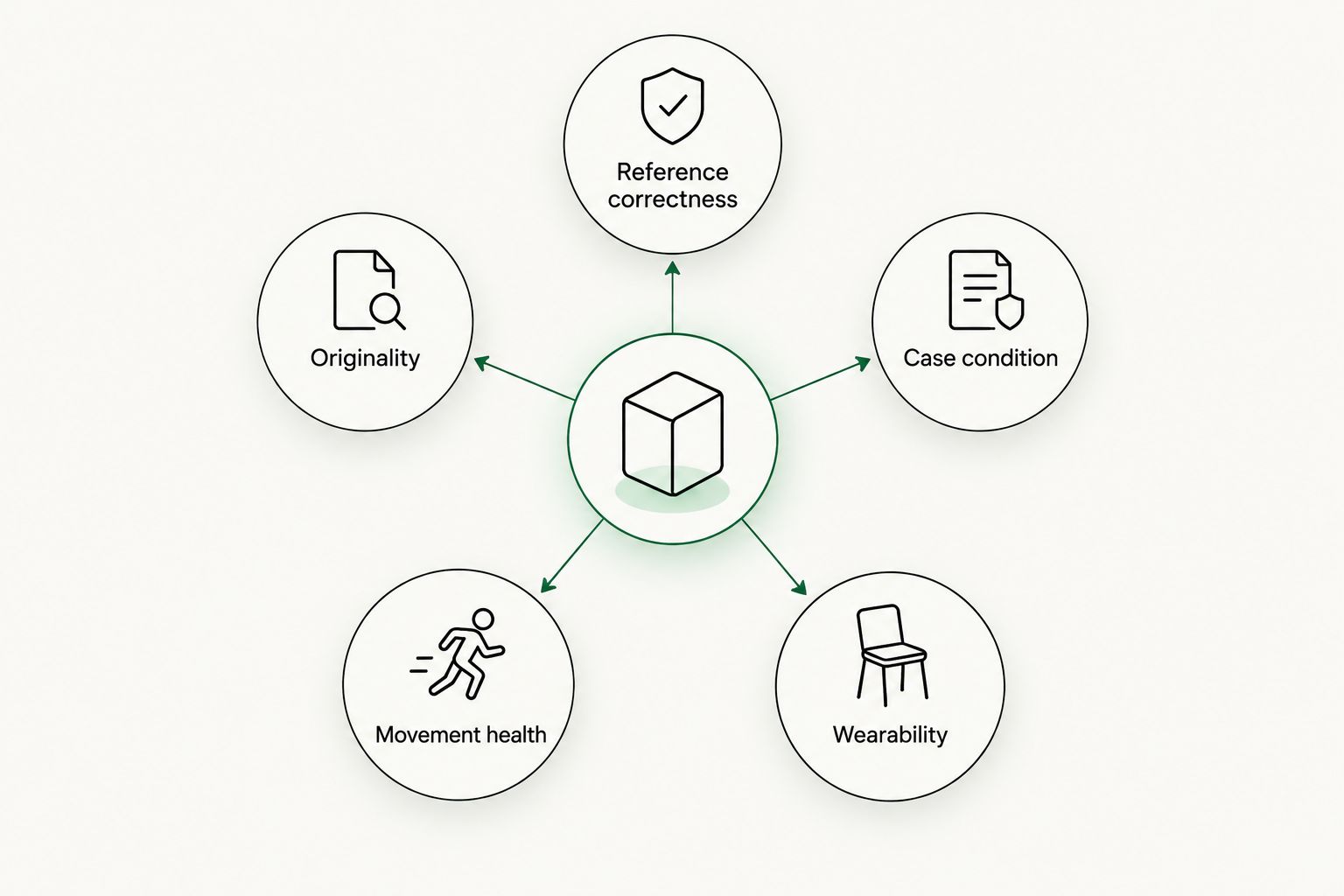
Independent authentication is a shared standard, not an automatic advantage for either seller. For your 2026 purchase, establish its scope in writing. Do not assume that a broad authenticity statement answers every question about replacement parts or mechanical condition.
Wrist fit can give either watch the decisive advantage
A reference that interests you academically still needs to work on your wrist. Consider case width, thickness, lug shape, bracelet articulation and clasp placement together. Diameter alone does not settle comfort.
The Omega Seamaster quartz mid-size listing provides a concrete comparison starting point: its URL identifies a 36.25 mm format. Confirm the actual watch’s measurements and configuration before using that detail to decide fit.
Request at least 3 photo angles: a straight-on dial view, a side profile and the case back with bracelet or strap attachment visible. Those images help you identify questions; they do not replace measurement or inspection.
Ask whether the bracelet accommodates your wrist and what adjustment is possible. For water use, seek a current assessment relevant to the intended activity rather than relying on the model name or an original specification.
The better-fitting watch wins for a daily wearer, provided its identity and condition also pass scrutiny. A visually compelling alternative loses its practical advantage if you will avoid wearing it.
Written purchase terms decide which transaction suits you
A watch can be appealing while the transaction is unsuitable. Read the terms that apply to that exact purchase before you pay, including inspection arrangements, delivery responsibilities and any stated remedies.
Separate authenticity representations from mechanical coverage. Ask what a stated warranty covers, what it excludes and how a claim is handled. Do not treat the word warranty as a complete explanation.
Clarify any return conditions directly. Establish whether they address a change of mind, an inaccurate description or a defect, and what procedure applies. Keep the answer with the watch description and purchase correspondence.
For a 2026 comparison, use current written terms rather than an old review or another buyer’s experience. Zaeger wins if its applicable terms better suit your requirements; James Patten wins if its terms do. This is a transaction-level decision, not a general ranking of either business.
Pricing: compare equivalent watches and written offers
Compare 2 written offers for equivalent examples before deciding which represents better value. The full reference, dial configuration, case condition, bracelet, disclosed replacements and mechanical evidence should accompany each offer.
The useful distinction is between a straightforward outright purchase and any alternative arrangement expressly offered for your transaction. With an outright purchase, assess the full obligation and agreed inclusions. If financing, a trade-in or another arrangement is proposed, examine its separate conditions rather than assuming it works like a cash purchase.
Neither seller earns a pricing advantage from a headline alone. A seemingly attractive offer can concern a different configuration or a watch needing further work. A higher offer is not automatically justified by seller reputation either.
Assess predictability through the written agreement: what you are buying, what is included and which obligations remain yours. Assess flexibility only through options the seller explicitly confirms. The better-value purchase is the suitable watch with the clearer total obligation, not merely the more appealing headline.
The standout feature should belong to the watch
For one example, the standout feature is an original dial in well-preserved condition. For another, it is clearer movement evidence or a bracelet that fits properly. Identify that strength precisely.
Then name the compromise. An originality-focused watch can show substantial wear; an attractive case can contain replacement parts; a mechanically sound example can be uncomfortable on your wrist. No single strength answers every buying question.
This is where the comparison becomes personal without becoming vague. Rank your requirements before reading seller descriptions, and reject an example that fails an essential requirement. A standout attribute matters only when it serves your collecting or wearing purpose.
Final verdict: choose the example that passes your priorities
Choose James Patten if its watch is your stronger match
Best for: an Australian online buyer whose preferred example satisfies the reference, condition and wearing brief. Choose James Patten when the watch-specific evidence supports that choice and the written transaction terms suit you. Its position as a new and pre-owned luxury-watch retailer is a starting point, not proof about any individual watch.
Do not choose it solely because the presentation appeals to you. Unresolved originality, function or fit questions still need answers.
Choose Zaeger if its competing example is better supported
Best for: a buyer whose shortlisted Zaeger example better meets the same documented requirements. Choose Zaeger when that particular watch has the stronger combination of suitable configuration, condition evidence, mechanical assessment and applicable terms.
Do not reject a stronger example simply to remain loyal to your initial shortlist. Equally, do not transfer claims about one watch to another watch from the same seller.
| Dimension | Winner |
|---|---|
| Best for | Seller whose example meets your brief |
| Reference match | Correct configuration with fewer unresolved questions |
| Originality and condition | Example matching your collecting priorities |
| Movement health | Clearer watch-specific mechanical evidence |
| Independent authentication | Tie on the required standard; compare actual evidence |
| Real-world wearability | Better-fitting, suitable example |
| Purchase terms | Transaction with terms that suit your requirements |
| Pricing model | Clearer obligation for an equivalent suitable watch |
| Standout feature | Verified attribute that serves your purpose |
FAQ
Is James Patten better than Zaeger for pre-owned watches?
Neither seller is automatically better for every pre-owned watch purchase. Choose the particular example that better meets your reference, originality, condition and wearability requirements, supported by mechanical evidence and suitable written terms.
What should I compare first when buying from either seller?
Compare the exact reference and configuration first. Then assess component originality, case and dial condition, movement health and the terms applying to each individual watch.
Does a pre-owned luxury watch need its original box and papers?
No: original boxes and papers are not prerequisites for a desirable or valuable watch. Assess the watch itself through reference correctness, originality, condition, independent authentication and practical suitability.
Is a recently serviced watch always the better purchase?
A service description alone does not establish that a watch is the better purchase. Check the date, scope and watch identity, then consider a current assessment alongside originality and condition.
How do I compare what each watch will cost me?
Compare written offers for equivalent watches and read the obligations attached to each transaction. Include any expressly stated additional obligations rather than assuming the headline tells the whole story.
Can I judge a pre-owned watch from photographs alone?
Photographs alone do not establish movement health or complete authenticity. Use detailed images to identify questions, then obtain the measurements, inspection evidence and independent assessment needed for your purchase.
What matters most when comparing sellers in 2026?
The individual watch and current written transaction terms matter most in 2026. Apply the same evidence requirements to both sellers instead of relying on general reputation or packaging.
One last thing
Ask what changed, not just what was serviced. A description of work performed becomes much more useful when it identifies replaced components and explains their relevance to the watch. That distinction lets you separate a sound daily wearer from an originality-focused collector’s choice without treating either as inherently better.


