
Choose James Patten if you want an Australian retailer selling both new and pre-owned luxury watches; choose Watchfinder if your search centres on a specialist pre-owned watch retailer. In 2026, the deciding factor should be the individual reference, its condition and the evidence behind it—not a blanket ranking of the sellers.
- James Patten vs Watchfinder: choose an Australian new-and-pre-owned retailer or a specialist pre-owned watch retailer.
- Watchfinder suits a pre-owned-focused search; compare the exact reference rather than the collection name alone.
- Originality, movement health and independent authentication matter more than packaging.
- Choose the individual watch with stronger evidence and the right fit, not the more familiar retailer name.
Why this matters
A pre-owned Rolex Datejust is not interchangeable with every other Datejust carrying the same reference. Dial configuration, case preservation, bracelet condition and replacement components all affect what you are buying. A polished case and a freshly serviced movement also answer different questions: appearance is not mechanical health.
The useful question in 2026 is therefore narrower than which retailer is better. Which seller can substantiate the particular watch you want, in the condition you are prepared to accept? Start with the buying model, then judge the actual example.
At a glance
| Dimension | James Patten | Watchfinder |
|---|---|---|
| Best for | Australian buyers considering new and pre-owned luxury watches | Buyers concentrating on pre-owned luxury watches |
| Buying focus | Watches alongside fine jewellery | Specialist pre-owned watch retail |
| Reference hunting | Start with an individual example that matches your brief | Start with a pre-owned reference-led search |
| Condition and originality | Assess the individual case, dial, hands and bracelet | Apply the same component-level assessment |
| Authentication | Request evidence specific to the watch | Request evidence specific to the watch |
| Real-world wearability | Judge the reference, dimensions and fitted bracelet or strap | Judge the reference, dimensions and fitted bracelet or strap |
| Standout distinction | Australian retail context with new and pre-owned options | A buying focus centred on pre-owned watches |
| Pricing model | Individual-watch retail purchase; compare the full written offer | Individual-watch retail purchase; compare the full written offer |
The table separates a verified difference in retail focus from matters that require watch-specific evidence. It does not assign a winner on warranty, returns, servicing or delivery: those belong in the written terms for your proposed purchase.
James Patten suits a new-and-pre-owned Australian shortlist
James Patten is best for Australian luxury-watch buyers comparing new and pre-owned pieces through an Australian retailer. That is a useful starting point when you have not decided whether your next purchase should be a contemporary watch or an older example.
The distinction is about scope, not an automatic quality advantage. A new watch and a pre-owned watch require different questions. For the pre-owned example, you need to establish originality, wear and mechanical condition; for either purchase, you need an accurate reference and clear transaction terms.
The limitation is equally clear: the retailer's identity does not establish the suitability of every watch. An attractive Panerai or Cartier still needs to satisfy your requirements for size, operation and condition. Do not substitute a preferred seller for a defined buying brief.
A useful brief names the reference or collection, acceptable materials, intended use and any non-negotiable condition requirements. “A steel everyday watch with an easily adjustable bracelet” is more useful than “something collectible”. It gives either seller a concrete standard to answer.
Watchfinder suits a search centred on pre-owned watches
Watchfinder is the better starting point when you specifically want a specialist pre-owned watch retailer. That focus is relevant if you have already ruled out buying new and want to organise your search around an existing reference.
Its advantage here is the match between the retailer's specialism and your brief—not a claim that every example is better preserved or more original. A specialist label cannot resolve whether a particular dial is correct, a case has been heavily refinished or a movement needs attention.
The corresponding limitation is that a pre-owned-focused search still demands item-by-item judgement. Two examples of a familiar reference can differ substantially in the details that matter to a collector. Treat a listing as the beginning of your assessment, not its conclusion.
For a reference-led buyer, write down the exact configuration before comparing sellers. Include the dial, bezel, case material and bracelet or strap. Otherwise, a search for the same model name can turn into a comparison of quite different watches.
Neither seller wins on condition without examining the watch
Condition is an individual-watch verdict, not a retailer-wide verdict. For a 2026 purchase, ask for photographs that reveal the watch rather than simply presenting it attractively: case sides, lug profiles, dial, hands, clasp and bracelet deserve separate attention.
Start with reference correctness. Does the case reference correspond with the stated model and configuration? Then separate originality from condition. An original dial with visible ageing and a replacement dial in cleaner cosmetic condition are different collecting propositions; neither description should be concealed behind a broad condition adjective.
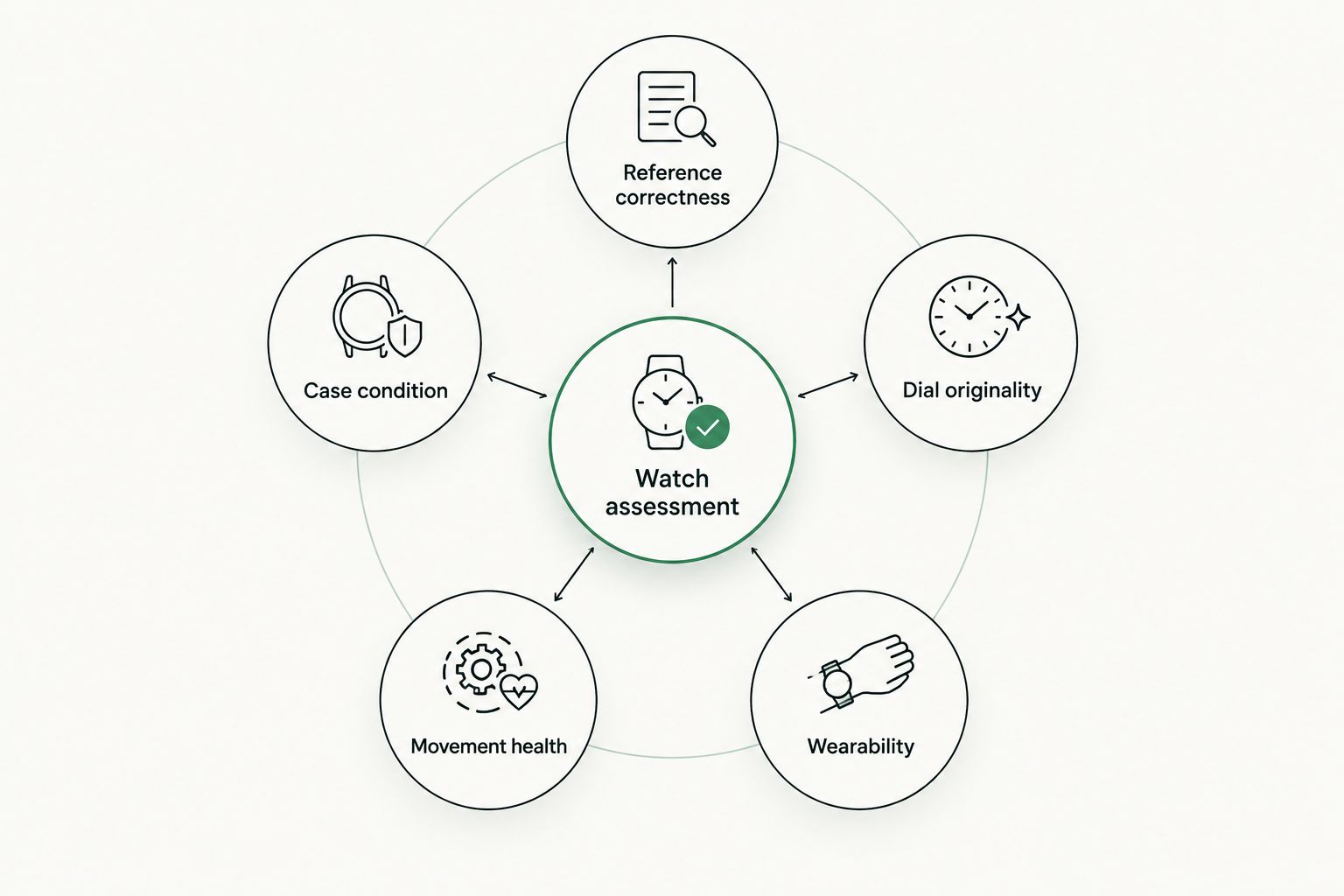
Use these five headings to structure your assessment:
- Reference correctness: establish exactly which watch and configuration you are considering.
- Case condition: examine shape, edges, surface wear and signs of refinishing.
- Dial originality: distinguish original components, replacements and refinishing.
- Movement health: request a meaningful account of operation and inspection.
- Wearability: assess how the actual watch fits and functions for you.
Ask what a condition grade actually covers. “Very good” does not, by itself, explain whether a dial has been restored or a bracelet has substantial wear. The guide to luxury watch condition grading provides a useful framework for those questions.
Winner: neither by default. Prefer the example whose description and photographs resolve the details important to you.
Both need watch-specific authentication and service evidence
Authentication and servicing answer different questions. Authentication concerns whether the watch and its components are what they are represented to be; servicing concerns mechanical work and condition. A service statement is not a complete account of originality.
Ask either seller to distinguish between an inspection, a repair and a full movement service. Request the date and scope of any work being relied upon, together with supporting evidence where available. “Recently serviced” becomes useful only when you understand what was done.
For a chronograph, ask about starting, stopping and resetting as well as ordinary timekeeping. For an automatic watch, include winding and setting behaviour. These are questions about the specific example, not claims that one movement type or retailer is inherently more reliable.
Independent authentication adds a separate basis for your decision. Before committing, establish whether an appropriately qualified independent specialist can inspect the watch and how that inspection fits the agreed transaction terms. Do not assume either seller offers a particular arrangement.
Winner: an honest tie until the evidence separates the examples. Strong documentation supports a purchase; a familiar seller name does not replace it.
Neither seller changes how a reference wears
The watch that looks most compelling in a photograph is not necessarily the watch you will enjoy wearing. Case diameter is a starting point, not a complete fit assessment. Thickness, lug span, case curvature, weight and bracelet adjustment all deserve attention.
Concrete examples make the distinction useful. The supplied product information identifies a Rolex Datejust example at 36 mm, a Bulova Sutton 97A169 at 43 mm, and an IWC Aquatimer IW376805 at 44 mm. These dimensions describe different watches; they do not establish a universal wrist-size rule.
A smaller case is not automatically more comfortable, and a larger case is not automatically unsuitable. Ask how the lugs sit relative to your wrist and whether the clasp can be centred. For a rectangular Cartier, evaluate the case proportions rather than treating its width as equivalent to a round watch's diameter.
Practical requirements should also shape your shortlist. If you intend to swim, ask for evidence of current water-resistance testing appropriate to that use. An original depth rating describes a design specification, not proof of the present condition of an older watch's seals.
Winner: neither seller. Choose the reference and individual example that meet your wearing requirements, then choose the transaction that supports that choice.
Pricing: compare the whole purchase, not an isolated figure
Both options involve buying an individual watch at retail rather than paying a subscription for access. The useful comparison is between complete written offers for sufficiently similar examples. A headline figure cannot tell you whether the watches have comparable originality, condition or service needs.
For your 2026 shortlist, separate the following before making a decision:
- The precise reference and configuration being offered.
- Any disclosed replacement components or cosmetic restoration.
- Service work completed and supporting evidence where available.
- Mechanical work or strap replacement still required.
- Delivery, insurance and applicable tax treatment for your transaction.
- Written warranty, return and dispute terms.
Keep foreseeable ownership costs separate from the purchase itself. A watch needing attention is not directly comparable with an otherwise equivalent example whose required work has been completed and documented. Equally, an undocumented service claim should not be treated as proof that future maintenance is unnecessary.
Do not assume the same transaction arrangements apply to every location or watch. Establish the contracting seller, dispatch location and applicable terms before paying. An Australian retailer's location is relevant context, but it does not establish a specific delivery promise or service policy.
Pricing winner: the clearer, like-for-like offer. Predictability comes from defined obligations and disclosed condition, not from the retailer's name.
Final verdict: choose the buying route, then the individual watch
Choose James Patten if you want an Australian retail starting point
Best for: the Australian buyer considering both new and pre-owned luxury watches. Choose this route when that scope matches your brief, then require reference-specific answers on condition, originality and mechanical health.
The limitation is that Australian retail context alone does not settle the purchase. Proceed only when the individual watch and written terms meet your requirements. A preferred buying location cannot compensate for unresolved questions about the example itself.
Choose Watchfinder if your brief is specifically pre-owned
Best for: the collector conducting a pre-owned reference-led search. Choose Watchfinder when a specialist pre-owned retail focus is the buying route you want, and the particular example stands up to your assessment.
The limitation is the same discipline required of any pre-owned purchase: specialist positioning does not make component-level questions unnecessary. Ask for evidence rather than inferring condition, originality or service scope from the seller's reputation.
One-glance scorecard
| Dimension | Winner |
|---|---|
| Australian retailer with new and pre-owned scope | James Patten |
| Specialist pre-owned retail focus | Watchfinder |
| Exact-reference suitability | The example matching your written brief |
| Condition and originality | The example with stronger supporting evidence |
| Authentication and movement health | Tie until watch-specific evidence separates them |
| Real-world wearability | The reference and fit, not the seller |
| Standout retail distinction | Australian mixed scope versus pre-owned specialism |
| Pricing comparison | The clearer like-for-like written offer |
FAQ
Is James Patten better than Watchfinder for Australian buyers?
James Patten suits Australian buyers seeking an Australian retailer with new and pre-owned luxury watches; Watchfinder suits a search focused on specialist pre-owned retail. Choose between individual examples using reference correctness, originality, condition and written transaction terms.
Which retailer should I choose for a pre-owned Rolex Datejust?
Choose the retailer offering the Datejust example that best satisfies your reference, condition and wearability requirements. Examine the dial, case, hands, bracelet and movement evidence rather than treating all watches with the same reference as equivalent.
Does a luxury watch need its original box and papers?
No: original packaging is not a substitute for assessing the watch itself. Reference correctness, originality, condition, movement health and independent authentication provide a more useful basis for your purchase.
Does a serviced watch automatically have original parts?
No: servicing and originality are separate matters. Ask what work was completed and whether the dial, hands, crown or other components were replaced.
How should I compare the cost of buying from either retailer?
Compare complete written offers for equivalent references and condition. Include disclosed work still required, delivery arrangements, applicable tax treatment and the terms governing the purchase.
Can I swim with a pre-owned dive watch?
Base that decision on current testing appropriate to your intended use, not the original depth rating alone. Ask for evidence concerning the individual watch before exposing it to water.
What should I check before buying a luxury watch online in 2026?
Confirm the exact reference, component disclosures, condition photographs and movement or service evidence. Then establish independent inspection arrangements where agreed and read the written transaction terms before paying.
One last thing
Before your next purchase in 2026, ask one precise question: What has been replaced or refinished on this watch? It separates originality from cosmetic presentation and gives you a practical basis for deciding what you value.
A replacement component is not automatically a reason to reject a watch. An unexplained component is a reason to keep asking questions.


