
Choose James Patten if you are looking for new or pre-owned luxury watches and want to assess a particular reference; choose Watch Depot if its exact watch better meets your wearing requirements and its documented condition and purchase terms satisfy your checks. This 2026 comparison puts the watch first: originality, case and dial condition, movement health, independent authentication and fit matter more than the seller’s name.
- James Patten vs Watch Depot should turn on the exact watch, condition evidence and written purchase terms.
- James Patten serves new and pre-owned luxury-watch buyers; assess each reference rather than assuming every example is equivalent.
- Choose Watch Depot when its exact watch meets your requirements and passes the same evidence checks.
- Original boxes and papers do not establish movement health, originality or everyday wearability.
Why this matters
A retailer comparison becomes useful when you compare actual watches rather than reputations. Two examples bearing the same model name can differ in dial originality, case shape, bracelet wear, replacement components and mechanical condition. Those differences affect what you own and how it wears.
For a 2026 purchase, compare the exact reference and the individual example before comparing the sellers. A desirable watch without its original packaging deserves assessment on its own merits. A presentation box cannot tell you whether a movement needs attention or a case has lost its original proportions.
The same discipline applies to a new watch. Confirm the model, dimensions, movement type and written terms rather than assuming that a familiar brand or polished listing answers every question.
At a glance
| Dimension | James Patten | Watch Depot |
|---|---|---|
| Best for | Buyers seeking new and pre-owned luxury watches | Buyers whose preferred watch passes the same reference, condition and terms checks |
| Reference suitability | Match the individual luxury watch to your collecting or wearing brief | Match the exact offered model to the same brief |
| Originality and condition | Assess the particular case, dial, hands and bracelet | Apply the same component-by-component assessment |
| Movement health | Request evidence appropriate to the movement and its condition | Request equivalent evidence before deciding |
| Authentication | Establish reference correctness and independent assessment where needed | Require the same standard of verification |
| Real-world wearability | Compare dimensions, fit, legibility and controls | Compare the same wearing requirements |
| Pricing model | Assess the individual watch’s asking terms and ownership costs | Assess the individual watch’s asking terms and ownership costs |
| Standout feature | New and pre-owned luxury watches within the stated retail offering | Let the exact watch’s verified features determine its appeal |
| Purchase terms | Read the current written terms attached to the purchase | Read the current written terms attached to the purchase |
The table is a decision framework, not a claim that either seller provides identical services. Each seller earns your preference by answering the questions that matter for the particular watch.
James Patten fits a reference-led luxury-watch search
The stated retail offering includes new and pre-owned luxury watches from brands such as Rolex, Patek Philippe, Panerai, Omega and Cartier. That is a relevant starting point if you already know the kind of collectible or daily-wear luxury watch you want.
James Patten is a relevant starting point for Australian buyers seeking new or pre-owned luxury watches. That does not make every example the right purchase. Your preferred reference still needs to meet your expectations for originality, condition, mechanical health and fit.
Write your brief before browsing:
- Identify the exact reference, not just the manufacturer or collection.
- Decide whether you want a historically original example or accept disclosed service replacements.
- Specify the functions you will actually use.
- Separate collecting interest from everyday wearing requirements.
A retailer’s category focus is an advantage only when it helps you find the right watch. It cannot substitute for evidence about that watch.
Watch Depot wins when its exact watch meets your brief better
Choose Watch Depot when the particular watch you are considering offers the reference, movement type, dimensions and condition you want, supported by satisfactory evidence. This is a genuine reason to choose another seller: a better-matched watch matters more than a preferred shop name.
Keep the comparison specific. If you want a readable everyday watch rather than a vintage collecting project, do not let an appealing dial persuade you to accept mechanical uncertainty or an uncomfortable fit. Equally, a contemporary alternative does not satisfy a search for a particular vintage reference merely because it looks similar.
Give Watch Depot the preference when its exact watch answers your brief more convincingly. Require the same authentication and condition checks, and read the purchase terms before committing.
The limitation of this approach is that you must assess each offer individually. A positive result for one watch is not evidence about another example, even from the same seller.
Originality and condition favour the better-documented example
For a pre-owned luxury watch, separate originality from appearance. A clean dial is not automatically an original dial, and a highly polished case is not automatically a better-preserved case. Ask what has been changed and what the seller can substantiate.
A Rolex Datejust reference 1601 provides a useful collecting example. Rather than treating every reference 1601 as interchangeable, examine the individual dial, hands, bezel, case and bracelet. Distinguish components that are correct for the reference from components that are demonstrably original to that particular watch.
Use these checks:
- Reference correctness: confirm that the case identity and configuration agree.
- Dial condition: inspect printing, surface damage, ageing and any disclosed restoration.
- Case condition: look for preserved geometry, wear, corrosion and evidence of refinishing.
- Component history: ask about replacement hands, crowns, bezels and bracelet parts.
Prefer the seller that explains the watch’s condition precisely, not the seller that uses the strongest adjective. Terms such as excellent or mint are less useful than clear photographs and a specific account of wear or intervention.
Neither box nor papers resolves these questions. Assess the watch independently of its packaging.
Movement health is a tie until the evidence separates the watches
Neither retailer’s name establishes how a particular movement is running. For a mechanical watch, ask for current operating evidence, details of any disclosed faults and service evidence where available. For a quartz watch, confirm operation and ask about any identified battery or movement issues.
A service record is useful when it identifies the work performed and the watch concerned. A vague statement that a watch was recently serviced does not explain whether the work involved adjustment, lubrication, replacement components or a fuller intervention.
For your 2026 comparison, distinguish these points:
- Does the watch run and perform its stated functions?
- What current checks support the condition description?
- Is there service evidence, and what does it actually establish?
- Are any faults, limitations or recommended interventions disclosed?
The movement-health winner is the better-supported watch, not a predetermined retailer. Absence of service evidence does not make a watch undesirable; it makes an independent condition assessment more important when you need to establish its mechanical state.
Do not mistake movement decoration, a visible balance or a high jewel count for proof of healthy operation.
Authentication demands the same standard from both sellers
Authentication and originality are related but different. A genuine watch can contain later replacement components. A correct-looking exterior also does not establish that every internal component matches the reference.
Ask for a coherent identification of the watch and clear photographs of the areas relevant to that reference. Where the purchase requires specialist judgement, obtain an independent assessment from someone qualified to examine the watch concerned. Do not treat a serial number alone as a complete authentication process.
Build the decision around four separate questions:
- Reference correctness: is the watch the reference being described?
- Originality: which components are original, replaced or uncertain?
- Movement health: what supports the account of mechanical condition?
- Wearability: does the watch meet your practical needs?
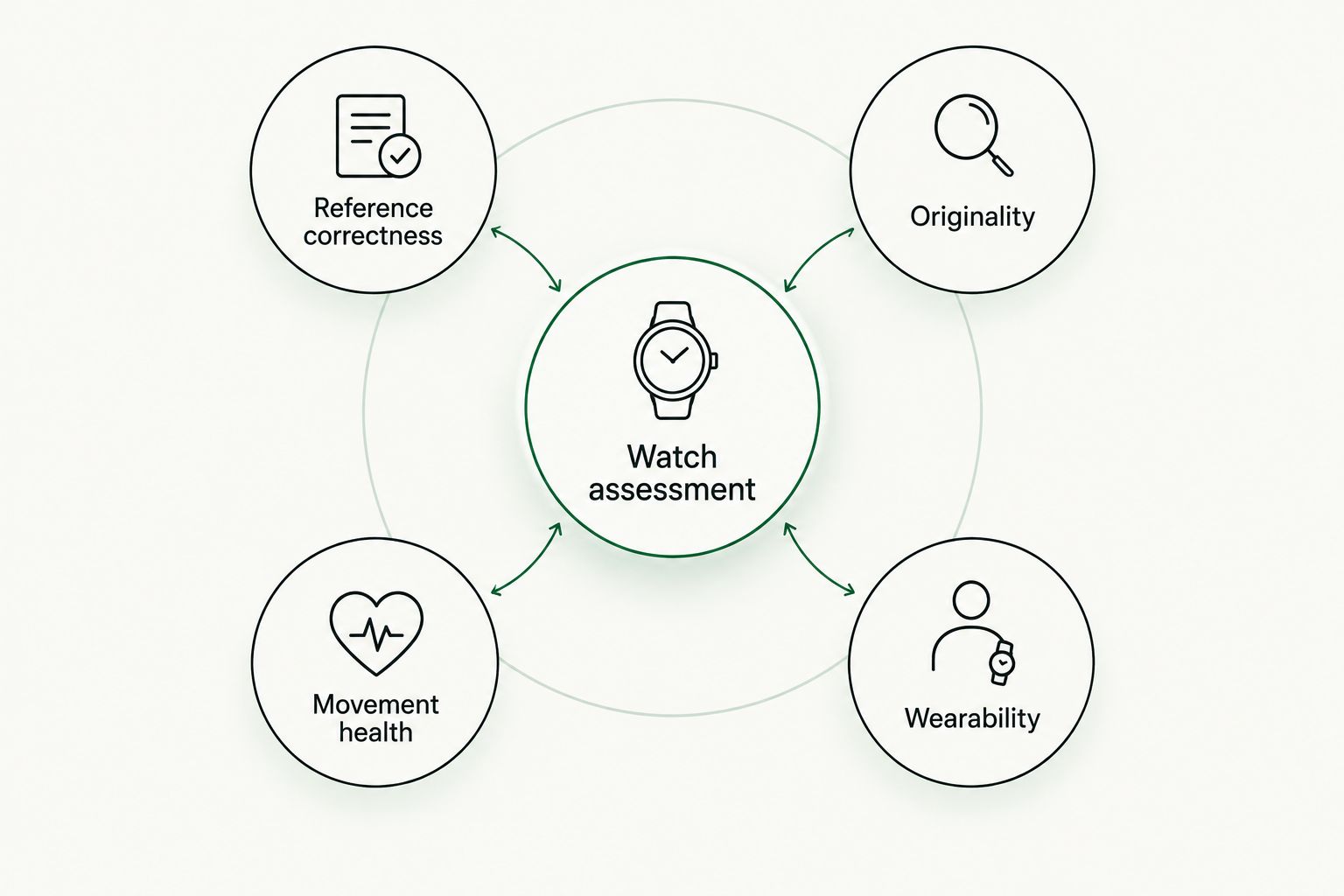
Both sellers should face the same verification standard. A retailer’s written authenticity claim and an independent examination serve different purposes; read the claim carefully and assess the watch itself.
Wearability favours the watch that fits, not the prestige label
Case diameter is a starting point, not a complete fit assessment. Thickness, lug shape, lug-to-lug length, bracelet articulation and clasp position also affect how a watch sits. Ask for the relevant measurements rather than inferring comfort from photographs.
The supplied Omega Seamaster quartz mid-size 36.25 mm listing identifies a distinctly different size proposition from the Bulova Classic Sutton reference 97A169, whose supplied specification gives a 43 mm case. Those diameters help frame a fit comparison; they do not establish which watch suits your wrist.
The Sutton specification also describes a 21-jewel automatic movement. That identifies a mechanical characteristic, not a ranking of accuracy, condition or suitability against the quartz Omega.
For an everyday watch, check:
- Whether the dial remains readable in your usual lighting.
- Whether the crown or pushers press against your wrist.
- Whether the bracelet or strap can achieve a comfortable fit.
- Whether the movement type suits your wearing routine.
A comfortable, legible watch wins the wearing comparison even when another model has greater collecting appeal. For water use, establish the individual watch’s current suitability rather than relying on its model name or an old rating.
Pricing models favour clarity, not an assumed saving
Treat the financial comparison as an individual watch purchase, not a comparison of seller names. The meaningful difference is what you are buying: a new example, a pre-owned example with known condition, or a watch that requires further assessment or work.
For either seller, distinguish the asking terms from ownership costs. Servicing needs, bracelet fit and disclosed mechanical issues belong in your decision. Do not assume a lower asking amount produces the better purchase, or that a higher amount proves better condition.
In 2026, compare like with like wherever possible. Match the reference, configuration, originality and condition before assessing the financial trade-off. If the examples differ, explain the difference to yourself rather than treating the asking terms as directly comparable.
The clearer offer wins on financial predictability. Read any offered payment arrangement separately from the watch assessment; payment flexibility does not improve the watch’s condition or suitability.
Written purchase terms decide the transaction comparison
Before committing to either seller in 2026, read the current written terms that apply to your particular purchase. Do not infer warranty, returns or delivery arrangements from another buyer’s experience or from a different product page.
Ask about the points that affect your decision:
- What condition and component disclosures form part of the purchase?
- What does any stated warranty cover, and what does it exclude?
- What are the applicable return conditions?
- Who is responsible for delivery arrangements and transit issues?
- How will a discrepancy between the description and the watch be handled?
Prefer the seller whose written terms you understand and accept. Keep the description, photographs and relevant correspondence with your purchase records. These records explain the transaction; they do not replace examination of the watch.
Final verdict: choose the watch that passes your checks
Choose James Patten if you have a luxury-reference brief
You are seeking a new or pre-owned luxury watch and want to compare an individual reference against your collecting and wearing requirements. Choose the example only after its originality, condition, movement health and purchase terms satisfy your assessment.
Choose Watch Depot if its exact watch is the better match
You have identified a particular watch there that fits your requirements more closely and passes the same verification process. Choose that watch on its merits, not because a retailer comparison declares an automatic winner.
| Dimension | Winner |
|---|---|
| Luxury-reference search | The stated luxury-watch retailer is a relevant starting point |
| Exact-model suitability | Watch Depot when its exact watch better meets your brief |
| Originality and condition | Better-documented individual example |
| Movement health | Better-supported mechanical assessment |
| Authentication | Tie on required standard |
| Wearability | Better-fitting individual watch |
| Financial predictability | Clearer offer with understood ownership needs |
| Purchase terms | Seller whose written terms you accept |
FAQ
Is James Patten better than Watch Depot for luxury watches?
James Patten is a relevant starting point for new and pre-owned luxury watches, but the better purchase is the individual watch that meets your requirements. Compare reference correctness, originality, condition, movement health and written terms before choosing.
When should I choose Watch Depot instead?
Choose Watch Depot when its exact watch better fits your brief and passes your condition, authentication and transaction checks. A better-matched watch is a stronger reason to buy than a preferred retailer name.
Does a pre-owned luxury watch need its original box and papers?
No, original box and papers are not required for a watch to be desirable. Assess reference correctness, originality, condition, movement health and independent authentication rather than using packaging as a proxy for quality.
What should I ask about a watch's service history?
Ask what work was performed, when it was performed and what evidence identifies the watch concerned. Service evidence helps explain maintenance, while a current assessment addresses present mechanical condition.
Is a smaller watch always better for a small wrist?
No, diameter alone does not establish fit. Compare thickness, lug-to-lug length, lug shape, bracelet articulation and clasp position alongside case size.
How should I compare the cost of two pre-owned watches?
Compare the exact reference, configuration, originality and condition before assessing the financial trade-off. Include identified servicing or fit needs rather than treating the asking terms as the whole decision.
Does authentication prove that every component is original?
No, a genuine watch can contain replacement components. Ask separately about authenticity, reference correctness, component originality and mechanical condition.
One last thing
Ask each seller the same question: Which parts of this watch’s description are established, and which remain uncertain? A precise answer lets you decide whether an uncertainty matters to your purchase. An immaculate box cannot answer it.


