
Choose James Patten if its exact Rolex Datejust 1601 or other shortlisted watch meets your originality, condition and wearing requirements; choose Watch Craze if its competing example provides stronger watch-specific evidence against those same requirements. In 2026, the deciding difference is the individual watch and the terms attached to it, not a blanket ranking of the sellers.
- James Patten vs Watch Craze: choose the watch with stronger evidence of reference correctness, condition and movement health.
- James Patten suits Australian luxury-watch buyers considering new and pre-owned pieces; assess each example individually.
- Choose Watch Craze when its competing example better satisfies your documented buying requirements.
- Original packaging does not establish originality, mechanical health or real-world wearability.
Why this comparison matters
Two watches bearing the same model name are not automatically equivalent purchases. A different dial, replacement component, altered case or unresolved mechanical issue changes what you are buying. Compare the watches first.
For an Australian buyer comparing sellers in 2026, a useful shortlist records the exact reference, material, dial configuration and disclosed condition beside each example. Separate collectible originality from practical suitability: an honestly disclosed replacement part can suit a wearer while failing an originality-focused collector's brief.
Buy the watch that withstands scrutiny, not the seller name that sounds most reassuring. The following comparison uses decision thresholds rather than assuming either retailer wins every category.
At a glance
| Dimension | James Patten | Watch Craze |
|---|---|---|
| Best for | Buyers considering its new and pre-owned luxury watches and fine jewellery | Buyers whose competing example better meets their specific watch brief |
| Reference correctness | Choose when the offered configuration is clearly established | Choose when the competing configuration is better established |
| Case and dial condition | Wins when photographs and disclosures support your condition requirements | Wins when its example has the condition you prefer, supported by evidence |
| Movement health | Choose when watch-specific findings support the intended use | Choose when the competing example has stronger mechanical evidence |
| Independent authentication | Apply the same independent assessment standard | Apply the same independent assessment standard |
| Real-world wearability | Choose the example that fits your wrist and routine | Choose the example that fits your wrist and routine |
| Standout feature | New and pre-owned luxury watches alongside fine jewellery | Judge the particular watch's distinguishing qualities, not assumed seller features |
| Purchase structure | Evaluate the written purchase terms for the exact watch | Evaluate the written purchase terms for the exact watch |
Your exact reference determines the better starting point
For a reference-led collector, the winning seller is the one offering the correct configuration with convincing evidence. Establish what you want before comparing descriptions: model family, reference, case material, dial style, bracelet or strap, and tolerance for replacement components.
Consider a Rolex Datejust 1601. The reference alone does not settle the appeal of a particular example. A collector seeking a linen dial needs to assess that dial's correctness and condition, rather than accept any Datejust carrying the same reference as an equivalent substitute.
The benefit of buying to a precise brief is discipline. The limitation is that an attractive watch outside that brief remains outside it, however persuasive the presentation. Neither seller earns a reference-level advantage merely by mentioning Rolex or another recognised manufacturer.
Write down your non-negotiables and your acceptable compromises. If both offered watches satisfy the same brief, move to the physical evidence rather than inventing a distinction between retailers.
The better-documented configuration wins on reference correctness
Reference correctness concerns whether the watch's components and configuration make sense together. It is not the same as proving that every component has remained untouched throughout the watch's life.
Ask for clear photographs of the dial, case, caseback and identifying details appropriate to that model. Where an internal examination is needed, have a qualified specialist assess the movement and relevant markings. Do not open a watch yourself to settle an online comparison.
Use these distinctions when reading the answers:
- Correct configuration: the components are appropriate to the reference and variant.
- Originality: the components' relationship to the watch's history needs separate assessment.
- Disclosed replacement: a changed component should be described clearly enough to inform your decision.
- Unresolved detail: pause the purchase until the material question is answered.
A detailed description is useful, but photographs and competent examination must support it. Conversely, a short listing is not evidence of a poor watch; the important question is whether the seller supplies the clarification you need before commitment.
Your condition priorities decide which example wins
Case and dial condition deserve separate verdicts. A pleasing dial does not cancel out case alteration, and an attractive case does not resolve questionable dial work.
For the case, inspect lug shape, edge definition, finishing and visible damage. For the dial, examine printing, surface condition, hands and any luminous material present. Ask which changes are disclosed and which observations require specialist interpretation.
Request 3 photographic views as a practical starting point: a straight-on dial image, an oblique case view and the bracelet or strap fastening. Add close-ups wherever those views leave an important question unresolved. This is a request for useful evidence, not a claim that three images authenticate a watch.
An originality-focused collector can reasonably prefer visible age to cosmetic intervention. A daily wearer can reasonably prefer a disclosed refurbishment. Neither preference makes the other wrong, and neither seller wins until the actual example is assessed against yours.
Do not let lighting do the deciding. Reflections can obscure surfaces, while flattering angles can leave the most relevant areas unseen.
Movement evidence matters more than a running photograph
A photograph of a working watch does not establish movement health. Ask what was checked, when it was checked and whether the findings relate to the exact watch under consideration.
For a mechanical watch, useful evidence includes an informed assessment of timekeeping and movement condition. For a quartz watch, ask about operation, battery-related concerns and the functions fitted to that reference. A chronograph adds another practical check: its timing functions need examination, not just its ordinary time display.
In a 2026 comparison, distinguish dated service evidence from a general statement that a watch has been serviced. Where documentation exists, identify its scope: an inspection, an adjustment and a full service are not interchangeable descriptions.
The advantage of stronger mechanical evidence is a clearer basis for ownership planning. Its limitation is that a historical service record does not replace assessment of present condition. Equally, missing service evidence is a reason to investigate, not an automatic finding that the movement is unhealthy.
Choose the seller whose exact example has the stronger relevant mechanical evidence; do not award this category on reputation alone.
Both sellers face the same authentication standard
Independent authentication should address the watch itself, including the relationship between the reference, components and movement. Packaging cannot settle those questions.
Ask an appropriately qualified, independent specialist what an assessment covers before relying on it. Confirm whether it addresses authenticity alone or also comments on originality, replacement parts and condition. Those are related questions, but they are not identical.
A watch can contain genuine replacement components while requiring a different collecting judgement from an example with greater retained originality. The useful outcome is a clear description of what you are buying, not a reassuring word detached from its scope.
Apply 5 checks to either seller's example: Reference correctness, Originality, Condition, Movement health and Wearability. Authentication supports this assessment; it does not remove the need to decide whether the watch suits you.
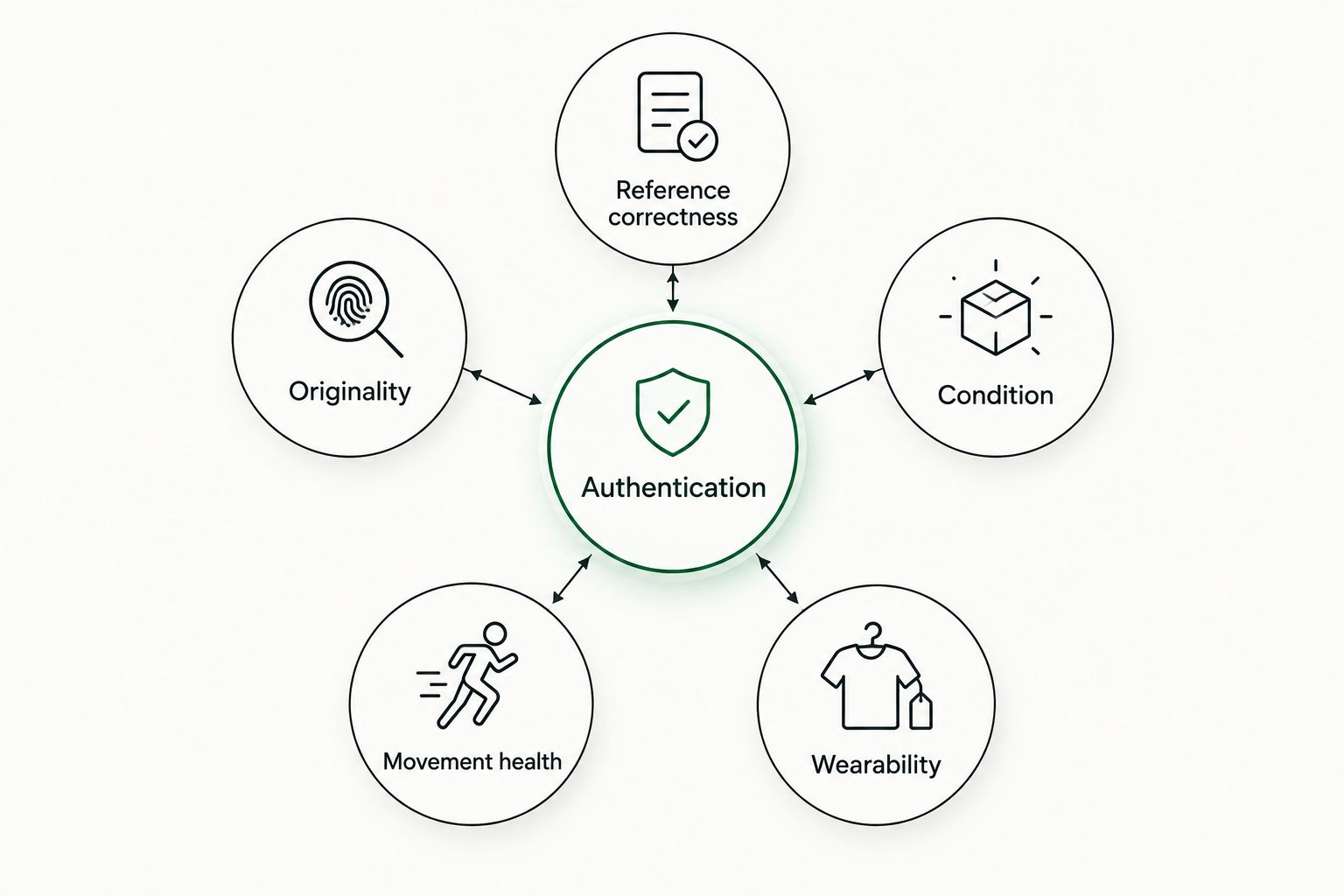
A box cannot be worn. Original packaging can interest a collector, but it should not displace assessment of the case, dial, movement or suitability on the wrist.
Both sellers must pass your wearing test
The better daily watch is the one you can wear comfortably for the activities you actually do. Case diameter is a starting point, not a complete description of fit.
The Omega Seamaster quartz mid-size 36.25 mm page illustrates why model-level detail matters. That size designation gives you something concrete to investigate, but it does not establish bracelet fit, case thickness, condition or suitability for water use.
Ask about the fitted bracelet or strap, adjustment and clasp operation. Check how the watch sits across your wrist and whether its thickness suits your clothing. A comfortable diameter can still produce an awkward fit through case shape or bracelet geometry.
For intended swimming or other water exposure, seek an appropriate current assessment rather than treating a model name or historical rating as evidence of present sealing condition. Vintage and pre-owned watches require attention to their actual state.
The benefit of prioritising wearability is straightforward: you select a watch for use rather than admiration alone. The trade-off is that your most wearable choice need not be your most collectible choice.
The standout feature should belong to the watch
James Patten's stated luxury-watch offering includes new and pre-owned pieces alongside fine jewellery. That gives a buyer a relevant place to begin, but breadth of offering does not prove the qualities of a particular example.
For either seller, identify the watch's distinguishing feature precisely. Is it a dial configuration you want, a case material you prefer, a useful complication or a size that suits you? Then verify the feature and assess its condition.
A distinctive dial is an advantage only if it is the dial you intend to buy and its description withstands examination. A complication is an advantage only if you want to use it and its operation is established. More features are not automatically more useful.
The watch with the more relevant, verified feature wins this category. Avoid substituting assumed retailer services, broad prestige language or packaging for a concrete reason to choose the piece.
Pricing and purchase terms: compare the obligation, not the headline
For a James Patten vs Watch Craze purchase in 2026, compare the written proposal for each exact watch. Keep the purchase structure separate from the watch's physical merits.
An outright purchase and a separately proposed finance arrangement create different obligations. If finance forms part of your comparison, examine the repayment schedule, fees, interest and total commitment in the actual agreement. Do not assume either retailer offers a particular arrangement.
Obtain the relevant written terms before committing. Establish what the transaction includes, how the watch is described, and which warranty, delivery or return provisions apply to that purchase. Read the scope rather than relying on a broad label.
Compare 2 watch-specific proposals side by side. A superficially attractive proposal is not equivalent if it leaves a material condition issue unresolved; equally, extensive paperwork does not improve a poor physical example.
Choose the purchase whose obligations you understand and whose watch evidence meets your brief. An unclear promise should not outweigh a clearly assessed watch.
Final verdict: choose by the evidence that matters to you
Choose James Patten if its exact example meets your collecting brief
Best for: an Australian buyer considering its new or pre-owned luxury-watch offering who has found a specific example worth examining. Choose it when reference correctness, originality, condition, mechanical evidence and fit satisfy your requirements, with written terms you understand.
Do not choose it simply because the retailer also sells other desirable watches or fine jewellery. Those facts do not authenticate or improve the particular watch.
Choose Watch Craze if its competing example better meets your brief
Best for: a buyer comparing a specific competing watch that provides a stronger match on the requirements they have established. Choose it when the watch-specific evidence, physical condition or fit is preferable and the transaction terms are clear.
Do not dismiss the competing example merely because you began your search elsewhere. A balanced 2026 buying decision leaves room for either seller to win on the watch actually being offered.
| Dimension | Winner |
|---|---|
| Best for | The seller whose exact watch matches your brief |
| Reference correctness | The example with the better-established configuration |
| Case and dial condition | The example meeting your stated condition priorities |
| Movement health | The example with stronger relevant mechanical evidence |
| Independent authentication | Tie: apply the same assessment standard |
| Real-world wearability | Tie: assess fit and intended use individually |
| Standout feature | The watch with the more relevant verified feature |
| Purchase structure | The proposal with clear, acceptable obligations |
FAQ
Is James Patten better than Watch Craze for a pre-owned Rolex?
Choose the seller whose exact Rolex better meets your reference, condition and originality requirements. Compare watch-specific evidence, movement health, independent authentication and written purchase terms rather than declaring a retailer-wide winner.
What should I compare when two sellers offer the same watch reference?
Compare the actual configuration, case and dial condition, disclosed replacements and mechanical evidence. The same reference does not make two individual watches equivalent purchases.
Does a luxury watch need its original box and papers to be desirable?
No: original packaging is not a proxy for watch quality or desirability. Assess reference correctness, originality, physical condition, movement health, independent authentication and wearability.
Is a service record enough to prove a used watch is healthy?
A service record does not replace an assessment of present movement condition. Check its date, scope and connection to the exact watch, then establish what current findings support the purchase.
How should I compare the purchase cost between sellers?
Compare written proposals for the exact watches and read all applicable obligations. If finance is proposed, assess its full terms separately from the watch's condition and suitability.
Can I swim with a pre-owned watch that has a diving model name?
A diving model name does not establish the present sealing condition of a pre-owned watch. Seek an appropriate current assessment for your intended water use before exposing it to water.
What's the best reason to choose one watch seller over another?
Choose the seller offering the watch that best meets your documented requirements with convincing evidence and clear terms. Give originality, condition, mechanical health and fit more weight than presentation alone.
One last thing
Before committing, write one sentence naming the watch's strongest merit and one naming its most important compromise. Be specific: a dial you have assessed, a case condition you accept, or a wearing limitation you understand.
If both sentences describe the retailer rather than the watch, return to the evidence. You are buying a timepiece, not a comparison-page winner.


