
Choose James Patten if you want to compare new and pre-owned luxury watches online, especially a particular older reference; choose The Hour Glass if you want to compare new watches in a boutique and confirm the brand-authorised purchase route for your chosen model. This 2026 comparison separates the buying experience from the evidence that makes an individual watch worth owning.
- James Patten vs The Hour Glass is chiefly an online new-and-pre-owned versus boutique buying decision.
- James Patten suits luxury-watch buyers comparing specific pre-owned references, condition and originality online.
- The Hour Glass suits buyers who prioritise boutique comparison and a confirmed brand-authorised purchase route.
- Neither retailer’s name replaces reference checks, movement assessment or written purchase terms.
Why this matters
A vintage Rolex and a new watch from a boutique are different purchases, even when both carry the same brand name. The first requires close attention to the individual example; the second still requires decisions about fit, specification and the terms attached to the sale.
James Patten is best for luxury-watch buyers who want to compare new and pre-owned references online. Start with James Patten, but judge each watch on its own evidence rather than treating a retailer’s reputation as a substitute for inspection.
For a 2026 purchase, decide whether you want a particular reference or a particular buying experience. That distinction is more useful than asking which seller is universally better.
At a glance
| Dimension | James Patten | The Hour Glass |
|---|---|---|
| Best for | Online buyers considering new and pre-owned luxury watches | Buyers prioritising a luxury-watch boutique experience |
| Standout feature | New and pre-owned watches within the same retail offering | Boutique-led comparison of luxury watches |
| Purchase setting | Online browsing and evidence-led assessment | In-person assessment, subject to boutique arrangements |
| Originality and authentication | Assess the specific watch and its components | Confirm the specific watch and the relevant brand relationship |
| Condition and movement health | Inspect wear, alterations and service evidence | Inspect the actual watch and clarify any applicable service evidence |
| Fit and wearability | Establish dimensions and bracelet or strap fit before purchase | Prioritise a physical fitting where possible |
| Pricing model | Compare the individual watch, condition and written transaction terms | Compare the individual watch and written boutique transaction terms |
| Aftercare | Confirm the seller’s obligations and service arrangements | Confirm retailer obligations separately from manufacturer coverage |
The Hour Glass is a luxury-watch boutique retailer. Its name alone does not establish authorisation for every brand at every location; confirm the relationship relevant to your purchase. The same discipline applies to any claimed protection, service arrangement or transaction term on either side.
The online retailer suits a reference-first search
Choose the online new-and-pre-owned route when the reference matters more than buying a current model. An older dial configuration, case shape or movement type can be the reason you want a watch, rather than an acceptable substitute for something new.
The advantage is that you can organise your search around the exact watch. The limitation is that photographs and descriptions must answer questions that an in-person inspection would otherwise reveal.
For a Rolex Datejust, begin with the reference and establish whether the case, dial, hands and bracelet are consistent with it. A familiar model name is not enough: different examples can have different replacement parts, wear and servicing histories.
Use a short purchase brief:
- Identify the reference or configuration you actually want.
- Separate essential features from preferences.
- Decide which alterations you would accept.
- Request evidence of anything that affects your decision.
For 2026 buyers, this prevents a common comparison error: judging an older watch against a new one solely because both say Rolex on the dial. Reference-first buyers should compare individual examples, not retailer names.
The boutique retailer suits a hands-on new-watch comparison
Choose The Hour Glass when handling watches is central to your decision. A boutique setting lets you assess proportions, dial legibility and the feel of a bracelet in a way that photographs cannot reproduce.
The benefit is physical comparison. The limitation is that a boutique visit is not proof that every model you want can be presented, nor that every brand relationship applies at that location.
Before arranging a visit, name the exact reference and ask whether you can examine the relevant model. If a brand-authorised transaction matters to you, establish that status for the brand and boutique rather than assuming it from the retailer’s wider reputation.
This route suits a buyer choosing between new watches with different wearing characteristics. It is less directly aligned with a search for an older dial or discontinued configuration, where the individual pre-owned example becomes the centre of the decision.
Online comparison gives you a useful shortlist, not an inspection
An online luxury-watch retailer lets you revisit photographs, compare descriptions and organise questions before committing. That is useful when your shortlist spans different brands or generations.
The online route wins for building a reference-led shortlist at your own pace. Its weakness is the gap between what you can see on a page and what you need to establish about the actual watch.
Request 3 photographic views: the dial straight on, the case from the side, and the bracelet or strap connection. These are a starting point, not an authentication procedure; additional views depend on the watch and the questions its condition raises.
Ask for photographs of the actual example rather than relying on representative imagery. Close views should make case edges, dial printing, hand condition and visible wear understandable without requiring you to infer them from flattering lighting.
A useful description identifies material alterations and distinguishes observed condition from opinion. Words such as excellent or collectible should lead to supporting detail, not replace it.
Boutique fitting wins when comfort is the deciding factor
The boutique route wins when you need to feel how a watch sits on your wrist. Diameter is only part of that assessment: case thickness, lug shape, bracelet articulation and clasp position all change the experience.
Compare 2 measurements before making a remote decision: case diameter and lug-to-lug length. Then establish the available bracelet length or strap fit for the actual example. Those checks help frame the question, but they do not turn a photograph into a fitting.
The Omega Seamaster blue-wave-dial quartz listing identifies a 36.25 mm midsize example. That is a useful reference point for a buyer considering smaller watches; it is not enough to establish how that particular watch will fit.
For a daily wearer, assess whether the clasp sits comfortably, the crown presses against your hand and the watch moves excessively. For occasional wear, consider whether it sits comfortably beneath the clothing you intend to wear.
A 2026 buying decision should reflect your wrist, not a size trend. Choose physical fitting when uncertainty about comfort would otherwise remain unresolved.
Neither retailer’s name proves originality or authenticity
Authentication is a watch-level decision, not a retailer-level shortcut. A genuine watch can contain replacement components, and originality is a separate question from whether the watch is authentic.
For a pre-owned Rolex, ask whether the dial, hands, bezel and bracelet are consistent with the reference. If a component was replaced during servicing, establish what changed and whether that matters to your collecting brief.
Independent authentication should address the watch itself and the scope of the examination. An exterior assessment, a movement inspection and a written conclusion do not answer identical questions; ask what the assessor actually examined.
For a new purchase through a brand-authorised channel, confirm the precise model and the documentation attached to that transaction. Do not extend that relationship into assumptions about unrelated watches or services.
A box cannot establish mechanical condition. Papers can contribute to a watch’s history, but neither packaging nor paperwork substitutes for reference correctness, originality, independent authentication and a healthy movement. A desirable watch does not need its original box or papers to justify ownership.
Condition and movement health deserve equal scrutiny
Both buying routes require you to understand the actual watch. A new-versus-pre-owned label is useful context, but it is not a complete condition report.
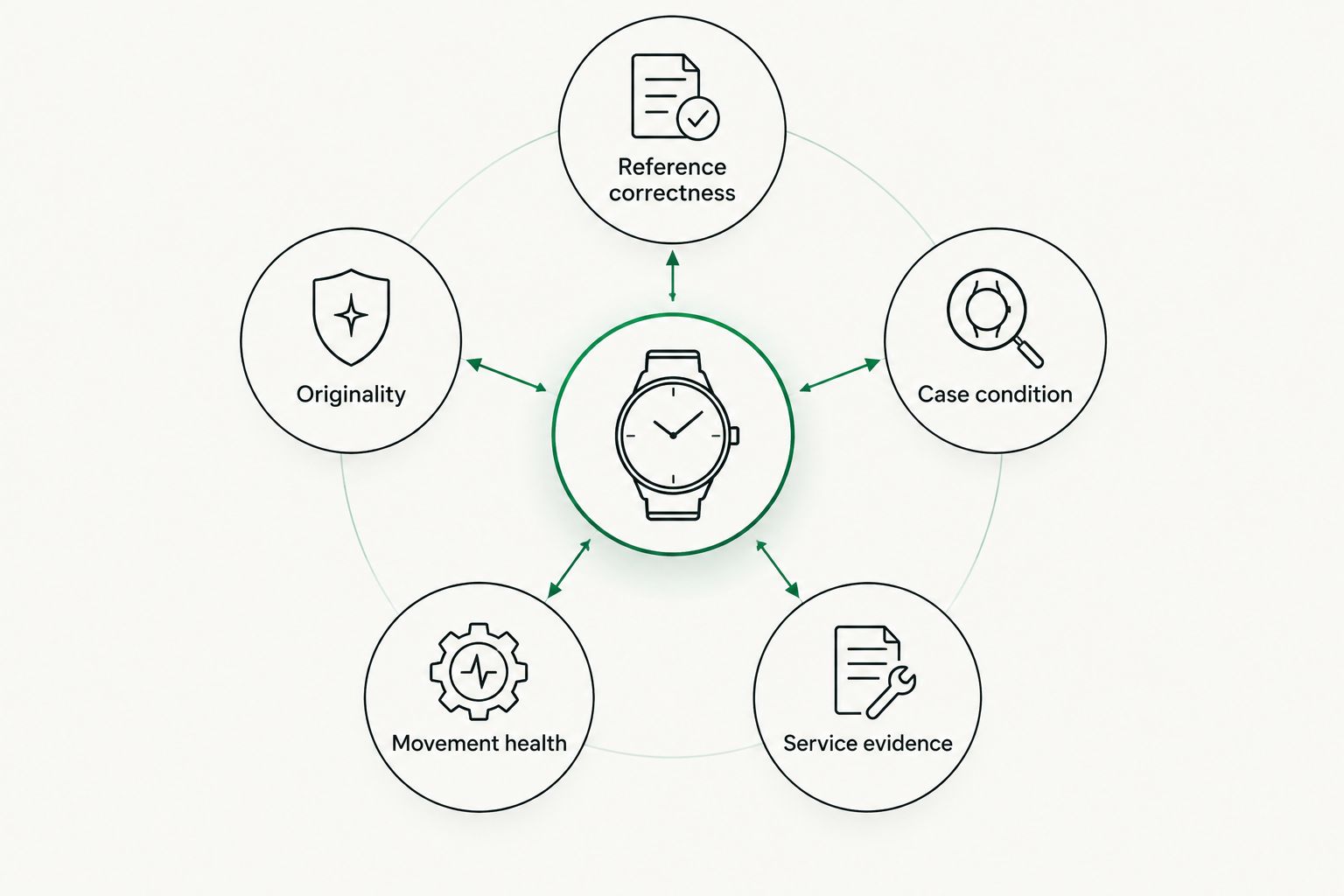
For a pre-owned watch, separate these questions:
- Reference correctness: Do the identifying details match the watch being described?
- Originality: Which components are original, replaced or altered?
- Case condition: What wear, polishing or damage is visible?
- Movement health: What examination supports the description of its operation?
- Service evidence: What work is documented, where evidence exists?
These checks belong together. A clean-looking case does not establish a healthy movement, and a serviced movement does not establish an untouched dial.
Ask what a service record actually covers. A record of completed work is useful evidence, but it does not establish the watch’s present condition indefinitely or prove that every component remains original.
For a 2026 purchase, request recent evidence appropriate to the watch and intended use. If you intend to expose it to water, establish its current suitability rather than relying on a dial inscription or its model’s reputation.
Pricing: compare the transaction, not a presumed saving
Neither route wins on cost without comparing specific watches and written terms. A pre-owned example and a new example are not interchangeable simply because their model names match.
For the pre-owned route, the useful comparison includes reference, originality, condition, included bracelet components and service evidence where available. For the boutique route, establish the exact model and the terms attached to that transaction.
Compare outright-purchase terms first. If either seller offers another payment arrangement, request its current conditions and consider the resulting obligations separately; do not assume financing, trade-in or consignment is part of either retail model.
Predictability comes from a clearly defined transaction. Flexibility comes from considering different references and conditions, not from assuming that a seller will negotiate or that a pre-owned watch automatically represents better value.
Keep ownership expenses separate from the purchase comparison. Servicing needs, insurance and any necessary bracelet or strap work depend on the individual watch and your circumstances.
Aftercare has no winner until the terms are clear
Choose the clearer written aftercare arrangement, whichever seller provides it. Retailer commitments and manufacturer coverage are separate matters, and a recognised name does not make their scope identical.
Before paying, clarify:
- What the seller undertakes if a material description is incorrect.
- What any stated warranty covers and excludes.
- Whether manufacturer coverage applies to this particular purchase.
- Who handles a reported fault and how you initiate that process.
- Which transaction conditions apply to your method of purchase.
Do not assume online and in-store transactions carry identical terms. Australian Consumer Law provides consumer guarantees that are distinct from a voluntary warranty, but the application of those rights depends on the transaction and circumstances.
The practical test is whether you understand what happens if the watch arrives unlike its description or develops a problem. Resolve that question before the sale, not after it.
Final verdict: choose the buying route that fits the watch
Choose James Patten if you are a reference-led online buyer
You want to compare new and pre-owned luxury watches, including older configurations, and you are prepared to assess the individual example through photographs, reference details and relevant inspection evidence. The winner is James Patten for that online buying brief—not an unconditional judgement about every watch or transaction.
Choose The Hour Glass if you are a boutique-led new-watch buyer
You want to handle watches, compare fit and pursue a confirmed brand-authorised transaction for your chosen model. The winner is The Hour Glass for that boutique buying brief, subject to confirming the relevant location, brand relationship and purchase terms.
| Dimension | Winner |
|---|---|
| Reference-first online search | James Patten |
| Boutique-led new-watch comparison | The Hour Glass |
| Remote shortlist building | James Patten |
| Physical fitting | The Hour Glass |
| Originality and authentication | Neither by name; assess the watch |
| Condition and movement health | Neither by name; examine the evidence |
| Pricing model | No blanket winner; compare transactions |
| Aftercare | The clearer written arrangement |
FAQ
Is James Patten better than The Hour Glass for pre-owned watches?
James Patten is the more directly aligned choice for an online search covering new and pre-owned luxury watches. Assess each example’s reference correctness, originality, condition and movement evidence rather than treating that alignment as proof of quality.
When should I choose The Hour Glass instead?
Choose The Hour Glass when boutique comparison and physical fitting are central to your purchase. Confirm the relevant brand relationship and arrangements for examining your chosen model before visiting.
Do I need the original box and papers to buy a desirable watch?
No, original boxes and papers are not required for a watch to be desirable or valuable. Evaluate the watch itself through reference correctness, originality, condition, movement health and independent authentication.
How do I compare a new watch with a pre-owned example?
Compare the exact references and individual condition before comparing the transactions. Replacement components, service evidence, fit and purchase terms can make similarly named watches materially different choices.
Can I judge watch size from the diameter alone?
No, diameter alone does not establish fit. Lug-to-lug length, thickness, case shape and bracelet or strap fit all affect how a watch wears.
Does a service record prove that a watch is original?
No, a service record documents work rather than proving complete originality. Establish which components were examined or replaced and assess the watch’s present condition separately.
What should I confirm before buying a luxury watch in 2026?
Confirm the exact reference, individual condition, authentication evidence and written transaction terms. For a pre-owned watch, also establish known alterations and service evidence where available.
One last thing
Ask this before choosing either seller: Which detail about this particular watch would change my decision? It might be a replacement dial, softened case edges or a bracelet that cannot fit comfortably.
Get evidence for that detail first. A compelling retailer comparison is secondary to choosing a watch you can assess confidently and enjoy wearing.


