
Choose James Patten if you are pursuing a particular new or pre-owned luxury reference; choose Shiels if you want to compare everyday watches through a jewellery retailer, including an in-store fitting. This 2026 comparison separates reference-led collecting from general watch shopping, so you can choose the buying route that suits the watch you actually want.
- James Patten vs Shiels is primarily a choice between luxury-reference collecting and general watch shopping.
- James Patten suits luxury-watch buyers seeking new or pre-owned pieces from established collecting brands.
- Shiels suits everyday-watch buyers who value comparing designs and trying watches in a jewellery-store setting.
- For either retailer, assess the actual watch, written purchase terms and wrist fit before committing.
Why this matters
A pre-owned Rolex and a new everyday watch demand different buying decisions. With the Rolex, reference correctness, component originality and movement condition sit at the centre of the assessment. With an everyday watch, fit, legibility and the suitability of its functions often decide the purchase.
James Patten is an Australian online retailer of new and pre-owned luxury watches and fine jewellery. Shiels is an Australian jewellery and watch retailer with physical stores and an online presence. Those are different shopping environments, not evidence that either seller's individual watch is automatically better.
Choose the buying route first, then judge the specific watch. A specialist focus does not replace authentication, and a familiar shopfront does not settle whether a watch suits your wrist.
At a glance
| Dimension | James Patten | Shiels |
|---|---|---|
| Best for | Buyers pursuing a particular luxury reference | Buyers comparing everyday watches and gifts |
| Range emphasis | New and pre-owned luxury watches, alongside fine jewellery | Watch shopping within a broader jewellery-retail setting |
| Standout distinction | A collecting-focused starting point | A physical-store comparison route |
| Reference and condition assessment | Especially relevant to pre-owned luxury purchases | Assess the precise model and the individual watch |
| Trying watches on | Online selection requires careful fit assessment | Physical stores provide an in-person fitting route |
| Everyday suitability | Choose by reference, condition and wearing needs | Choose by model, fit and wearing needs |
| Pricing model | Compare the individual watch and its condition | Compare the exact model and purchase terms |
| Ownership and purchase protection | Confirm written terms for the specific purchase | Confirm written terms for the specific purchase |
Luxury-reference buyers have the clearer fit with James Patten
James Patten is best for buyers whose watch search begins with a luxury reference rather than a general style. Its stated focus includes Rolex, Patek Philippe, Panerai, Omega and Cartier, with both new and pre-owned watches forming part of the business.
That focus matters when “an Omega” is not a sufficiently precise brief. You might want a particular Seamaster dial, a quartz rather than mechanical movement, or a case proportion that differs from another version bearing the same family name. Establish the reference before comparing sellers.
A collector's brief should identify:
- The model family and exact reference where known.
- The preferred dial, case material and movement type.
- Whether originality or a particular configuration is central to the purchase.
- The condition you will accept on the case, bracelet and dial.
- The activities and occasions for which you will wear it.
The advantage is relevance: a luxury-focused retailer aligns with that kind of search. The trade-off is the work an individual pre-owned watch requires. A familiar model name does not tell you whether its dial is original, its case has been heavily polished or its movement needs attention.
For a 2026 purchase, assess the actual example rather than transferring the reputation of the watch brand to the seller or listing. Specialist positioning is a reason to begin your search, not a reason to stop checking.
Shiels is the better starting point for general watch shopping
Shiels is the more natural starting point when your brief is an everyday watch or a gift, rather than a particular collectible reference. Its jewellery-retail setting suits browsing across designs and making the watch part of a broader personal or gifting decision.
That distinction is useful if you know the wearing requirement but have not chosen a model. Perhaps you want a clear dial, a bracelet rather than a strap, or a watch that feels comfortable throughout the day. Comparing those qualities in person is more useful than beginning with a luxury-brand hierarchy.
For a gift, ask what the recipient already wears. A slim dress watch and a substantial sports watch solve different needs, even when both look attractive in photographs. Their preference for winding, battery-powered operation or a particular display matters more than your preference for a prestigious name.
The limitation is equally clear: a general retail setting is not, by itself, evidence of expertise in a particular vintage or pre-owned luxury reference. If your search becomes specific to originality, production variants or historical components, move from general browsing to reference-level investigation.
Do not choose Shiels because it is assumed to be cheaper, or reject it because it is not positioned like a collector-focused retailer. Choose it when its shopping environment matches your decision.
Pre-owned luxury watches need reference-level evidence
For a pre-owned luxury purchase, the watch itself is the evidence. Original packaging cannot establish that the dial, hands, bezel, movement and case belong together, and its absence does not make a good watch undesirable.
Separate these checks instead of accepting a single condition adjective:
- Reference correctness: establish which configuration the reference should have.
- Originality: distinguish original components, service replacements and aftermarket modifications.
- Condition: inspect case geometry, dial surfaces, hands, bracelet wear and clasp function.
- Movement health: seek evidence of operation and a qualified assessment where appropriate.
- Service evidence: read available records for what was done, not merely whether a service occurred.
A service replacement is not automatically a reason to reject a watch. It changes the assessment according to your purpose: strict originality and dependable daily wearing are related but different priorities. Ask what changed and whether that change is acceptable to you.
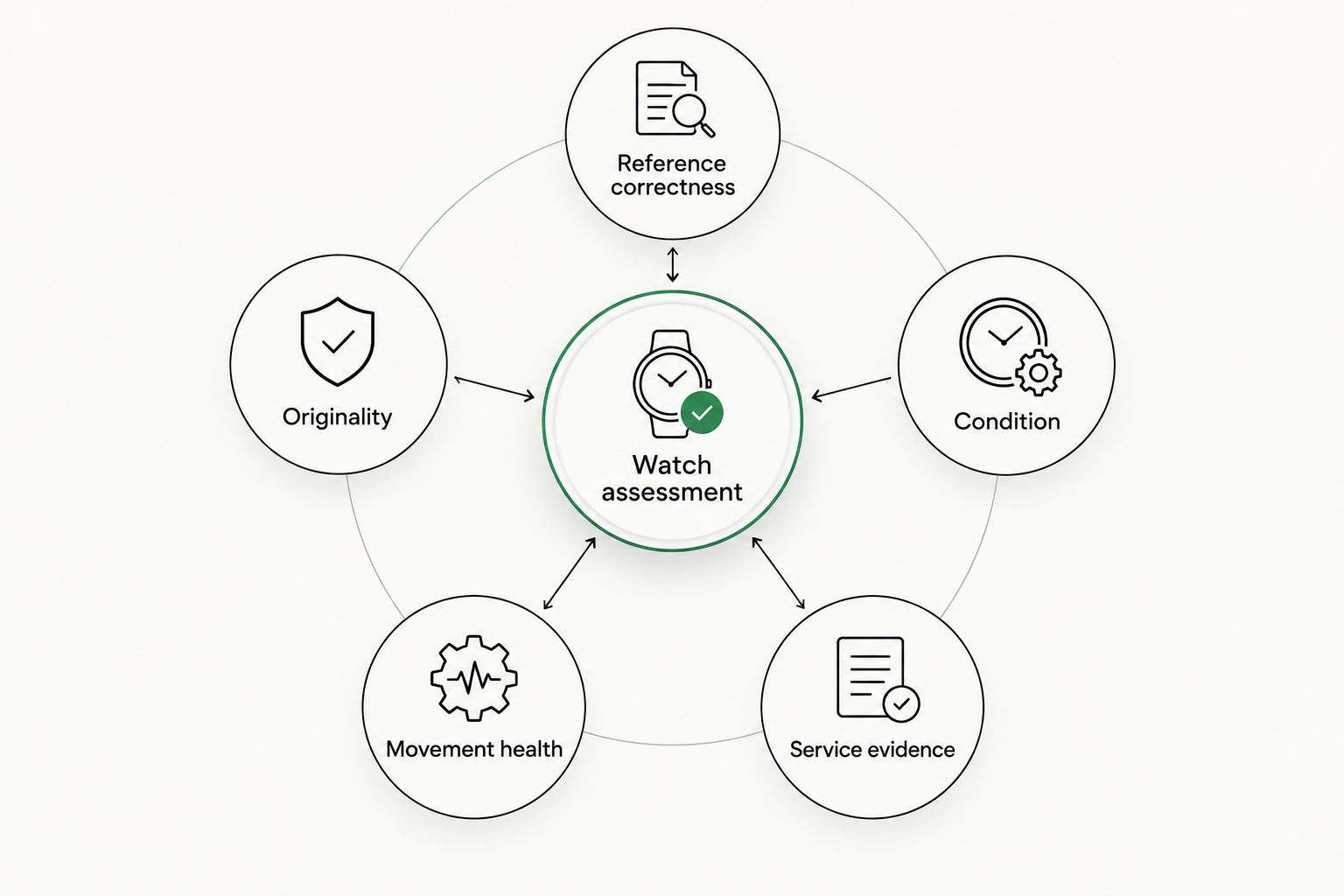
Neither retailer wins authentication by name alone. For either purchase, use independent authentication when the watch's identity or component correctness needs specialist confirmation. Authentication addresses what the watch is; a condition assessment addresses how well it has survived and functions.
Shiels wins on the in-person fitting route
Shiels' physical-store presence provides a fitting route that an online-only selection process does not reproduce. Choose an in-person comparison when comfort and proportion are your unresolved questions. Confirm that the particular watch you want can be examined before making a journey.
Diameter is only part of fit. Lug shape, case thickness, bracelet articulation and the position of the clasp influence how a watch sits. A watch that looks modest from above can still feel awkward if its lugs extend beyond your wrist or its caseback concentrates pressure.
When trying a watch, check it from the side as well as from above. Move your wrist, fasten the clasp and assess the dial in ordinary light. If you wear cuffs, test whether the watch passes beneath one without catching.
For an online luxury purchase in 2026, ask for information that addresses those same questions: case measurements, side-profile photographs, bracelet configuration and any relevant sizing limitations. Do not assume a retailer offers remote fitting services or resizing arrangements; confirm those details directly.
The in-store advantage is practical rather than absolute. A comfortable watch that does not meet your collecting brief is still the wrong purchase.
Neither retailer wins everyday wearability by default
Everyday suitability belongs to the watch, not the retailer. A luxury piece can be an excellent daily companion, while a general-retail watch can be entirely wrong for the way you use it.
Decide whether you need simple time display, a date, elapsed-time measurement or another function. Then examine how clearly the watch presents that information. A busy dial does not become useful simply because its functions are technically impressive.
Movement choice deserves the same attention. A mechanical watch introduces winding and servicing considerations; a quartz watch introduces battery or other power-system considerations according to its design. Confirm the exact movement rather than inferring it from appearance or model-family reputation.
Water use requires a separate check. For a pre-owned watch, an original water-resistance specification does not establish its present sealing condition. Obtain an appropriate current assessment before exposing it to water, especially when its maintenance history is incomplete.
The tie is deliberate: both buying routes require a watch-specific wearing assessment. Prestige cannot answer comfort, and convenience cannot answer suitability.
Pricing: compare the watch, not the retailer's reputation
For this 2026 comparison, the useful distinction is reference-and-condition assessment versus model-led retail comparison. That is a way to evaluate an offer, not a claim about either retailer's current checkout, finance or payment arrangements.
For a pre-owned luxury watch, compare examples with the same reference and account for originality, case condition, bracelet condition, movement health and disclosed replacements. Two watches carrying the same model name are not necessarily equivalent purchases.
For a new-watch comparison, establish that you are looking at the same model, movement and configuration. A different dial, bracelet or movement can change the proposition even when the watches share a family name. Confirm purchase terms separately rather than treating them as interchangeable.
If you are considering staged payments or finance, establish whether the seller offers an applicable arrangement and read its terms. Check the total commitment, payment schedule and any fees or interest stated in the agreement. Do not infer an arrangement from either retailer's market position.
Neither retailer wins a cost comparison without like-for-like watches and current terms. Your decision should account for purchase suitability and expected ownership requirements, not an assumed specialist premium or chain-retailer saving.
Purchase protection is a tie until you read the terms
Written terms matter at both retailers. Review them for the specific transaction before paying, particularly if fit, condition or an authentication question remains unresolved.
Keep these categories separate:
- Seller description: what the listing says about the watch and its condition.
- Authentication: evidence supporting identity and component correctness.
- Warranty: the scope and exclusions of any stated contractual cover.
- Returns: the applicable conditions and process for that purchase.
- Delivery: the agreed arrangements and responsibility for transit.
Ask whether statements about servicing refer to an inspection, a repair or a full service. Those descriptions are not interchangeable. Likewise, a claim of authenticity should not be mistaken for a guarantee of movement health or water resistance.
Australian consumer guarantees exist separately from a retailer's voluntary warranty. For a 2026 purchase, consult current Australian Competition and Consumer Commission guidance when you need to understand those rights; do not treat a seller's warranty summary as the whole legal position.
There is no justified blanket winner here. Choose the transaction whose watch description and written terms resolve your actual concerns.
Final verdict: collector brief or everyday-watch brief?
Choose James Patten if you are a reference-led luxury buyer
You want a new or pre-owned luxury watch, and your decision turns on a particular reference, configuration or collecting purpose. Begin with the luxury-focused selection, then require evidence about the individual watch's correctness, condition and movement.
The named winner for this profile is James Patten. The reason is alignment with its stated luxury-watch focus, not an unverified claim about service, protection or superiority.
Choose Shiels if you are an everyday-watch or gift buyer
You want to compare designs, establish comfort and choose a watch around its intended use. An in-store jewellery-retail setting is relevant when you have not settled on a specific collectible reference.
The named winner for this profile is Shiels. The advantage is the general-shopping and fitting route; it does not establish that every model suits you or that every purchase term is preferable.
| Dimension | Winner |
|---|---|
| Reference-led luxury search | James Patten |
| General watch and gift browsing | Shiels |
| Pre-owned authenticity and condition | Watch-specific evidence; no automatic winner |
| In-person fitting route | Shiels |
| Everyday wearability | Tie; assess the individual watch |
| Pricing comparison | No winner without equivalent watches and current terms |
| Purchase protection | Tie; assess written terms and applicable rights |
FAQ
Is James Patten better than Shiels for luxury watches?
James Patten is the better-aligned starting point for a buyer pursuing a specific new or pre-owned luxury reference. That does not establish that an individual watch, warranty or purchase arrangement is better; assess those separately.
Should I choose Shiels for my first watch?
Choose Shiels when your first-watch decision benefits from general browsing and an in-store fitting. If you already want a particular collectible luxury reference, a reference-led search is more useful than broad browsing.
Can I compare watch prices between the two retailers?
Compare only equivalent watches using current purchase terms. For pre-owned pieces, reference, originality, condition, movement health and disclosed replacements must form part of that comparison.
Does a pre-owned watch need its original box or papers?
No: original packaging is not required for a watch to be desirable or worth considering. Assess reference correctness, originality, condition, movement health and independent authentication rather than using packaging as a quality test.
What should I check before buying a pre-owned luxury watch online?
Check the exact reference, component correctness, detailed condition, movement assessment and service evidence where available. Establish wrist fit and read the written purchase terms before committing.
Is trying a watch on better than buying it online?
Trying a watch on is better for resolving immediate questions about comfort and proportion. An online purchase requires careful measurements, useful photographs and confirmation of the terms that apply if the watch does not meet your expectations.
Will a luxury watch hold its value?
A luxury watch is not guaranteed to retain its value. Reference, originality, condition and changing demand affect future resale, so choose a watch you want to own rather than relying on an assumed return.
One last thing
A polished case can look attractive while revealing less original geometry than a visibly worn example. Look closely at lug shape, edges and symmetry rather than ranking watches by shine alone. For your 2026 shortlist, request photographs that reveal the watch's condition, not just its presentation.


