
Choose James Patten if you want a reference-specific new or pre-owned luxury watch; choose Michael Hill if your priority is jewellery shopping with an in-store fitting. In 2026, the useful distinction is specialist watch selection versus a jewellery-led retail experience—not a blanket judgement about which seller is better.
- James Patten vs Michael Hill: choose the watch specialist for reference-led collecting, the jeweller for in-store jewellery selection.
- Michael Hill suits buyers who want to compare jewellery proportions and fit in person.
- Assess pre-owned luxury watches through originality, condition, movement health and independent authentication.
- Compare written purchase terms separately; neither a familiar name nor packaging establishes an item's quality.
Why this matters
A Rolex Datejust 1601 and an engagement ring demand different buying decisions. For the watch, you need to establish what the reference should contain, what has changed and how it runs. For the ring, dimensions, setting construction, stone information and fit shape the decision.
James Patten is the better starting point for buyers seeking reference-specific pre-owned luxury watches. Michael Hill is the more natural starting point when you want a jewellery-led store visit, particularly for a ring you need to try on.
Neither recommendation establishes the quality of an individual item. Your final choice should follow the evidence for the piece you intend to wear.
At a glance
| Dimension | James Patten | Michael Hill |
|---|---|---|
| Best for | Buyers researching named luxury-watch references, including pre-owned examples | Buyers prioritising jewellery selection and in-store fitting |
| Standout feature | Reference-led watch selection across brands including Rolex, Panerai, Omega and Cartier | Jewellery-led shopping through a physical retail network |
| Shopping format | Online retailer; resolve item-specific questions before purchase | Store-based comparison suits buyers who need to see and try jewellery |
| Jewellery gifting | Consider when a particular design matches the recipient | Better starting point when the design and fit remain undecided |
| Originality and condition | Assess the individual watch and supporting evidence | Assess the individual item and supporting evidence |
| Wearability | Compare case shape, dimensions, strap or bracelet fit | Use a store visit to assess jewellery proportions and fit |
| Purchase protections | Read the applicable written terms for the specific purchase | Read the applicable written terms for the specific purchase |
| Pricing model | Item-by-item retail purchase; compare condition and likely ownership costs | Item-by-item retail purchase; compare materials, construction and purchase terms |
Reference-led collectors should start with the watch specialist
If your brief already names a Rolex Datejust 1601, Panerai PAM00217 or Cartier Tank Anglaise, start with the actual watch rather than a broad jewellery search. A reference gives you a basis for checking the movement, dial configuration, case and other components.
The specialist catalogue includes these kinds of named watches. That makes it a relevant starting point for a collector who wants to examine differences between individual examples, rather than simply choose a familiar brand.
The trade-off is scrutiny. A pre-owned reference can appear in different states of preservation, with replacement components or past refinishing that require explanation. A recognisable model name does not settle those questions.
Best for: the buyer who knows the reference or wants to build a reference-specific shortlist. Ask for evidence about the individual example before treating any catalogue description as a purchase decision.
Named references make the watch shortlist more useful
A concrete example is the IWC Aquatimer Chronograph Expedition Jacques-Yves Cousteau, reference IW376805. Its supplied description identifies a 44 mm stainless-steel case, an internal rotating dive bezel, chronograph and day/date display.
Those details give you useful questions. Do you want both elapsed-time functions? Can you read the displays easily? Does the case sit securely without extending beyond the usable surface of your wrist?
Another supplied example, the Bulova Classic Sutton 97A169, has a 43 mm case and a skeletonised dial. That is a different visual proposition, even before you compare movement type, case shape and strap fit.
The advantage is a more precise comparison, not automatic superiority. A detailed listing helps you identify what to investigate; it does not replace an inspection, establish movement health or confirm suitability for swimming.
For a 2026 purchase, keep the reference and the individual condition assessment together. Comparing model names alone leaves out the information that distinguishes one pre-owned watch from another.
Michael Hill wins when an in-store jewellery fitting is the priority
Michael Hill's physical retail network makes it the more direct choice when you want to see jewellery on your hand, wrist or neckline before deciding. A photograph cannot tell you whether a ring sits comfortably beside an existing band or whether a pendant's proportions suit you.
An in-store visit is particularly useful when the brief is still open. You can compare shapes and wearing positions without committing first to a specific design.
The limitation is equally clear: access to a shop does not establish the specifications or quality of a particular piece. Ask for the metal description, stone information where relevant, dimensions and applicable purchase terms.
Best for: the buyer whose decision depends on a physical jewellery fitting. Confirm the relevant store can help with the item you want to examine before planning your visit; a retail network does not mean every location carries every design.
Michael Hill is the clearer starting point for undecided jewellery gifts
If you are choosing a ring or necklace but have not settled on a shape, material or proportion, a jewellery-led store visit is a useful way to narrow the brief. Michael Hill suits that stage of the decision better than beginning with a collector's watch-reference search.
That advantage becomes smaller once you know the exact design you want. The specialist retailer also sells fine jewellery, so compare the actual pieces rather than assuming its catalogue is exclusively watches.
For example, the supplied Bold Paperclip Chain Necklace description states an adjustable circumference up to 50 cm and links measuring 9.1 mm long by 4 mm wide. Those measurements are more useful for assessing scale than an adjective such as delicate or bold.
Best for: the gift buyer who needs to discover the right jewellery format in person. The drawback is that a pleasant fitting experience still leaves practical questions to resolve, including sizing and the terms applicable to a gift purchase.
Neither seller wins on originality without item-level evidence
For a pre-owned watch, distinguish authenticity from originality. An authentic watch can contain genuine replacement components; that is different from establishing that its dial, hands and other parts are original to the example.
Use the same assessment regardless of the seller:
- Reference correctness: check that the configuration is consistent with the identified reference.
- Case condition: examine edges, surfaces, lugs and signs of refinishing or damage.
- Dial condition: ask about refinishing, replacement, staining and any changes to luminous material.
- Movement health: request relevant findings from inspection or testing, not just a statement that it runs.
- Service evidence: review what was done and which components were replaced, where records exist.
- Independent authentication: arrange an appropriate assessment rather than relying on photographs alone.
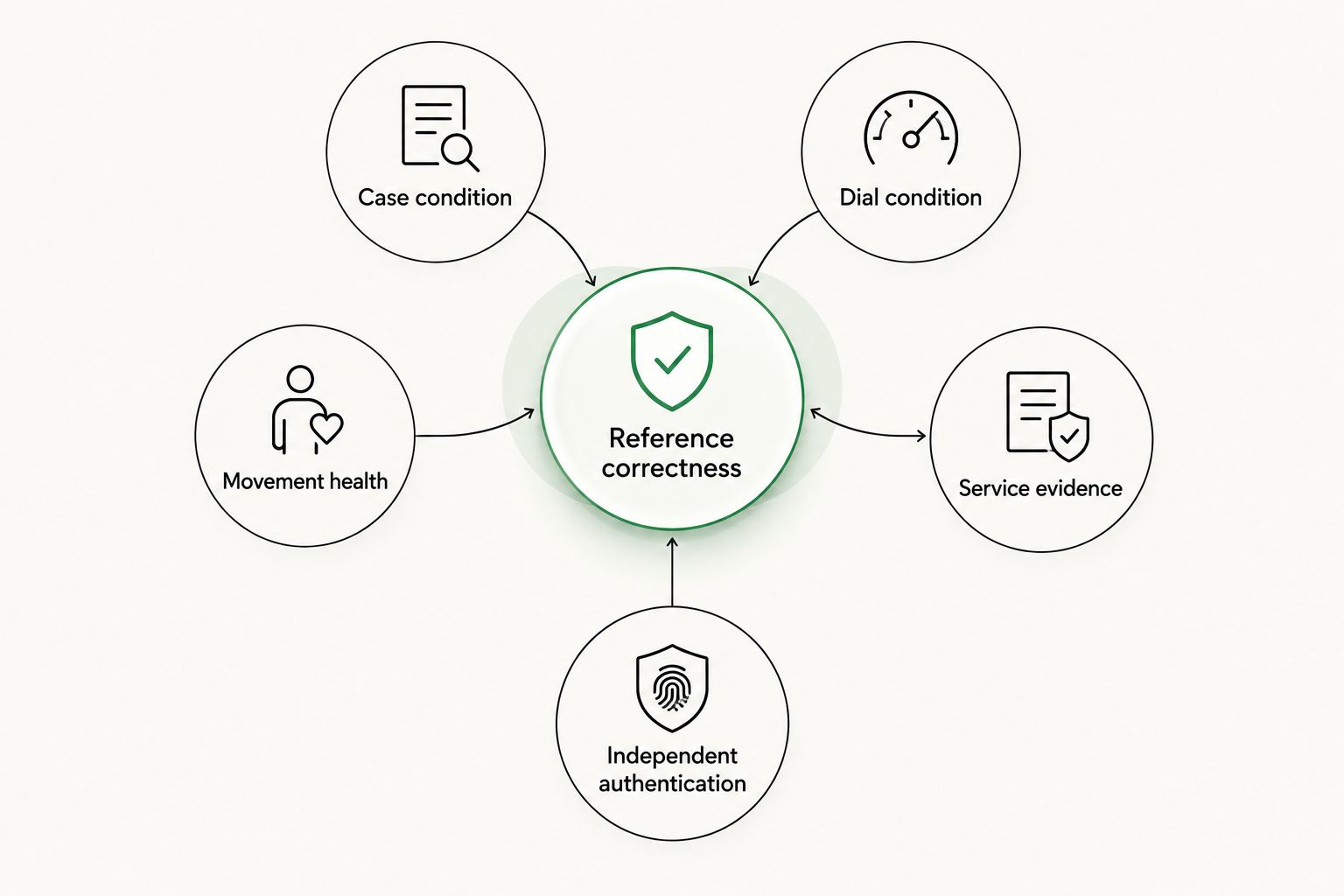
A replacement service part is not automatically a reason to reject a watch. What matters is understanding the change, its effect on your collecting priorities and whether the watch remains appropriate for your intended use.
A box cannot establish any of these qualities. Evaluate the watch itself; packaging is neither necessary evidence of quality nor a substitute for independent assessment.
Wearability is a tie until you assess the actual piece
Neither seller wins on comfort as a general proposition. A watch or ring fits a person, not a retail category.
For watches, diameter is only one measurement. Compare lug shape, case thickness, crown position, bracelet articulation and the position of the strap holes. A broad, flat case and a rounded case can sit differently despite similar stated widths.
For jewellery, consider the contact points. Check whether a ring's shoulders press against adjacent fingers, whether a clasp is manageable and whether a pendant turns during normal movement.
Your 2026 shortlist should describe the wearing requirement in plain language: under a shirt cuff, beside a wedding band or comfortable for extended desk use. These requirements are more useful than recommendations based on an occupation or a broad lifestyle label.
Choose the piece that fits your use, not the seller with the more persuasive category description. For an online purchase, resolve the measurements and applicable terms before making that judgement remotely.
Purchase protections have no winner without the written terms
Do not assume a pre-owned luxury watch has manufacturer warranty coverage because the brand still operates. Equally, do not assume a retailer's warranty covers every component, cosmetic issue or type of damage.
Before buying from either seller, establish:
- Who provides any warranty and what the written coverage includes.
- Whether particular exclusions apply to the item.
- What the return terms say about condition, sizing or alterations.
- How a fault or disputed description should be raised.
- What evidence supports any authentication or certification statement.
For Australian purchases in 2026, distinguish store policies from rights under Australian Consumer Law. Consumer guarantees are separate from a voluntary warranty; their application depends on the purchase and circumstances.
Neither seller earns a policy advantage from its name alone. Read the terms that apply to your transaction, and keep the written description and correspondence with your purchase records.
Pricing: compare the purchase model and the ownership obligation
Both comparisons begin with an individual retail item, not a subscription or access fee. The meaningful distinction is what that purchase commits you to owning and maintaining.
With a pre-owned mechanical watch, separate the purchase decision from unresolved maintenance questions. Ask about movement condition, service evidence and the condition of the strap, bracelet and clasp. Do not treat an unspecified service history as proof of either neglect or recent attention.
For jewellery, compare the actual metal description, construction, stone information and dimensions. Establish whether any sizing or alteration is required and obtain the applicable terms before authorising it.
Neither seller is automatically the better-value choice. A comparison between unlike watches or unlike jewellery specifications does not establish value; it establishes that the pieces are different.
If you are considering instalments or another payment arrangement in 2026, obtain the current written conditions separately. Compare the total obligation, fees and eligibility requirements rather than treating a payment format as a reason to choose the item.
Final verdict: choose the seller that matches the buying task
Choose James Patten if you are buying a reference-specific luxury watch
Your brief names a model or reference, you are open to new or pre-owned examples, and you want to compare originality, condition and mechanical suitability. The named luxury-watch selection makes this the more relevant starting point.
The condition is discipline: investigate the actual watch. Do not substitute a prestigious maker, a compelling description or an attractive photograph for evidence.
Choose Michael Hill if you are choosing jewellery through an in-store fitting
Your brief centres on a ring, necklace or other jewellery, and you want to establish proportions and comfort before settling on a design. The store-based jewellery experience is the more useful starting point.
The condition is the same: investigate the piece. Confirm its specifications and written terms rather than treating physical access as proof of quality.
| Dimension | Winner |
|---|---|
| Reference-led luxury-watch search | James Patten |
| Named watch-reference shortlist | James Patten |
| In-store jewellery fitting | Michael Hill |
| Undecided jewellery gifting | Michael Hill |
| Originality and condition | Item-level evidence decides |
| Wearability | Actual fit decides |
| Purchase protections | Written terms decide |
| Pricing and ownership costs | Like-for-like assessment decides |
FAQ
Is James Patten better than Michael Hill for pre-owned watches?
James Patten is the more relevant starting point for reference-specific pre-owned luxury watches. Choose the individual example only after assessing originality, case and dial condition, movement health and authentication evidence.
Is Michael Hill better for choosing a ring in person?
Michael Hill is the more direct starting point when an in-store jewellery fitting is central to your decision. Confirm that the relevant store can help with the design you want to examine.
Does a pre-owned luxury watch need its original box and papers?
No, original packaging is not required for a watch to be desirable or valuable. Assess reference correctness, originality, condition, movement health, service evidence where available and independent authentication.
What should I check before buying a vintage Rolex Datejust 1601?
Check the individual watch's reference correctness, dial and hand configuration, case condition and movement health. Ask about replacement components and service evidence, and obtain independent authentication.
Can I compare the sellers just by the watch brand names?
No, brand names alone do not establish the quality or suitability of an individual watch. Compare the reference, configuration, condition, mechanical evidence and fit.
How should I compare the cost of a pre-owned watch and a new piece of jewellery?
Compare the ownership obligations as well as the purchase itself. For a watch, investigate maintenance needs; for jewellery, establish material specifications, fit and any required alterations.
Does a retailer warranty replace Australian Consumer Law rights?
No, a voluntary retailer warranty is separate from consumer guarantees under Australian Consumer Law. Read the warranty terms and assess the statutory rights applicable to your purchase and circumstances.
One last thing
Ask what would make you reject the piece before asking what makes it attractive. For a watch, that might be an unexplained dial replacement or unresolved movement issue; for jewellery, an uncomfortable setting or unsuitable dimensions.
Write that requirement down before shopping. It gives you a consistent decision rule across both sellers—and keeps the object you will wear at the centre of the purchase.


