
Choose James Patten if you want to assess a luxury watch through an Australian retailer; choose Chrono24 if you want to compare a specific reference across an international marketplace. For a Rolex Datejust 1601 or another pre-owned reference, the decisive evidence is the watch’s originality, condition and movement health—not the selling channel alone.
- James Patten vs Chrono24 is an Australian luxury-watch retailer versus an international marketplace comparison.
- Choose James Patten for retailer-led buying; choose Chrono24 for reference searches across multiple sellers.
- Neither channel replaces independent authentication, condition assessment or movement checks.
- Compare the actual watch and transaction terms, not packaging or asking figures alone.
Why this matters
A dealer and a marketplace solve different buying problems. James Patten is an Australian online retailer of new and pre-owned luxury watches and fine jewellery. Chrono24 is an international watch marketplace connecting buyers with professional dealers and private sellers.
James Patten is the better fit for buyers who prefer an Australian luxury-watch retailer over a multi-seller marketplace. That is a buying-channel verdict, not a claim that every watch offered by a retailer is better than every marketplace listing.
For a 2026 purchase, separate three questions: which reference suits you, whether the individual watch is sound, and whether the transaction terms are acceptable. A convincing answer to one does not settle the others.
At a glance
| Dimension | James Patten | Chrono24 |
|---|---|---|
| Best for | Buyers who prefer an Australian retail transaction | Buyers comparing references across international sellers |
| Standout distinction | An Australian retailer selling watches and fine jewellery | A marketplace bringing together multiple watch sellers |
| Seller contact | Assess one retailer’s offer and written terms | Establish the identity and terms of each listing’s seller |
| Reference search | Assess references presented by the retailer | Compare listings from different sellers |
| Originality and condition | Judge the individual watch through evidence | Judge the individual watch through evidence |
| Real-world wearability | Case, bracelet and movement matter more than channel | Case, bracelet and movement matter more than channel |
| Cross-border decisions | Start with an Australian retail counterparty | Consider seller location when comparing listings |
| Pricing model | Retailer presents its offer for the individual watch | Each seller presents an offer for the individual watch |
An Australian retailer suits buyers who want a direct seller relationship
The retailer route wins when your priority is assessing one seller’s offer rather than sorting through multiple sellers. You can concentrate your questions on the watch, the retailer’s description and the terms attached to that transaction.
For example, a vintage Rolex Datejust buyer should ask whether the dial is original to the reference, whether the hands are appropriate, and what case refinishing is evident. The next question is not whether the description sounds reassuring. It is whether photographs and inspection evidence support the answer.
The limitation is selection. A retailer’s offering is not a substitute for a wider reference search, and a particular dial configuration or case material still needs to match your brief. Do not compromise on a reference you do not want merely to stay within one buying channel.
On Chrono24, each listing introduces a seller you must assess. Establish who is selling the watch, where that seller is based and which written terms apply before treating two listings as interchangeable.
Chrono24 suits collectors comparing exact references
Chrono24 is the better starting point when your task is comparing the same reference across multiple sellers. A marketplace lets you examine different examples without mistaking one retailer’s selection for the entire field.
Define the watch before searching. “Vintage Rolex” is too broad; “Datejust 1601 with a specific dial configuration and acceptable case condition” is a useful brief. Reference numbers narrow the search, but they do not establish that every component belongs on the watch.
The drawback is comparability. Two listings bearing the same reference can differ materially in dial originality, bracelet wear, polishing, movement condition and service evidence. A lower asking figure does not explain those differences.
For your 2026 shortlist, record the same observations for every candidate:
- Exact reference and claimed configuration.
- Dial, hands and bezel observations.
- Case shape, surface wear and visible refinishing.
- Bracelet condition and fit information.
- Movement assessment and service evidence where available.
A marketplace is useful for finding candidates. Your comparison becomes useful only when those candidates are assessed against the same standard.
The retailer route reduces seller comparisons, not watch checks
A direct retailer relationship simplifies the seller comparison; it does not remove the need to inspect the watch. This distinction matters when a familiar business name makes a listing feel settled before the evidence has been examined.
Ask for answers tied to the actual example. “Excellent condition” does not identify a replacement dial, describe the clasp or explain a movement assessment. Equally, a long marketplace description is not stronger evidence simply because it contains more words.
Keep the description, correspondence and transaction terms together. If an answer changes your decision—such as confirmation of a replacement component—make sure that answer is recorded clearly rather than left as an assumption.
Chrono24’s multi-seller structure requires you to repeat this seller assessment for each serious candidate. That is additional work, but it gives a reference-focused collector a way to reject weak descriptions and continue searching.
Neither route wins on the basis of a seller’s confidence alone. Choose the offer with specific, consistent answers that survive scrutiny.
Neither channel wins on authenticity or originality without evidence
Authenticity and originality are different questions. An authentic watch can contain genuine replacement parts; a correct reference number does not prove that the dial, hands, bezel and movement form an original configuration.
For a Datejust 1601, assess the dial and hands alongside the case and movement rather than relying on one attractive front photograph. On any vintage watch, ask an independent specialist to distinguish reference correctness from later service replacements or modifications.
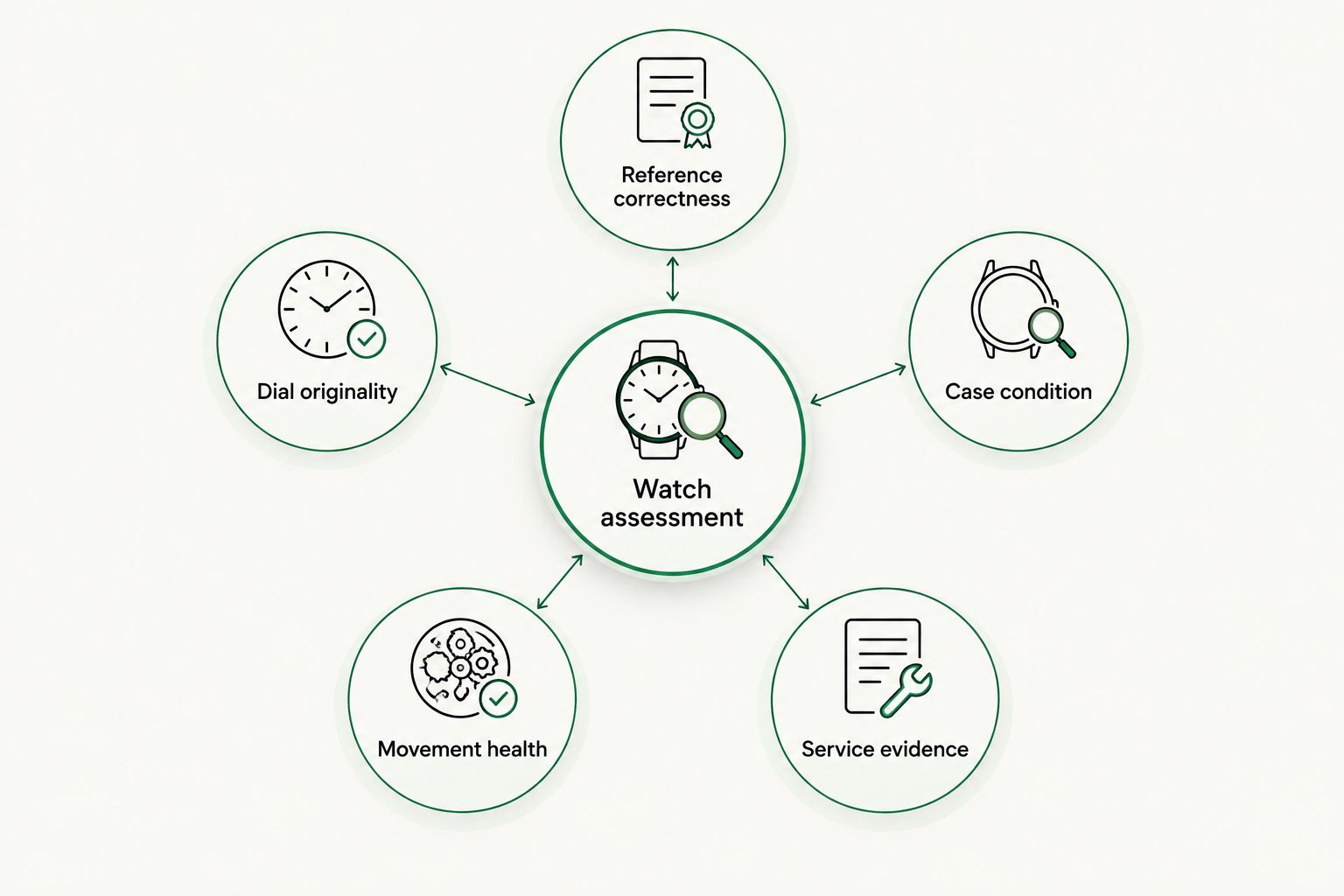
Use these five checks for either buying channel:
- Reference correctness: Does the watch’s configuration agree with the identified reference?
- Dial originality: What supports the description of the dial and hands?
- Case condition: Are the contours, edges and surfaces consistent with the stated condition?
- Movement health: What inspection or test evidence supports the movement’s condition?
- Service evidence: What work is documented, when was it performed and what did it include?
Independent authentication should address the actual watch. Photographs support an initial assessment, but they do not answer every question about internal components or movement health.
A box cannot be worn. Original packaging is not a proxy for quality, desirability or mechanical condition, and its presence does not settle authenticity. Assess the watch itself; use relevant documentation as evidence of specific facts, not as a substitute for inspection.
Wearability is a tie: dimensions and condition decide
Neither seller model changes how a watch sits on your wrist. The better daily watch is the example that fits, functions properly and suits your actual use.
Consider the nominal case diameters of three familiar references: the Rolex Datejust 1601 is 36 mm, the Rolex Submariner 14060 is 40 mm, and the Rolex Explorer II 216570 is 42 mm. Those measurements describe different starting points, not a universal ranking of comfort; lug span, thickness and bracelet fit also matter.
The Omega Seamaster mid-size quartz watch provides another concrete comparison, with 36.25 mm stated in its page title. Treat that as a reason to investigate fit, not proof that it will wear like another watch of similar diameter.
For bracelet watches, establish whether the bracelet can be fitted to your wrist and examine its condition. For a chronograph, check the operation and reset of the chronograph functions. For a watch intended for swimming, seek current water-resistance test evidence rather than relying on the model’s original rating.
In 2026, buying online still leaves physical fit unresolved unless you have tried the same configuration or obtained useful measurements. A desirable reference is not automatically a comfortable daily companion.
An Australian counterparty suits buyers avoiding cross-border complexity
An Australian retailer is the more suitable starting point when you want an Australian counterparty. That does not establish a dispatch location, delivery promise, warranty or returns policy; those are transaction-specific matters to verify.
Chrono24 lets you consider sellers in different countries, but international scope brings additional questions. Establish the seller’s location, the watch’s dispatch location, the invoicing currency and who is responsible for applicable import requirements.
Before committing to an overseas transaction, clarify:
- Responsibility for shipping and insurance.
- Applicable Australian import obligations.
- The process for addressing a material mismatch with the description.
- Who pays and arranges any agreed return shipment.
- Which written terms govern the transaction.
Chrono24 is not synonymous with buying from overseas: assess the actual seller and dispatch location. Equally, an Australian business address should not be treated as evidence of every logistical detail.
For a 2026 purchase, verify current requirements and terms before payment. Do not let an appealing reference turn unresolved transaction questions into an afterthought.
Pricing models: compare the complete offer, not the headline
The retailer model presents a seller’s offer for an individual watch. The marketplace model presents individual offers from different sellers. Neither structure establishes that one channel is cheaper, better value or more predictable for your particular purchase.
The practical trade-off is simplicity versus comparison. With a retailer, assess one offer and the obligations attached to it. Across a marketplace, you can compare several offers, but you must normalise differences in watch condition, seller location and written terms.
A sound comparison separates the watch from the transaction:
- Watch: originality, replacement components, case and dial condition, movement health and bracelet condition.
- Transaction: applicable charges, currency treatment, delivery arrangements and any written warranty or return terms.
Do not assume that documented servicing means every component was inspected or replaced. Read what the service evidence actually says. Likewise, do not assume that a warranty covers every future mechanical issue; establish its scope and exclusions before deciding what it adds to the offer.
For your 2026 decision, retain the current written offer rather than relying on remembered figures or another buyer’s experience. The comparison must concern the actual watch and the actual agreement.
Final verdict: choose the channel that matches your buying task
Choose James Patten if you are a retailer-led buyer
Best for: an Australian buyer who prefers assessing a luxury watch through an Australian retailer. This route fits when the presented watch matches your reference brief and you want to focus on one seller’s evidence and terms.
Proceed only when the individual watch passes your checks. The retail format is a reason to choose a channel, not a reason to overlook unclear originality, weak condition photographs or unresolved movement questions.
Choose Chrono24 if you are a reference-led collector
Best for: a collector comparing a precise reference across multiple sellers. Chrono24 fits when you are prepared to assess each seller and distinguish superficially similar examples through condition and originality evidence.
The additional choice demands additional screening. Reject listings that cannot answer material questions rather than treating a familiar reference number as sufficient reassurance.
| Dimension | Winner |
|---|---|
| Australian retailer-led buying | James Patten |
| Multi-seller reference comparison | Chrono24 |
| Fewer seller assessments | Retailer route |
| Authenticity and originality | Tie: evidence decides |
| Real-world wearability | Tie: the watch decides |
| Australian counterparty preference | Australian retailer route |
| Value and transaction terms | Individual offer decides |
FAQ
Is James Patten better than Chrono24 for buying a pre-owned watch?
James Patten suits buyers who prefer an Australian retailer; Chrono24 suits buyers comparing watches across multiple sellers. Neither channel establishes the quality of an individual watch without condition, originality and movement evidence.
Does buying on Chrono24 mean buying from overseas?
No: establish the location of the particular seller and where the watch will be dispatched from. Cross-border obligations depend on the actual transaction, not the marketplace name alone.
Is a watch more authentic because a dealer sells it?
No: the selling channel does not authenticate the watch. Seek independent assessment of the actual example, including reference correctness and relevant components.
Does a luxury watch need its original box and papers?
No: original packaging is not a requirement for desirability or a proxy for watch quality. Judge the watch through originality, condition, movement health and relevant evidence.
Is Chrono24 cheaper than an Australian watch retailer?
Neither buying model proves which individual offer represents better value. Compare equivalent references and condition, then examine the complete transaction terms.
What should I ask before buying a vintage Rolex online?
Ask about reference correctness, dial and hand originality, case refinishing, bracelet condition and movement health. Request service evidence where available and resolve material questions before payment.
Should I choose a smaller watch when buying online?
Choose the dimensions and configuration that suit your wrist, not a smaller diameter by default. Lug span, thickness and bracelet fit also influence real-world comfort.
One last thing
Ask this before paying: “Which parts are known replacements, and what remains unverified?” A precise answer is more useful than an unqualified claim of excellent condition.
A disclosed service replacement gives you something concrete to evaluate. An unanswered originality question leaves the decision unfinished, regardless of the seller or the presentation.


