
The Jaeger-LeCoultre Polaris is the reference point for buyers who want one watch that moves from the boardroom to the dive boat without changing character, and this guide breaks down which Polaris reference actually fits that brief in 2026.
- Jaeger-LeCoultre Polaris Mariner Date wins for sports-elegance buyers wanting genuine dive-rated durability with a dress silhouette.
- The Polaris line traces to the 1968 Memovox Polaris, giving the sports-elegance case shape real heritage, not a marketing label.
- Case size runs roughly 41-42mm across the range — confirm wrist fit before buying pre-owned in 2026.
- A pre-owned Jaeger-LeCoultre Polaris is judged on reference correctness and movement health, never on box and papers.
Why this matters for sports-elegance buyers
Sports-elegance is a real ownership category, not a design trend: it describes buyers who need a single watch for a client dinner on Friday and a boat on Saturday, and who are tired of owning two watches to cover both. The Jaeger-LeCoultre Polaris was built for exactly that brief when the line reappeared with an integrated bracelet and a dive-capable Mariner Date variant.
At James Patten Fine Watches, the buyers asking about Jaeger-LeCoultre Polaris pieces are usually collectors who already own a dress reference and a sports reference from bigger names and want a third watch that does not repeat either. That's a different brief from a first-luxury-watch buyer, and it changes which Polaris model actually makes sense.
The Jaeger-LeCoultre Polaris also sits in a different collector conversation than Rolex or Audemars Piguet sports pieces: it's bought on the strength of the watch and the manufacture behind it, not on hype cycles. That makes reference correctness and movement condition the whole story when you're evaluating one in 2026, not resale speculation.
Define what sports elegance means for your wrist
Before comparing Polaris references, work out what gap you're actually filling. A watch bought to solve the wrong problem gets worn twice and then sits in a drawer.
- Count how many watches already cover pure dress duty and pure sports duty in your current rotation
- List every setting the new watch needs to cover: boardroom, dinner, weekend sailing, gym-adjacent errands
- Decide whether you need a genuine dive rating or just a sports-dial look under a cuff
- Set a wrist-presence target — slim dress case versus tool-watch heft — before you start comparing models
- Note whether a bracelet or a strap suits your climate, your skin, and how often you swim in the watch
Map the Jaeger-LeCoultre Polaris lineup to your use case
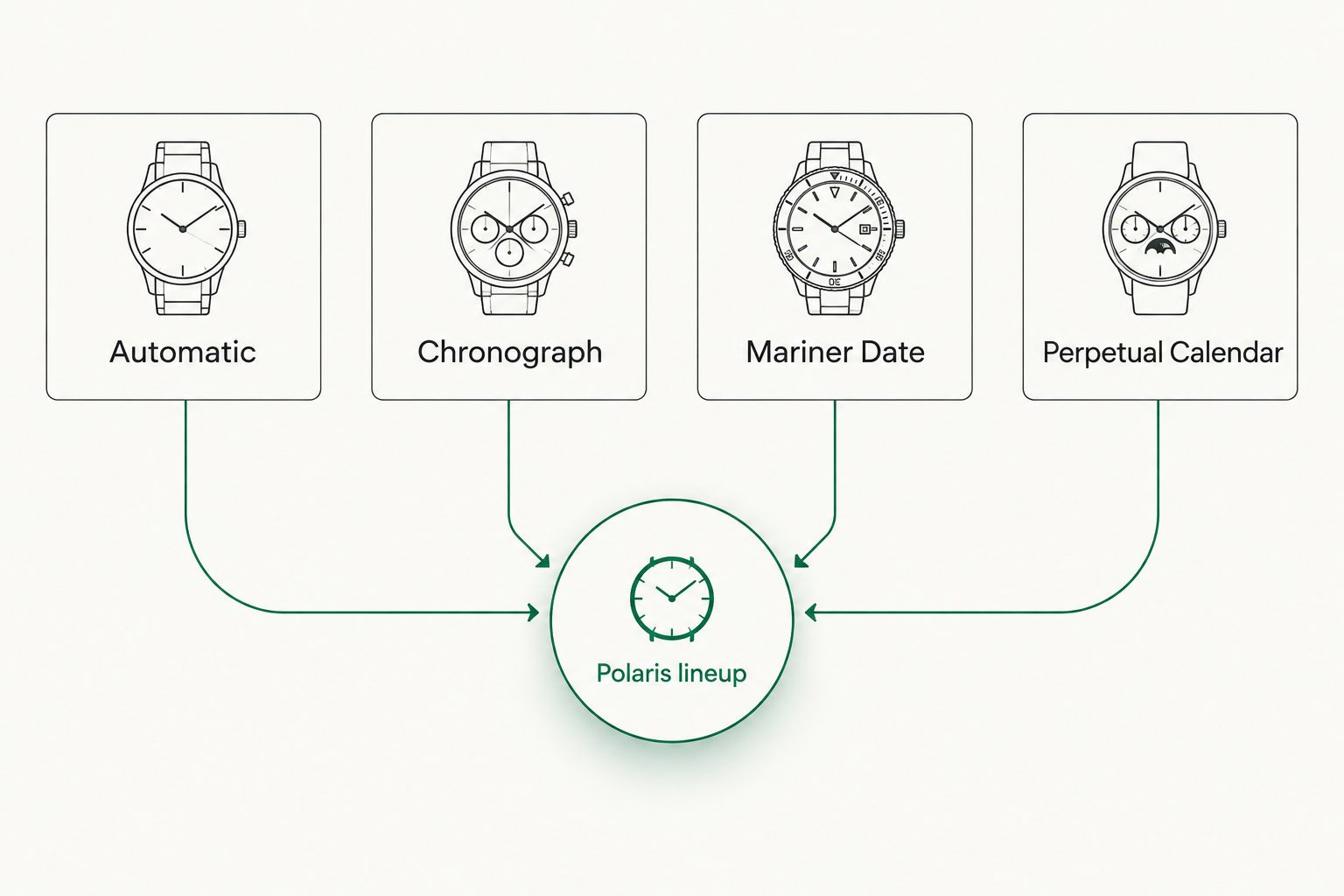
The Polaris family isn't one watch — it's four distinct cases built off the same 1968 Memovox Polaris silhouette, and picking the wrong one is the single most common mistake in this segment.
- Choose the Polaris Automatic for daily three-hand wear with a date function and the slimmest case in the range
- Choose the Polaris Chronograph when you need a column-wheel stopwatch on a sports-dress case rather than a pure tool look
- Choose the Polaris Mariner Date if diving or watersports are genuinely part of your week, not a hypothetical
- Choose the Polaris Perpetual Calendar only if you already collect complications and want that depth in a sports case
- Compare the Polaris silhouette against a pure dress reference like the Jaeger-LeCoultre Master Control before committing to a sports case at all
Get the case size and bracelet fit right
Case diameter alone doesn't tell you how a Jaeger-LeCoultre Polaris will sit on your wrist — lug-to-lug length and bracelet taper matter more, especially buying pre-owned without trying the piece on first.
- Try the Polaris Automatic at roughly 41mm on a 6.5-7.5 inch wrist before committing to a pre-owned purchase
- Try the Mariner Date and Chronograph at roughly 42mm if your wrist runs larger or you prefer more tool-watch presence
- Check bracelet taper and clasp type against your cuff clearance if the watch needs to disappear under a shirt sleeve
- Read a case size guide's wrist-to-lug advice if you're buying online without handling the piece
- Ask for lug-to-lug measurement, not just diameter, when buying pre-owned sight unseen — a full guide to choosing the right watch case size walks through the maths
Judge pre-owned examples on the watch, not the box
A Jaeger-LeCoultre Polaris does not need its original box or papers to be desirable, and treating packaging as a proxy for quality is a mistake that costs buyers real leverage in negotiation. A box cannot be worn — the reference itself is what you're buying.
- Verify the reference number against Jaeger-LeCoultre's published Polaris references before you go any further
- Check dial printing, lume plots and bezel insert for consistency with the stated reference
- Confirm the movement inside the case matches what that reference should carry, not a swap
- Treat original box and papers as nice-to-have, never as a substitute for checking the watch itself
- Ask the seller for independent authentication before you commit — a full guide to understanding luxury watch condition grading sets out what "good condition" should actually mean
Check movement health and service evidence
A sports-elegance watch gets worn hard — more sun exposure, more temperature swings, more knocks than a dress piece sitting in a safe most of the week. Movement health matters more here than on a watch you'll wear twice a month.
- Ask when the movement was last serviced and by whom, and get it in writing
- Look for amplitude and timekeeping figures from a recent service report if one exists
- Check the rotor and bridges for signs of prior water intrusion or corrosion
- Budget for a service if there's no documented work in the last several years
- Treat an undocumented movement as a negotiating point on price, not an automatic dealbreaker
Weigh new against pre-owned for this segment
Both paths make sense depending on what you're solving for. New buyers want zero condition questions; pre-owned buyers usually want a specific reference that's no longer in production.
- Buy new when current warranty coverage and zero condition ambiguity matter more than reference choice
- Buy pre-owned when you want a specific discontinued Polaris reference not currently sold new
- Compare resale patterns against better-known sports-luxury references before assuming a Jaeger-LeCoultre Polaris holds value the same way a Rolex Submariner does
- Factor in that condition grading affects long-term value more than the model name alone
- Get a written condition report before wiring funds on any pre-owned piece
Jaeger-LeCoultre Polaris models compared
| Model | Best for | Key limitation |
|---|---|---|
| Polaris Automatic | Daily three-hand wear, slimmest case in the range | No chronograph or dive rating |
| Polaris Chronograph | Buyers wanting a stopwatch function on a sports-dress case | Larger case reads less formal under a cuff |
| Polaris Mariner Date | Genuine watersports use with an integrated-bracelet silhouette | Bulkier bezel adds tool-watch presence |
| Polaris Perpetual Calendar | Collectors wanting complication depth in a sports case | Added complexity raises service considerations |
The Jaeger-LeCoultre Polaris Mariner Date is the clearest sports-elegance verdict in the range: it's the only reference rated for genuine water time while keeping the integrated-bracelet silhouette the rest of the family shares.
Talk through a Polaris purchase
Get guidance on reference choice, condition and fit before you buy.
Common mistakes sports-elegance buyers make
- Assuming a Jaeger-LeCoultre Polaris needs box and papers to be desirable. Reference correctness and movement health carry the value, not the packaging.
- Picking the Chronograph for actual diving. Only the Mariner Date is built for genuine water time; the Chronograph is a sports-dress piece, not a tool watch.
- Ignoring lug-to-lug length and buying on diameter alone. A 42mm case can still overhang a smaller wrist depending on lug spread.
- Comparing Polaris resale directly against Rolex Submariner without adjusting for demand. Different collector bases move resale differently — treating them as equivalent misreads the market.
- Skipping independent authentication because a seller "seems legitimate." Reference correctness needs verification every time, regardless of how the transaction feels.
FAQ
What is the Jaeger-LeCoultre Polaris best for?
The Jaeger-LeCoultre Polaris is best for buyers who need one watch to cover both dress and sports settings without switching pieces. The Mariner Date variant adds genuine water resistance for anyone who actually swims or sails in the watch.
Is the Jaeger-LeCoultre Polaris a dive watch?
Only the Polaris Mariner Date is built as a genuine dive watch, rated to 300m with a unidirectional bezel. The Automatic, Chronograph and Perpetual Calendar are sports-styled but not dive-rated in the same way.
How does the Jaeger-LeCoultre Polaris compare to the Rolex Submariner?
The Polaris Mariner Date and the Rolex Submariner both offer integrated-look sports cases with genuine water resistance, but they sit in different collector conversations — Rolex trades on brand recognition and liquidity, while Jaeger-LeCoultre trades on manufacture depth and relative rarity.
Does a Jaeger-LeCoultre Polaris need box and papers to be worth buying?
No. A Jaeger-LeCoultre Polaris is judged on reference correctness, originality, movement condition and independent authentication, not on whether the original box survived. Packaging cannot be worn and does not affect how the watch performs.
What size is the Jaeger-LeCoultre Polaris case?
The Polaris range runs roughly 41mm on the Automatic up to about 42mm on the Chronograph, Mariner Date and Perpetual Calendar. Confirm lug-to-lug length as well as diameter before buying pre-owned.
Should I buy a new or pre-owned Jaeger-LeCoultre Polaris in 2026?
Buy new in 2026 if you want current warranty coverage and zero condition questions. Buy pre-owned if you want a specific discontinued reference, but get a written condition report first.
What movement powers the Jaeger-LeCoultre Polaris?
The Polaris range runs on in-house Jaeger-LeCoultre automatic movements specific to each model — the three-hand Automatic, the column-wheel Chronograph, and the more complex Perpetual Calendar each use a different caliber built for that function.
One last thing
The Polaris name and rotating compass bezel aren't a modern styling choice — they're a direct callback to the 1968 Memovox Polaris, which used a rotating outer ring as a functional compass bezel for divers. That heritage detail is why the current Jaeger-LeCoultre Polaris reads as a real tool-watch descendant rather than a dress case with a sports dial bolted on, and it's the detail worth mentioning if you're ever asked to justify the purchase to another collector.


