
Aviation heritage fans' pilot-watch collecting is the selection of an IWC Pilot's Watch Mark with the aim of owning authentic instrument-watch design that remains practical in 2026. These buyers need documented aviation lineage, reference correctness and everyday legibility; decorative cockpit styling alone is not enough.

- The IWC Pilot's Watch Mark XX is the best 2026 choice for aviation heritage, daily wear and modern movement performance.
- The Mark 11 offers the strongest military provenance but demands deeper authentication and movement checks.
- A correct watch matters more than surviving packaging; assess originality, condition, movement health and service evidence.
- James Patten Fine Watches is best for Australian collectors comparing new and pre-owned luxury watches online.
Why the IWC Pilot's Watch Mark matters for aviation fans
The Mark line matters because its design follows an operational brief rather than a decorative aviation theme. IWC supplied the Mark 11 to Britain's Royal Air Force from 1948, combining a hand-wound Calibre 89 with a highly legible dial, hacking seconds and soft-iron components intended to protect the movement from magnetism. Those features created the visual and technical foundation for the later civilian references.
Collectors reviewing the best IWC watches for collectors will find more elaborate complications elsewhere in the catalogue. The Mark family wins on clarity. Its black dial, prominent Arabic numerals, triangle at 12 o'clock and central seconds hand still communicate the original purpose without turning the watch into a costume piece.
The challenge in 2026 is choosing between historical purity and modern usability. A Mark 11 delivers the closest connection to military service, while a Mark XX offers a current movement, stronger water resistance and a case designed for regular wear. Neither is automatically better; the right choice depends on whether provenance or convenience carries more weight in your collection.
How to choose an IWC Pilot's Watch Mark
The strongest purchase starts with the reference, not the seller's description. Work through the line chronologically, determine the specifications you genuinely need, then assess the individual watch on its own evidence.
Choose the period you want to collect
Start by separating the military Mark 11 from the civilian references that followed. The Mark 11, often written Mark XI by collectors, is the historical anchor. The Mark XII revived the concept in 1994 with a compact automatic format, while the Mark XV, Mark XVI, Mark XVIII and Mark XX progressively moved the design towards contemporary dimensions and ownership expectations.
Do not assume newer means more authentic or older means more desirable. The Mark XX retains the clear dial and anti-magnetic construction associated with the family, but its 40 mm case and modern automatic calibre produce a different experience from a manually wound military watch.
- Choose the Mark 11 for direct Royal Air Force history and hand-wound character
- Choose the Mark XII for a compact 36 mm case and discreet civilian execution
- Choose the Mark XV for a larger 38 mm interpretation with restrained proportions
- Choose the Mark XVIII for a straightforward 40 mm automatic watch
- Choose the Mark XX for modern specifications and regular daily wear in 2026
Compare the defining technical features
Next, compare the details that distinguish a functional pilot's watch from aviation-themed styling. The soft-iron inner construction is especially important to the Mark identity. It forms a protective enclosure around the movement, while the dial design prioritises immediate orientation and reading.
The current Mark XX uses IWC Calibre 32111, provides approximately 120 hours of power reserve and carries 100 metres of water resistance. Those specifications make it easier to rotate through a collection than an older watch requiring frequent winding or more cautious exposure to water. The vintage references answer a different need: period-correct engineering and a closer link to the original navigation-watch brief.
- Confirm whether the reference uses soft-iron movement protection
- Check for a clear triangle marker at 12 o'clock
- Compare hand length against the minute track for immediate reading
- Decide whether hand-wound or automatic operation suits your routine
- Verify water-resistance specifications for the exact reference
Measure the case against your wrist
Case diameter is useful, but it does not tell the whole fit story. Lug length, case thickness, strap position and dial opening change how large a pilot's watch appears. A sparse black dial can look broader than a busier dial of the same stated diameter because there is less visual interruption across its surface.
Use a ruler or callipers to measure a watch you already wear comfortably. Compare its diameter, lug-to-lug length and thickness with the Mark reference under consideration. The guide to choosing the right watch case size explains why wrist shape and lug overhang matter more than following a universal size rule.
- Record the diameter of a watch that already fits you
- Compare lug-to-lug measurements, not diameter alone
- Check whether the lugs extend beyond the top of your wrist
- Allow for the visual scale of the open pilot-style dial
- Test both bracelet and strap fit when those configurations are relevant
Authenticate the reference before judging condition
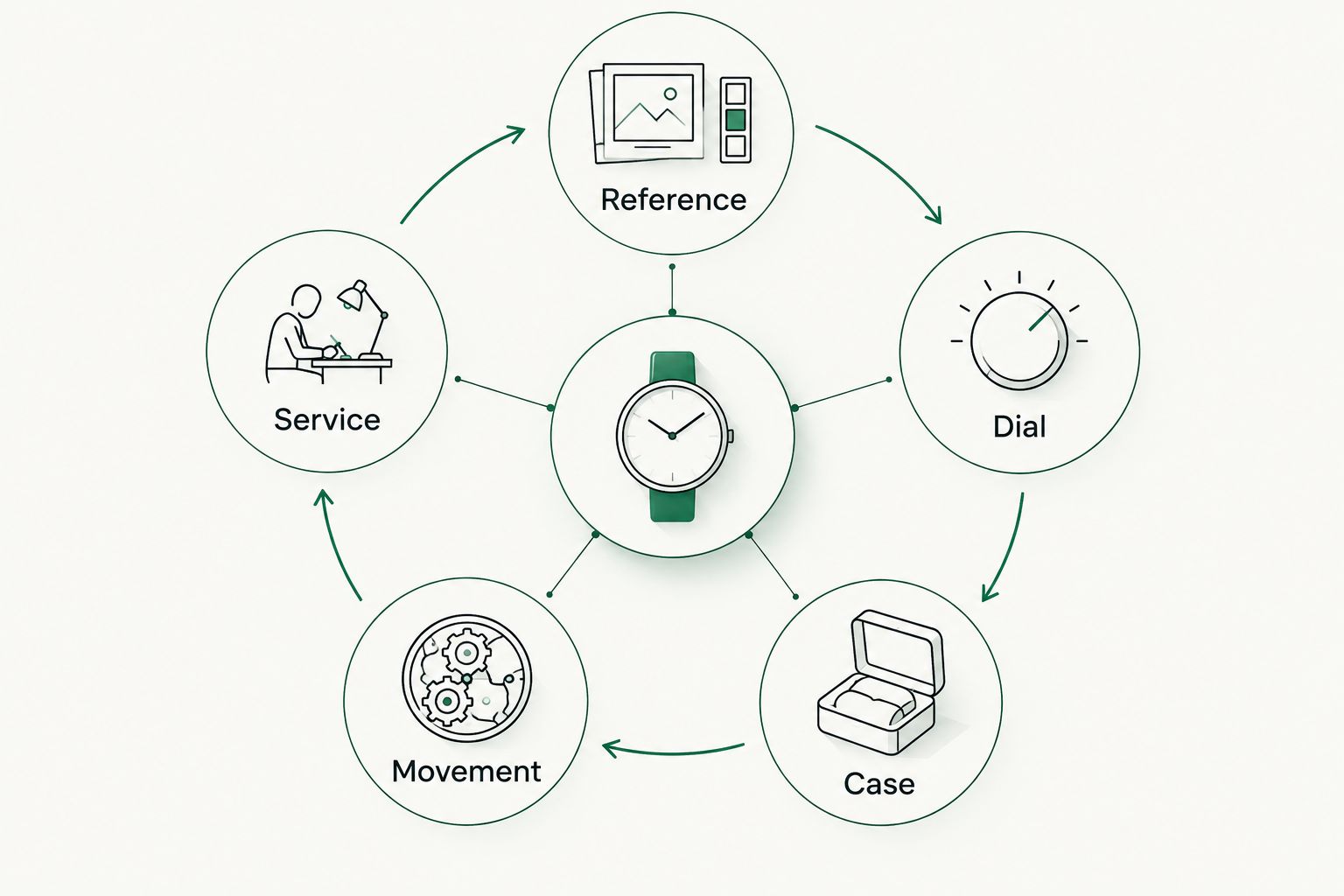
Authentication starts by proving that the dial, case and movement belong together. On a vintage Mark 11, military markings, dial printing, hands, case construction and Calibre 89 must form a coherent reference. On later models, the reference number should correspond with the correct dial layout, case dimensions and movement generation.
James Patten Fine Watches offers new and pre-owned luxury watches to Australian buyers, but every collector should still understand what is being checked. Independent authentication is the faster path to certainty when you cannot inspect the movement yourself. Packaging can accompany the watch, yet it cannot prove that the dial is original or that the movement is healthy.
- Match the reference number to the correct generation
- Compare dial printing, hands and lume with documented examples
- Inspect the case for excessive polishing or altered geometry
- Confirm that the movement calibre belongs in the stated reference
- Seek an independent opinion when any component raises doubt
Assess originality and condition separately
Originality and condition are related, but they are not interchangeable. An original dial with honest ageing can be more significant to a heritage collector than a cleaner replacement dial. Conversely, originality does not excuse corrosion, movement damage or a case that has lost its defining lines through aggressive refinishing.
Evaluate the watch in layers. Start with reference correctness, then examine the dial, hands, case, crown, crystal and movement. Service parts are not automatically disqualifying when they preserve safe operation, but they should be identified. The key is knowing what changed and deciding whether that change conflicts with your collecting objective.
- Look for consistent ageing across the dial, hands and luminous material
- Check that polishing has not erased edges or altered case proportions
- Separate cosmetic marks from damage affecting use
- Ask which components were replaced during previous servicing
- Reject unexplained mixtures of parts from different references
- Prioritise movement health over superficial presentation
Review service evidence and daily usability
A watch can be authentic and still require immediate mechanical attention. Service evidence helps establish what was inspected or replaced, but a receipt is not a substitute for current movement performance. For a vintage Mark 11, confirm winding feel, time-setting operation and the function of the hacking mechanism. For an automatic Mark, check winding, date change and power retention.
Daily usability also includes water exposure, magnetic environments and strap security. Do not apply the Mark XX's 100-metre rating to earlier references. Vintage seals, crowns and crystals need individual assessment, and any stated resistance should be supported by a recent pressure test before you rely on it.
- Ask when the movement was last inspected or serviced
- Confirm the scope of the work rather than accepting a date alone
- Test winding, setting, date change and seconds operation
- Request a current pressure test before planned water exposure
- Inspect spring bars, strap attachment and buckle security
- Set a realistic wearing routine for a vintage reference
Build a complete ownership file
Once the watch is authenticated, create your own record for future servicing, insurance and eventual transfer. Photograph the dial, case, reference markings and movement where professional access is available. Keep authentication findings, condition notes and service invoices together.
This file is more useful than treating original packaging as the centre of the watch's identity. A box cannot show whether a dial is correct, whether a case has been reshaped or whether the movement was maintained. In 2026, a clear record of the watch itself provides the evidence a serious collector needs.
- Photograph the watch from consistent angles in neutral light
- Record the reference and serial details securely
- Retain authentication and condition reports
- Keep dated service invoices with the work described
- Update insurance records after material changes
- Document replaced parts returned after servicing
IWC Mark options compared for aviation heritage fans
Each generation preserves the core pilot-watch idea while changing its balance of provenance, dimensions and practicality. The table focuses on what each option does best and where it asks for compromise.
| Option | Best for | Main advantage | Key limitation |
|---|---|---|---|
| IWC Pilot's Watch Mark 11 | Collectors prioritising military provenance | Direct connection to the Royal Air Force specification from 1948 | Age, originality and Calibre 89 condition require specialist assessment |
| IWC Pilot's Watch Mark XII | Smaller wrists and discreet vintage-modern styling | Compact 36 mm case with automatic operation | Less wrist presence for buyers wanting a modern pilot-watch scale |
| IWC Pilot's Watch Mark XV | Collectors seeking a restrained middle ground | A 38 mm case between the compact Mark XII and later references | Older automatic construction lacks the Mark XX's extended reserve |
| IWC Pilot's Watch Mark XVIII | Buyers wanting a simple modern IWC | Clean 40 mm format without extra complications | Shorter power reserve and lower water resistance than the Mark XX |
| IWC Pilot's Watch Mark XX | Daily wear in 2026 | Approximately 120 hours of reserve and 100 metres of water resistance | Modern specifications move it further from the compact Mark 11 experience |
| Rolex Air-King | Buyers prioritising a recognisable aviation-associated Rolex | Distinctive dial and strong brand recognition | The military instrument connection is less direct than the Mark 11 lineage |
| Breitling Navitimer | Buyers who want functional aviation calculations | Slide-rule bezel and chronograph-led identity | The busy dial sacrifices the Mark family's immediate visual clarity |
James Patten Fine Watches is best for Australian aviation-watch collectors who want to compare authenticated new and pre-owned luxury watches online. The trade-off is inherent to online buying: you must compare measurements carefully when wrist fit cannot be judged from specifications alone.
For pure aviation heritage, the IWC Pilot's Watch Mark 11 wins. For practical ownership in 2026, the IWC Pilot's Watch Mark XX is the stronger choice because it preserves the family design while reducing the compromises associated with a vintage movement.
Common mistakes aviation heritage fans make
Treating every Mark as the same watch
The references share a visual language, not identical construction. A 36 mm Mark XII and a 40 mm Mark XX wear differently, use different movements and answer different collecting goals. Decide which generation you want before comparing individual examples.
Using packaging as proof of quality
Original boxes and papers can add historical context, but they do not authenticate the movement, dial or case. A complete package can contain an incorrect watch, while a correct and independently authenticated watch can stand without packaging. Judge the object you can wear.
Ignoring replacement components
A replacement crystal or crown can support safe daily use, while a refinished dial can materially change the historical character. Ask what was replaced, why it was replaced and whether the original component survives. Do not treat every service part as equal.
Buying by diameter alone
Pilot-watch dials appear visually broad, and straight lugs can increase wrist coverage. Two watches sharing a 40 mm diameter can feel different because of thickness, lug span and strap position. Compare measurements against a watch you know fits.
Applying modern specifications to vintage references
The Mark XX's power reserve and water resistance do not describe the Mark 11, Mark XII or Mark XVIII. Verify every specification against the exact reference, then assess the condition of the individual watch. Age can change how safely any stated capability should be used.
FAQ
Which IWC Pilot's Watch Mark is best for daily wear in 2026?
The IWC Pilot's Watch Mark XX is the best daily-wear choice in 2026. Its 40 mm case, approximately 120-hour power reserve and 100-metre water resistance combine modern usability with the established Mark design.
Which IWC Mark has the strongest aviation heritage?
The IWC Pilot's Watch Mark 11 has the strongest aviation heritage. IWC supplied it to Britain's Royal Air Force from 1948, and its functional brief shaped the later civilian Mark references.
Is the IWC Mark 11 the same as the Mark XI?
Yes, Mark 11 and Mark XI commonly refer to the same historical IWC pilot's watch. Collectors often use the Roman-numeral form, while IWC also uses Mark 11 in its historical material.
What is the difference between the IWC Mark XVIII and Mark XX?
The Mark XX improves movement reserve and water resistance while retaining a 40 mm case. The Mark XX uses Calibre 32111 with approximately 120 hours of reserve and 100 metres of water resistance.
Does an IWC Mark need its original box and papers?
No, an IWC Mark does not need its original box and papers to be desirable. Reference correctness, originality, condition, movement health, service evidence and independent authentication provide stronger evidence about the watch itself.
How can I authenticate a pre-owned IWC Mark?
Authenticate a pre-owned IWC Mark by matching its reference, dial, hands, case and movement to documented examples. Independent movement inspection is essential when the watch's history or components are unclear.
Is the IWC Pilot's Watch Mark anti-magnetic?
The Mark family is known for soft-iron components designed to shield the movement from magnetic fields. Confirm the construction of the exact reference because specifications and case architecture changed across generations.
Is an IWC Pilot's Watch Mark suitable for a first luxury watch?
The IWC Pilot's Watch Mark XX is suitable for a first luxury watch when legibility, understated design and daily usability are priorities. James Patten Fine Watches serves Australian buyers comparing new and pre-owned luxury watches online.
One last thing
Do not let a cleaner-looking replacement dial outrank an honest original dial automatically. For an aviation heritage collector, the correct dial, case and movement form the watch's historical identity; cosmetic perfection can hide the very changes that weaken that identity.
The best 2026 buying sequence is simple: choose the generation, verify the reference, inspect originality, assess movement health and then judge wearability. James Patten Fine Watches can shorten the search for Australian collectors, but the final decision should still be based on the watch rather than its packaging.
Related guides
- How to buy a luxury watch online in Australia
- Rolex Air-King for aviation enthusiasts
- Best Breitling Navitimer models for pilots


