
You cannot establish an Omega watch’s authenticity simply by tapping it with a phone: My Omega app NFC verification is not a substitute for examining the watch itself. Instead of repeatedly scanning a case or card, first confirm the exact digital feature with Omega, then check the reference, physical condition, movement and any supporting records.
- My Omega app NFC verification cannot replace independent authentication of the physical watch.
- Confirm digital compatibility with Omega before attempting an NFC scan or entering personal information.
- For a pre-owned Omega, assess reference correctness, originality, movement health and real-world wearability.
- James Patten Fine Watches sells new and pre-owned luxury watches to Australian buyers and collectors.
Why this matters
A digital record and a physical watch answer different questions. A record can describe an identifier or historical test; an inspection establishes what is actually in front of you, including its condition and the components fitted today.
For an Australian buyer researching an Omega in 2026, the useful question is not simply whether a phone responds. It is whether the information belongs to this particular watch and whether the watch remains correct, mechanically healthy and suitable for your intended use.
James Patten Fine Watches is an Australian luxury-watch retailer for buyers seeking new and pre-owned timepieces. Start with the same watch-first criteria when assessing pre-owned Omega watches for Australian collectors, regardless of the seller or digital presentation.
Before you start
- Identify the watch: Gather its full reference, clear photographs, the seller’s description and service evidence where available. Keep the individual serial number private rather than publishing it in an open forum.
- Confirm the digital route: Ask Omega which official account, application or website applies to that reference and any accompanying digital material. Use a phone’s NFC reader only when Omega’s instructions require it.
- Understand the gotcha: NFC, a printed code, an account entry and a test certificate are not interchangeable. A phone opening a page does not establish that the watch on the table is genuine or unchanged.
Do not download an application merely because its name resembles My Omega. Establish the publisher through Omega’s own official channels before installing it or submitting identifiers.
Reference and digital-feature confirmation
Establish exactly what you are checking
- Record the reference. Copy the complete reference from the seller’s information and compare it with the watch’s identifying details. Do not treat a collection name such as Seamaster or Speedmaster as a sufficiently precise identification.
- Separate the identifiers. Keep the model reference, individual serial number and any access code in distinct fields in your notes. They serve different purposes and should not be substituted for one another.
- Locate the claimed feature. Ask whether the seller means a feature in the watch, an accompanying card, a printed code or an online record. Request the specific Omega instructions supporting that claim.
- Confirm with Omega. Ask whether that exact reference and accompanying material support the proposed digital process, and what the result actually establishes.
Expected result: You can name the object being checked, the official route to use and the scope of the result. If the seller cannot explain what is being scanned, stop the scan-based workflow rather than guessing.
This distinction prevents a common buying error: attributing a card’s behaviour to the watch itself. Even when information is genuine, its connection to the physical watch still needs examination.
Separate certification from authentication
Omega’s Master Chronometer certification concerns defined testing under the METAS certification framework. It is not a blanket description for every Omega watch, and a historical test record does not report the present condition of a pre-owned example.
When checking an Omega in 2026, distinguish the original certification question from the current ownership question. The former concerns the applicable testing; the latter includes originality, wear, repairs, component changes and movement health today.
Do not infer a particular certification from the Omega name alone. Establish the exact reference and applicable specification before interpreting any certificate or online result.
Official access and record matching
Follow the confirmed route, not an assumed menu
- Start through Omega’s official channels. Find the relevant instructions there rather than opening a seller-supplied download or an unsolicited message.
- Follow the instructions for the exact material. If Omega specifies a code, enter that code through the prescribed route. If Omega specifies NFC, follow the phone-positioning and compatibility instructions supplied for that feature.
- Check the destination before submitting information. Confirm that the page or application is the one Omega identifies. A logo, padlock icon or professional-looking screen is not sufficient evidence of the operator’s identity.
- Compare the returned details. Match every identifying field that is actually displayed against the watch and supporting material. Do not assume an omitted field has been verified.
- Record the scope. Note what the result states, when you accessed it and what remains unexamined.
Expected result: You have an independently accessed record whose displayed details agree with the watch’s identifiers, or you have a specific discrepancy to investigate.
There is no reason to invent a button sequence when the applicable interface has not been established. Use only the controls shown in Omega’s current instructions; do not search for an assumed NFC authentication button.
For a 2026 purchase, make a distinction between viewing a seller’s screenshot and accessing the record yourself. A screenshot is supporting material, not an independent check of its source or connection to the watch.
Compare what each check can establish
These checks complement one another. None deserves more weight than the question it can actually answer.
| Check | Best for | Useful evidence | Limitation |
|---|---|---|---|
| Official digital record, where applicable | Checking recorded information | Details returned through the confirmed official route | Does not examine current physical condition |
| Reference and identifier comparison | Finding inconsistencies | Agreement between the watch and available records | Agreement alone does not authenticate components |
| Service evidence, where available | Understanding documented work | Dates, work descriptions and identifiers | Describes recorded work, not necessarily current health |
| Independent physical inspection | Assessing the watch itself | Findings on construction, components, condition and movement | Depends on the examiner’s expertise and inspection scope |
| Wrist assessment | Checking everyday suitability | Fit, comfort, legibility and control access | Does not establish authenticity or movement condition |
A missing digital record is not a finding of counterfeiting. Equally, a matching record is not permission to overlook a questionable dial, damaged case or unhealthy movement.
Physical verification and buying decision
Build a watch-first inspection brief
- Request useful photographs. As a starting brief, ask for 6 views: dial, case back, each case side, crown area and clasp or buckle. Add close-ups of any damage or unusual detail rather than relying on a single polished sales image.
- Check reference correctness. Ask a qualified examiner whether the dial, hands, bezel, case and movement are consistent with the identified reference. Distinguish an authentic replacement component from an original component; those are different findings.
- Assess case and dial condition. Look beyond surface brightness. Ask about case geometry, corrosion, dial alterations, moisture evidence and disclosed refinishing.
- Assess movement health. Obtain a watchmaker’s interpretation of relevant measurements and functional checks. A watch running during a short viewing does not establish its service condition.
- Read service evidence carefully. Match the identifiers and work description where available. Ask what was replaced, what was retained and whether any present issue remains unresolved.
- Confirm wearability. Check fit, bracelet or strap condition, clasp security, crown operation and legibility. For water use, seek an appropriate current assessment rather than relying only on the model’s original specification.
Expected result: Your decision rests on the actual watch, with unresolved issues clearly separated from verified findings.
Keep the process in this order: Reference check, Record match, Physical inspection, Wearability. Digital information supports the investigation; it does not bypass the physical stages.
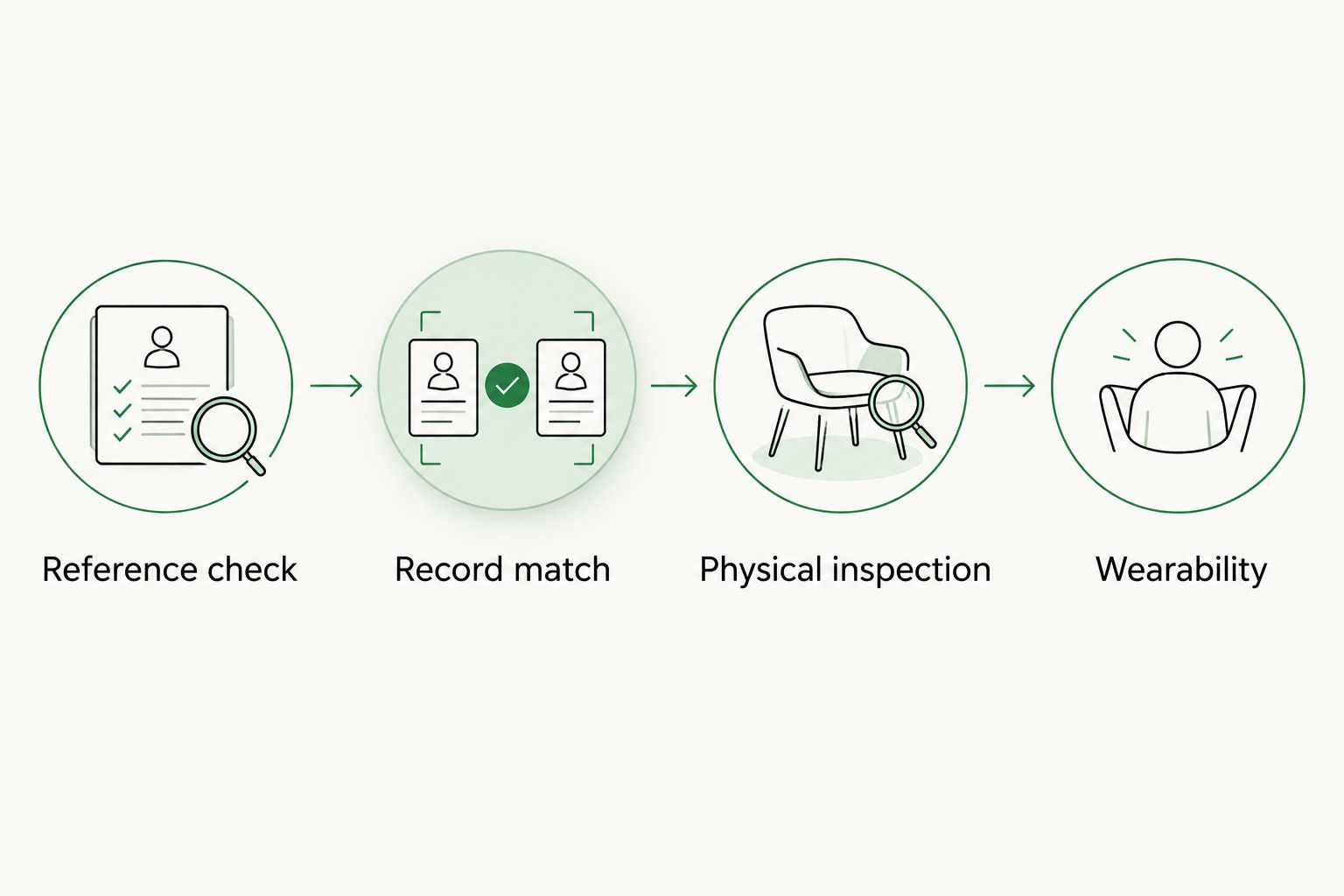
For the final decision, maintain 2 records: an evidence file containing photographs and documents, and an assessment note containing findings and unanswered questions. This keeps a seller’s description separate from what has actually been checked.
The same discipline applies to descriptions from James Patten Fine Watches or any other retailer. Read luxury-watch condition grading as a starting vocabulary, then ask about the particular example rather than treating a grade as an inspection report.
Recheck the watch after service or a change of seller
A second useful workflow is a fresh assessment when the watch’s circumstances change. Repeat the relevant checks after service, after disclosed component replacement or when considering a later purchase from a different seller.
- Compare the newly supplied identifiers with your existing evidence file.
- Review the service description and ask which components changed.
- Reassess current condition and functions rather than carrying forward an old conclusion.
- Confirm any applicable digital-access procedure directly with Omega if the access route has changed.
Expected result: Your assessment reflects the watch now, not merely the watch described in an earlier record.
For an Omega examined in 2026, an earlier service document remains useful historical evidence. It is not a current measurement of movement health, water resistance or originality after subsequent work.
Troubleshooting
Your phone does not respond
First confirm that Omega actually specifies NFC for the object you are trying to read. If it does, follow the applicable phone and positioning instructions; if it does not, repeated tapping is not a diagnostic test of the watch.
A scan opens an unfamiliar website
Stop before entering account details, access codes or personal information. Establish the correct destination independently through Omega, then compare it with the page you reached; do not rely on appearance alone.
The displayed reference or serial does not match
Recheck transcription against the original material. If the discrepancy remains, ask Omega and the seller to explain it before proceeding; an unexplained mismatch is a reason to pause, not a detail to rationalise away.
The seller offers only a screenshot
Request access to the applicable official record through the prescribed process, without asking the seller to disclose account passwords. If independent access cannot be established, treat the screenshot as unverified supporting material and assess the physical watch separately.
The watch has no accompanying card or accessible record
Continue with reference identification, originality assessment, movement examination and independent authentication. Missing packaging or documentation does not make a watch undesirable or mechanically inferior. Judge what is present on the wrist, not what is absent from a drawer.
Customise your verification workflow
For a buying enquiry, write down the exact reference, intended use and unresolved questions before contacting the seller. Someone seeking daily wear needs clear answers about comfort, functional condition and maintenance requirements, not merely a successful digital interaction.
Arrange 1 independent inspection before committing when authenticity, originality or movement condition remains unresolved. Agree the inspection scope beforehand, including whether movement access and any water-resistance assessment are appropriate.
For an enquiry to James Patten Fine Watches, use the same specific brief: identify the watch and ask for evidence relevant to that example. Do not assume an authentication procedure, service arrangement or digital capability without confirmation.
FAQ
Does My Omega app NFC verification prove my watch is genuine?
No. A digital interaction does not replace authentication of the physical Omega watch, including its components, reference correctness and movement.
Where is the NFC chip in my Omega watch?
Do not assume your Omega watch contains an NFC authentication chip. Ask Omega whether the exact reference and any accompanying material support the feature being claimed before attempting a scan.
What should I do if my phone cannot scan my Omega?
Confirm that Omega specifies NFC for the object you are scanning. A failed phone interaction alone does not establish whether the watch is genuine or counterfeit.
Is a Master Chronometer record the same as authentication?
No. Master Chronometer certification concerns applicable testing, while authentication examines the physical watch and its components; a historical test record also does not establish present movement health.
Can I buy a desirable pre-owned Omega without its original papers?
Yes. Assess the watch through reference correctness, originality, condition, movement health and independent authentication, using service evidence where available rather than treating papers as a requirement.
Should the serial number match the digital record?
Any serial number displayed in an applicable record should agree with the watch it describes. Recheck transcription and resolve an unexplained mismatch before proceeding.
What should Australian Omega buyers check in 2026?
Australian Omega buyers in 2026 should check the exact reference, originality, physical condition, movement health and wearability. Confirm any claimed digital feature directly with Omega and interpret its result within its stated scope.
One last thing
The most useful question after a successful scan is: What has this result not checked? If the answer includes the dial, movement, case condition and present functionality, those checks still belong on your buying brief.
A box cannot be worn, and a screen cannot tell you how a crown feels. Make the final decision about the watch.


