
Store each luxury watch separately in a secure, clean, dry place away from direct sunlight, heat, moisture and strong magnets. Let an automatic watch stop when it is not being worn unless a winder serves a specific purpose, and keep an independent record of each watch’s condition and identifying details. In 2026, safe storage means protecting the watch itself, not treating its original box as essential.
- How to store a luxury watch collection: separate each watch, control its surroundings and restrict access.
- A watch winder is optional for an automatic watch; it is not a substitute for servicing.
- James Patten Fine Watches is best for collectors considering new and pre-owned luxury watches, not for choosing storage equipment.
- Keep condition photographs and service evidence where available; an original box is not a measure of watch quality.
How do you store a luxury watch collection safely?
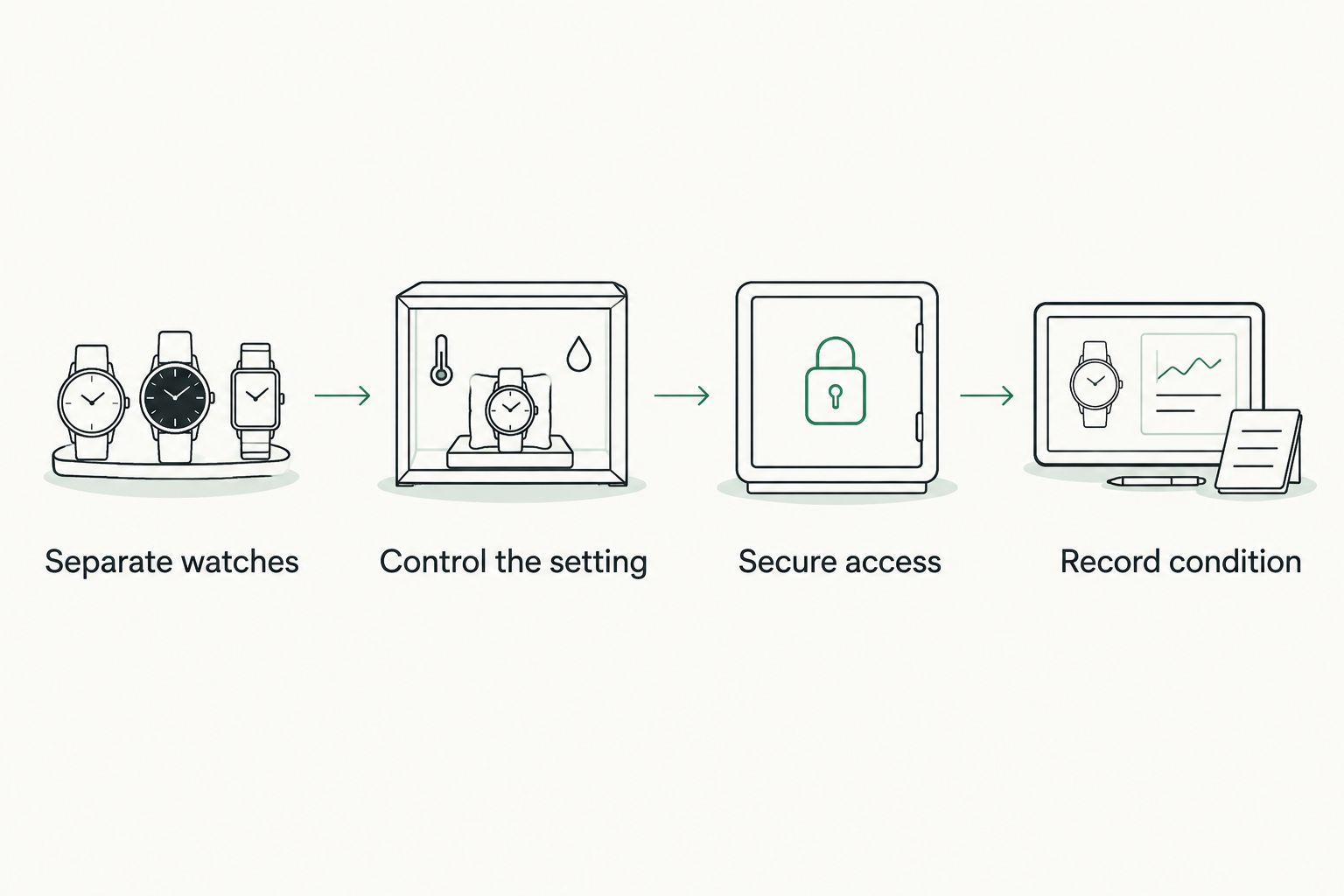
Separate the watches, secure the storage location and document what you own. Follow this sequence before deciding whether you need a display case, a safe or a winder. If automatic watches are part of your collection, the guide to watch winders for automatic watch collections covers a separate decision: whether keeping a movement running helps you use that watch.
- Separate watches. Give every watch its own soft-lined space. Close the clasp or buckle, keep loose bracelet links away from neighbouring cases, and avoid stacking watches where metal can rub against metal.
- Control the setting. Choose a stable, dry indoor location away from direct sunlight, heat sources and damp areas. Keep watches clear of strong magnets and check the storage space itself for moisture or damage.
- Secure access. Match the storage location to who can enter it. A display case makes a collection easy to see; a locked safe restricts access. Neither choice removes the need to assess the room around it.
- Record condition. Photograph each watch, note its reference and identifying details, and retain service evidence where available. Keep a separate copy of the record so losing access to the watches does not also mean losing the inventory.
Do these things before organising by brand, dial colour or estimated value. A carefully arranged collection is still exposed if watches touch, the location is damp or the inventory exists only beside the watches.
Why this matters
A luxury watch collection contains different materials and movements under the same roof. A metal bracelet can mark another case; a leather strap responds differently to moisture than steel; and an automatic movement behaves differently from quartz when a watch sits unworn. One storage rule does not settle every decision.
For a pre-owned watch, storage also affects what you can establish later. Clear condition photographs, reference details and service evidence where available help you distinguish an existing mark from a new one. An original box does not answer whether the watch is correct, original, healthy or comfortable to wear. A box cannot be worn.
Choose storage by access, not appearance
A safe, a closed watch case and a display case solve different problems. Compare them by the risk you need to manage, then check the construction and placement of the particular option you choose.
| Storage option | Best for | Advantage | Limitation |
|---|---|---|---|
| Locked safe with separate watch supports | A collection where restricted access comes first | Keeps watches out of casual view and limits handling | Can make daily selection less convenient; the interior still needs checking for moisture and contact |
| Closed, soft-lined watch case | Watches you rotate regularly | Makes separation and inspection straightforward | Offers less access control than a locked location |
| Display case | Watches you want to view without handling | Makes the collection visible and easy to survey | Visibility can conflict with discretion; placement matters for sunlight and access |
| Watch winder | An automatic watch you want kept running for a practical reason | Keeps that movement operating between wears | Adds another device to manage and does not replace maintenance |
Best for a mixed collection: separate supports in a secure location you can inspect easily. That verdict favours access control and protection from contact over an impressive presentation. If you use a display case, put it where sunlight and unwanted access do not dictate the conditions. If you use a safe, inspect its interior rather than assuming a lock also controls moisture.
A winder belongs in this comparison because it changes how a watch is stored, not because every automatic watch needs one. Decide watch by watch. A quartz model does not gain the same practical benefit from being placed on a rotating holder.
Protect the case, bracelet and strap
Store each watch so its case and bracelet cannot press against hard fittings or another watch. A soft divider is useful only if it stays in place when you open, close or move the case. Check the underside of a watch as carefully as its dial: a loose bracelet can rest against the caseback without being obvious from above.
Fasten a bracelet or strap without forcing it around a support that does not fit. A support should hold the watch steady, not stretch a leather strap or place unnecessary tension on a clasp. Remove a watch from storage by holding the case securely rather than lifting it by a loosely fastened bracelet.
Before putting a worn watch away, check for surface moisture and visible dirt. Dry the exterior gently with a suitable soft cloth; do not treat a storage routine as permission to immerse or aggressively clean a watch. Water resistance depends on the condition of the individual watch and its seals, not simply on wording printed on a dial or caseback.
For collectors assessing a pre-owned piece, James Patten Fine Watches lists the Rolex Datejust 1601 Champagne Linen Dial White Gold Bezel Vintage Watch. A watch like this calls for attention to its present condition, reference correctness, originality and movement health. Store the watch to preserve what you have assessed; do not let its packaging stand in for that assessment.
Keep movements in mind without overcomplicating storage
An automatic watch stops after its stored energy runs down when it is not being worn or wound. That alone is not a storage failure. If you choose a winder, follow the watch and winder manufacturers’ instructions rather than assuming one setting suits every movement. If a watch has stopped, check the appropriate setting procedure before returning it to wear.
Quartz watches present a different issue when left unused: a depleted battery requires attention rather than continued display as though nothing has changed. Arrange an assessment when a quartz watch stops unexpectedly, particularly if it will remain in storage. Do not attempt a case opening merely to check the battery unless you have the appropriate expertise.
Mechanical watches also need service decisions based on their condition and the guidance for the particular watch. Storage does not repair poor timekeeping, moisture intrusion or a damaged crown. If a stored watch shows a change in operation, keep a note of the symptom and seek qualified assessment before relying on it for daily wear.
A rotation routine helps you notice these changes. When you take a watch out, inspect the case, crystal, crown, strap and clasp, then check that its operation matches your expectations. When it goes back, update your condition record if something has changed. This is a practical 2026 collection habit, not a reason to run every movement continuously.
Make the storage location part of the inspection
A good watch case cannot correct a poor location. Avoid spots exposed to direct sun, temperature swings, dampness or strong magnetic sources. Check shelves, drawers and safe interiors for condensation, odour, damaged lining or objects that could strike a watch when the compartment closes.
Think about routine access. If the collection sits somewhere inconvenient, watches are more likely to be left on a bedside table after wear instead of returned to storage. Choose a location you will actually use, while limiting access to the people who need it. Discretion and a consistent routine are more useful than a display that encourages unnecessary handling.
In 2026, collectors often need both a working rotation and longer-term storage. Keep the watches you wear frequently easy to retrieve without moving every other piece. Give watches that remain stored their own protected spaces, then inspect them rather than treating the closed case as a set-and-forget solution.
Keep a useful collection record
Record enough detail to identify each watch without depending on its original packaging. Note the brand, model or reference, identifying numbers where available, visible condition, and any service evidence you hold. Photograph the dial, case, caseback, bracelet or strap, and any existing marks that matter to you. Store sensitive identifying details securely rather than publishing them with collection photographs.
Keep the record separately from the watches and update it after servicing, a strap change or a newly observed mark. If a watch moves between locations, note where it is kept. That simple discipline makes your own inventory more reliable and gives you a clearer starting point when discussing a watch with a qualified watchmaker or insurer.
For James Patten Fine Watches’ new and pre-owned luxury watches, the sound collecting principle is the same: assess the individual watch. Box and papers can be retained when present, but their absence does not make a watch undesirable. Reference correctness, originality, condition, movement health, independent authentication and real-world wearability deserve the closer look.
Should you keep a luxury watch in its original box?
No. Keep a luxury watch in a suitable protected space, whether or not its original box is available. An original box can hold associated items, but it is not proof of quality, authenticity or good condition. Check whether its interior actually separates and supports the watch before using it for regular storage.
A box can still be kept as part of the collection’s history. Store any records securely, and judge the watch itself on its reference, originality, condition, movement health and wearability. In 2026, packaging remains a separate consideration from safe day-to-day storage.
Should an automatic watch stay on a winder?
No. An automatic watch does not need to stay on a winder simply because it is part of a collection. A winder is a convenience when keeping a particular watch running serves your wearing routine. The trade-off is another piece of equipment to set, place and check; it is not a remedy for a watch that needs assessment or service.
If you rotate watches, decide which ones benefit from being ready to wear and which can rest in protected storage. Follow the guidance for each movement before setting or winding it. The decision belongs to the individual watch, not to the size or prestige of the collection.
Should you insure a stored watch collection?
Review insurance separately from physical storage. A safe does not establish what a policy covers, and an inventory does not replace cover. Check your policy’s terms for watches, storage, use outside the home and evidence requirements; do not assume that one arrangement applies to every watch or location.
Keep your inventory current before discussing cover, especially when the collection changes. The related guide on how to insure a luxury watch collection addresses that decision in more detail. In 2026, storage, documentation and insurance remain distinct parts of collection care.
FAQ
What is the safest way to store several luxury watches at home?
Keep each watch separated in a secure, clean, dry location away from direct sun, heat and strong magnets. Inspect both the watches and the storage interior regularly.
Can luxury watches touch each other in a storage case?
No. Give each watch its own supported space so cases, bracelets and clasps cannot rub together when the case is opened or moved.
Do automatic watches need to run while stored?
No. An automatic watch can stop when it is not worn or wound. Use a winder only when keeping that particular watch running serves a practical purpose.
Is a safe better than a display case for watches?
A safe is better when restricting access is the priority; a display case is better for viewing. Either option still needs suitable placement, watch separation and an interior you can inspect.
Do luxury watches need their original boxes for safe storage?
No. Suitable protection matters more than an original box. Evaluate the watch itself through its correctness, condition, originality, movement health and wearability.
How should I store a watch with a leather strap?
Keep the strap dry and supported without forcing it around a support that stretches it. Inspect the strap before wear if the watch has been stored for an extended period.
What records should I keep for a luxury watch collection?
Keep identifying details, condition photographs and service evidence where available in a secure record separate from the watches. Update the record when a watch is serviced, moved or shows a new mark.
One last thing
The storage check that is easiest to miss is the one inside the case or safe: look where the bracelet rests against the watch, not just where the dial faces you. In 2026, a collector who checks contact points and keeps an independent condition record has a clearer view of the watch than someone who relies on an original box. James Patten Fine Watches is best approached with that watch-first standard when considering a new or pre-owned addition.


