
For corporate gifting, a Rolex Datejust 1601 suits a recipient who already enjoys vintage watches; a Cartier Tank Anglaise suits someone drawn to shaped cases rather than sporting designs. Choosing luxury watches for corporate gifting means matching the individual reference, condition and wearing experience to the recipient—not simply choosing the most recognisable name.
- Choose luxury watches for corporate gifting by recipient preference, reference correctness and condition—not job title.
- A Rolex Datejust 1601 suits a vintage-watch enthusiast; assess dial originality, case condition and movement health.
- James Patten Fine Watches offers new and pre-owned luxury watches; compare each example on its own merits.
- Confirm gift acceptance, wrist fit and maintenance expectations before committing to a watch.
Why luxury-watch gifting matters for corporate buyers
A corporate watch gift has two audiences: the person wearing it and the organisation approving it. The recipient needs something personally desirable, while the buyer needs a defensible selection, clear identification and an appropriate handover.
For a 2026 presentation, start with the recipient’s existing watches, not a trend forecast. Someone who wears a compact vintage watch has given you more useful evidence than their position on an organisation chart.
James Patten Fine Watches sells new and pre-owned luxury watches, creating different routes to that personal fit. James Patten Fine Watches is best suited to corporate buyers who want to compare new and pre-owned luxury watches by individual reference. That breadth does not remove the need to investigate the particular watch: model names alone cannot establish originality, mechanical condition or comfort.
The central distinction is between a meaningful gift and a purchasing shortcut. A familiar logo cannot compensate for a case that feels too large, a bracelet that does not fit or a movement requiring attention immediately after presentation.
How to choose the watch
Establish permission before choosing a reference
Begin with an internal conversation, not a product shortlist. Ask the person responsible for corporate gifts to confirm whether the recipient can accept a watch and what approvals your organisation requires.
An employee milestone, a retirement presentation and a gift to an external business contact are different situations. Do not assume the same approval covers all three, or that an expensive gesture will be welcome simply because the relationship is established.
For a 2026 gifting brief, record the occasion and approval alongside the intended recipient. Ask your accountant or adviser about any tax or reporting questions rather than treating the watch purchase as routine office expenditure.
- Confirm the recipient’s gift-acceptance rules before approaching a seller.
- Identify who approves the purchase and who receives the invoice.
- Separate employee recognition from external-client gifting in your brief.
- Record the occasion, presentation date and authorised spending limit.
- Keep the recipient free to decline without a public explanation.
Build a wearing brief rather than a job-title profile
Use what the recipient actually wears to narrow the field. You can do this without specialist equipment: note their preferred case shape, metal colour, bracelet or strap, and whether their existing watch sits discreetly beneath a cuff.
Shortlist 3 watches with genuinely different wearing characteristics, rather than three variations of the same unfamiliar design. A discreet question through someone close to the recipient is more reliable than assuming every executive wants a gold watch or every traveller wants a complicated dial.
A Rolex Datejust 1601 described as 36 mm and a Breitling Superocean Steelfish A17390 described as 44 mm are materially different starting points. Diameter does not tell the whole story; thickness, lug shape, bracelet articulation and wrist shape also affect fit.
- Record the recipient’s current watch and what they like about it.
- Establish whether they prefer round or shaped cases.
- Check whether a bracelet, leather strap or another material suits their routine.
- Ask whether they enjoy mechanical watches or prefer quartz convenience.
- Exclude unfamiliar sizes unless the recipient can try them on.
Inspect the individual watch before comparing prestige
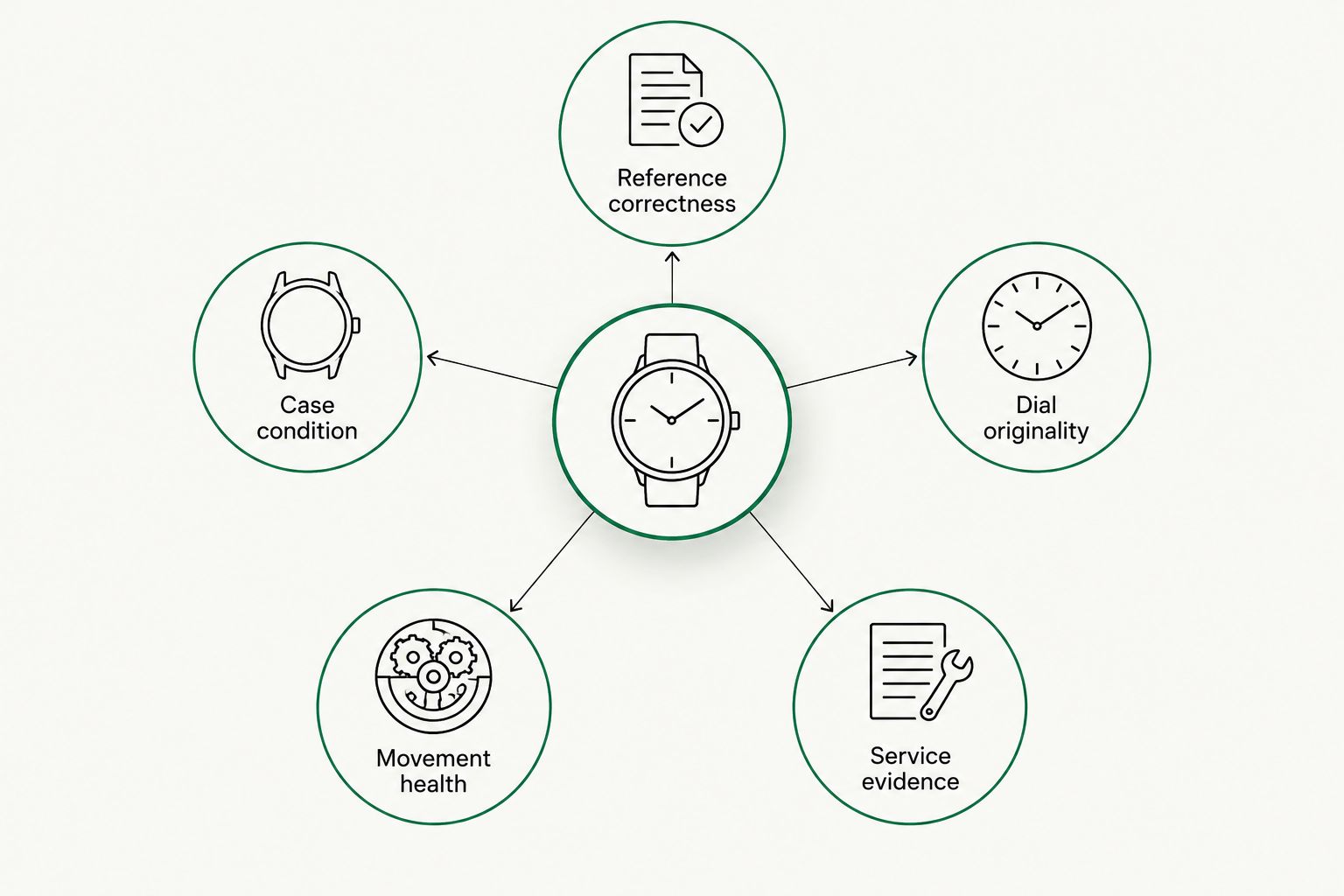
Start with the reference and ask whether the case, dial, hands and movement are consistent with it. For a pre-owned watch, separate original components from genuine service replacements and later alterations; those are different descriptions, not interchangeable assurances.
Photographs help you identify questions, but they do not establish movement health. Request clear views of the actual watch, service evidence where available and an explanation of any restoration or replacement parts. Independent authentication should address the watch itself, not just its accompanying accessories.
At this stage, give James Patten Fine Watches the same specific brief you would give any retailer. Asking reference-level questions is more efficient than requesting an unspecified corporate watch recommendation, but a seller’s description still needs to answer the questions relevant to your chosen example.
- Reference correctness: confirm the exact model and identifying details.
- Case condition: examine edges, surface wear and signs of refinishing.
- Dial originality: ask about refinishing, replacement hands and service components.
- Movement health: request an assessment appropriate to the movement and functions.
- Service evidence: establish what work is documented and what remains unknown.
Compare a small shortlist on explicit trade-offs
Make the comparison manually first: put the actual examples beside one another in a simple document. Include photographs, reference details, condition observations, maintenance questions and the reason each suits the recipient.
The options below illustrate different gifting directions, not a universal ranking. Their merits depend on the recipient’s preferences and the condition of the example offered; none earns a recommendation from its brand name alone.
| Option | Best for | Reason to consider it | Key limitation |
|---|---|---|---|
| Rolex 1601 Wide Boy | A recipient already interested in vintage Datejust watches | A distinctive dial variation within the Datejust family | Dial originality, bracelet condition and movement health require individual assessment |
| Cartier Tank Anglaise | Someone who has expressed a preference for shaped Cartier cases | A different design direction from a round sports watch | The Tank name alone does not establish the right proportions or fit |
| Breitling Superocean Steelfish A17390 | A recipient who prefers a substantial sports watch | The supplied example is described with a blue dial and 44 mm case | Its proportions are unsuitable as a blind choice for someone who prefers compact watches |
| Panerai Luminor Marina PAM00217 | A recipient who specifically enjoys manual-winding watches | The supplied example is described as manual winding, stainless steel and fitted with a brown strap | Manual winding introduces a routine the recipient must actually want |
For the Rolex 1601 Wide Boy, confirm the dial, hands, bracelet and reference together rather than treating the nickname as authentication. For the Cartier Tank Anglaise, obtain the exact variant and measurements before drawing conclusions about fit.
For the Breitling Superocean Steelfish A17390, do not treat its dive-watch identity as proof of present water resistance. For the Panerai Luminor Marina PAM00217, establish the operating instructions and service position before presentation.
- Compare actual examples rather than generic model photographs.
- Write one recipient-specific reason for each option.
- Record each watch’s principal compromise beside its appeal.
- Resolve conflicting descriptions before approving a purchase.
- Reject a shortlist that depends entirely on brand recognition.
Confirm the practical handover before committing
A presentation date is not evidence that a watch will be ready for it. Ask the seller directly about the chosen example, any outstanding work, sizing requirements and the arrangements applicable to your transaction; obtain current written answers rather than assuming a standard service.
For a 2026 corporate presentation, make readiness a separate approval item. A visually appealing watch is not ready to give if its condition, functions or required maintenance remain unresolved.
Keep commercial information separate from the recipient’s care information. The recipient needs to know how to operate and maintain the watch, while your organisation needs an accurate purchase record. Neither purpose requires making the ceremony about the transaction.
- Confirm the exact watch being supplied matches the approved example.
- Establish whether servicing, repairs or a replacement strap remain outstanding.
- Ask how bracelet sizing will be handled without assuming it is included.
- Obtain the applicable written terms before authorising payment.
- Record the reference and identifying details for your organisation’s records.
- Prepare reference-appropriate operating and care instructions for the recipient.
Match everyday use before adding personalisation
Test your choice against a normal working day. Does the recipient move between formal meetings and practical tasks? Do they wear close-fitting cuffs, dislike noticeable weight or already rotate several watches? These details change the wearing brief; a senior title does not.
The distinction also applies to luxury watches for hospitality executives: the relevant questions concern fit, legibility and interaction with daily tasks, not an assumed executive aesthetic. The same watch will not suit every person working in the same sector.
Personalisation comes after those questions, not before them. Engraving changes the watch, so obtain the recipient’s agreement and check suitability with the relevant specialist before authorising work. A separate presentation inscription can mark the occasion without altering the case.
- Check comfort while sitting, typing and moving the wrist.
- Confirm that the crown and case edges do not cause discomfort.
- Check dial readability in ordinary indoor light.
- Establish whether winding and setting routines suit the recipient.
- Ask permission before engraving or making other permanent changes.
- Put corporate branding on accompanying presentation material instead of assuming it belongs on the watch.
Common mistakes corporate watch buyers make
Choosing a watch for an imagined executive persona
An occupation is not a wrist measurement or a collecting preference. Choose a substantial sports watch because the recipient enjoys that format, not because a promotion supposedly calls for something imposing.
If your only evidence is a job title, stop the model selection. A discreet conversation is a better next move than another prestige-led shortlist.
Treating packaging as evidence of quality
A box cannot be worn, and original papers do not establish present mechanical condition. A desirable watch can stand on reference correctness, originality, condition, authentication and wearability without its original packaging.
Keep accompanying material in its proper place: supplementary context, not a substitute for examining the watch. Do not reject a sound example solely because its packaging is absent.
Confusing attractive appearance with resolved condition
A polished case and clean dial do not tell you whether the movement needs work. Equally, visible wear does not automatically make a watch unsuitable; understand whether the marks are acceptable to the recipient and consistent with the description.
Ask what has been checked, what has been replaced and what work remains. Unresolved mechanical questions belong before purchase, not after the presentation.
Making the recipient responsible for the surprise
A surprise becomes a burden if the recipient must resolve poor fit, unwanted engraving or immediate maintenance. Confirm these practical points privately rather than expecting gratitude to overcome a mismatch.
For a 2026 milestone, preserve the surprise in the presentation, not in whether the watch is suitable. Involving the recipient discreetly does not diminish the significance of the gift.
FAQ
What's the best luxury watch for a corporate gift?
The best corporate gift watch is the reference that matches the recipient’s taste, wrist fit and maintenance preferences. A Rolex Datejust 1601 suits an established interest in vintage watches; a Cartier Tank Anglaise suits someone who has expressed a preference for shaped cases.
Is a pre-owned luxury watch appropriate as a corporate gift?
Yes, a pre-owned luxury watch is appropriate when the recipient appreciates it and the individual example has been properly assessed. Prioritise reference correctness, originality, condition, movement health and independent authentication.
Does a corporate gift watch need its original box and papers?
No, original box and papers are not prerequisites for a desirable corporate gift watch. Evaluate the watch itself; accompanying material does not prove its present condition or authenticity.
Should we engrave a luxury watch for an employee milestone?
Only engrave the watch with the recipient’s agreement and after confirming suitability with a specialist. A separate inscribed presentation item marks the occasion without permanently altering the watch.
How do we choose a watch size without spoiling the surprise?
Use the recipient’s current watch as a starting point and discreetly confirm their preferred fit. Compare case thickness, lug shape and bracelet fit as well as diameter; no single size suits every recipient.
Is an automatic watch better than quartz for corporate gifting?
Neither movement type is universally better for corporate gifting. Choose according to the recipient’s interest in mechanical watches and willingness to manage setting, winding or battery maintenance as applicable.
Can James Patten Fine Watches help us compare gift options?
James Patten Fine Watches sells new and pre-owned luxury watches, giving corporate buyers different references to assess. Ask about the exact example’s condition, service evidence and fit, and confirm any transaction-specific arrangements directly.
One last thing
Ask one final question before approving the watch: would the recipient choose to wear it if nobody knew which company gave it to them? If the answer depends on the presentation speech, revisit the selection.
Put the company’s message in the presentation and the recipient’s preferences on the wrist. That distinction keeps the gift personal without turning the watch into corporate merchandise.


