
A Grand Seiko’s cost in Australia depends on the exact reference, movement, materials and condition; use a current Australian-dollar quote for that watch rather than a brand-wide average. The purchase figure is only part of the decision: check any immediate servicing, bracelet or strap work, and authentication requirements before comparing offers.
- Grand Seiko price Australia comparisons should match the exact reference, condition and movement—not just the collection name.
- Grand Seiko 9F quartz suits precision-focused buyers; mechanical and Spring Drive watches offer different ownership experiences.
- Judge a pre-owned Grand Seiko by originality, case condition, movement health and independent authentication.
- Confirm the current AUD quote and any work required before deciding which example represents better value.
How much does a Grand Seiko cost in Australia?
The useful price is the current AUD figure for a specific Grand Seiko reference in a documented condition. A quartz SBGX261 and a Spring Drive SBGA211 are different watches, not interchangeable examples of a single price bracket. Even two examples of the same reference need separate assessment when their case condition, bracelet completeness or service evidence differs.
For a 2026 purchase, separate the manufacturer’s current Australian retail figure from a seller’s asking figure and evidence of completed secondary-market transactions. Each answers a different question. Retail identifies the manufacturer’s positioning; an asking figure tells you what a seller wants; a completed transaction records what one buyer actually paid for a particular example.
Use this movement comparison to establish what you want before comparing individual watches.
| Grand Seiko movement family | Best for | Main attraction | Ownership trade-off |
|---|---|---|---|
| 9F quartz | Buyers prioritising timekeeping and straightforward daily use | High-accuracy quartz timekeeping without winding | Requires battery replacement and does not offer a mechanical escapement |
| 9S mechanical | Collectors who want a conventional mechanical movement | A spring-driven movement regulated by a mechanical escapement | Requires winding or regular wear, depending on the calibre, and mechanical servicing |
| 9R Spring Drive | Buyers drawn to a continuously gliding seconds hand | Mainspring power combined with quartz-controlled regulation | Requires calibre-appropriate service expertise; it is not a conventional mechanical escapement |
Why this matters
A watch that suits your wrist and arrives with a clear account of its condition is a different proposition from an apparently similar example needing investigation. Compare the watch you will own, not simply the headline figure.
James Patten Fine Watches is an Australian luxury-watch retailer for buyers considering new and pre-owned timepieces. The same buying discipline applies whether you choose Grand Seiko or another maker: establish reference correctness, assess the individual watch, and understand the ownership requirements before committing.
A higher asking figure does not establish better condition. Nor does an attractive dial photograph establish movement health. Keep those judgements separate until the evidence connects them.
Grand Seiko 9F quartz: precision without winding
Best for: buyers who value accurate timekeeping and want a watch that does not need winding. The SBGX261 is a useful reference to investigate if this is your priority: it uses Grand Seiko’s 9F62 quartz calibre.
Grand Seiko’s published specification for the standard 9F62 states an accuracy of ±10 seconds per year. That is a movement specification, not a substitute for assessing an individual pre-owned watch. Confirm normal operation, battery history where available, and the condition of the crown and setting functions.
The advantage is practical. You can leave a functioning quartz watch unworn without having to replenish a mainspring, although battery replacement remains an ownership requirement. The limitation is equally clear: if your interest centres on mechanical regulation, quartz will not provide that experience.
For a 2026 comparison, identify the actual calibre rather than applying one accuracy claim to every Grand Seiko quartz reference. Different calibres and specially specified examples require their own checks.
Grand Seiko 9S mechanical: assess the movement and case together
Best for: collectors who specifically want a conventional mechanical watch. Grand Seiko’s 9S designation covers different mechanical calibres, so do not treat it as one specification or a single level of performance.
Start with the exact reference and calibre. Establish whether the watch winds manually, automatically or both, then confirm its stated functions against the manufacturer’s information. Ask for evidence of how the individual movement performs rather than assuming its original factory specification describes its present condition.
Mechanical ownership brings a particular appeal: the interaction of mainspring, gear train and escapement. It also brings servicing requirements and sensitivity to operating conditions. An unsupported statement that a watch keeps excellent time tells you less than a dated assessment with a clear testing method.
Case condition deserves equal attention. Strong timekeeping does not resolve softened case edges, a damaged dial or incorrect components. Assess those separately before deciding whether the asking figure makes sense.
Grand Seiko Spring Drive: distinguish technology from condition
Best for: buyers who want mainspring power and Spring Drive’s continuously gliding seconds hand. The SBGA211, commonly called the Snowflake, provides a concrete reference for understanding this category rather than treating Spring Drive as an abstract upgrade.
Grand Seiko’s published specifications for its 9R65 calibre state an approximate power reserve of 72 hours and accuracy of ±15 seconds per month. Spring Drive uses a mainspring as its energy source and quartz-controlled regulation; it is not a battery-powered quartz movement.
Those distinctions explain the ownership experience, not the condition of a particular watch. Confirm winding, setting, power-reserve indication where fitted, and the movement’s performance. A moving seconds hand in a short video does not establish that the watch reaches its specified reserve.
The attraction is the regulation system and hand motion. The trade-off is that service assessment needs to suit Spring Drive specifically. Do not assume a conventional mechanical timing-machine reading answers every relevant question.
Why Grand Seiko prices vary
For your 2026 shortlist, investigate these factors before deciding that one example is better value than another:
- Exact reference and calibre: Match the complete reference. Similar dials do not establish identical movements, functions or case construction.
- Case material and execution: Confirm the manufacturer’s material specification, then inspect the actual surfaces, edges and transitions between finishes.
- Originality: Establish whether the dial, hands, crown, bezel and bracelet are correct for the reference. Ask for disclosure of replacements and modifications.
- Condition and movement health: Separate cosmetic wear from damage and assess operation independently. A clean exterior is not a mechanical report.
- Service evidence: Read the scope and date of any available work. An invoice for a limited intervention does not establish that the entire movement was overhauled.
- Purchase terms and location: Confirm the currency, applicable charges, seller identity and written terms. An overseas asking figure is not automatically comparable with a local transaction.
None of these factors supplies a universal adjustment formula. Their purpose is to establish whether you are comparing equivalent watches and equivalent purchase conditions.
How do you compare two Grand Seiko offers properly?
Use a reference-first sequence. It prevents an attractive photograph or an unexplained condition label from carrying more weight than the watch itself.
- Reference check: Record the full reference and stated calibre. Compare the seller’s description with Grand Seiko’s published information for that model.
- Condition check: Request clear photographs of the dial, hands, case sides, lugs, bezel, caseback, bracelet and clasp. Ask specifically about polishing and component replacement.
- Movement check: Seek a suitable operational assessment and any service evidence. Make sure the assessment matches quartz, mechanical or Spring Drive technology.
- Fit check: Confirm dimensions, bracelet fit and any adjustment required. Consider thickness, lug shape and clasp position, not diameter alone.
- Written terms: Obtain the current AUD quote and written transaction terms. Resolve unanswered questions before paying.
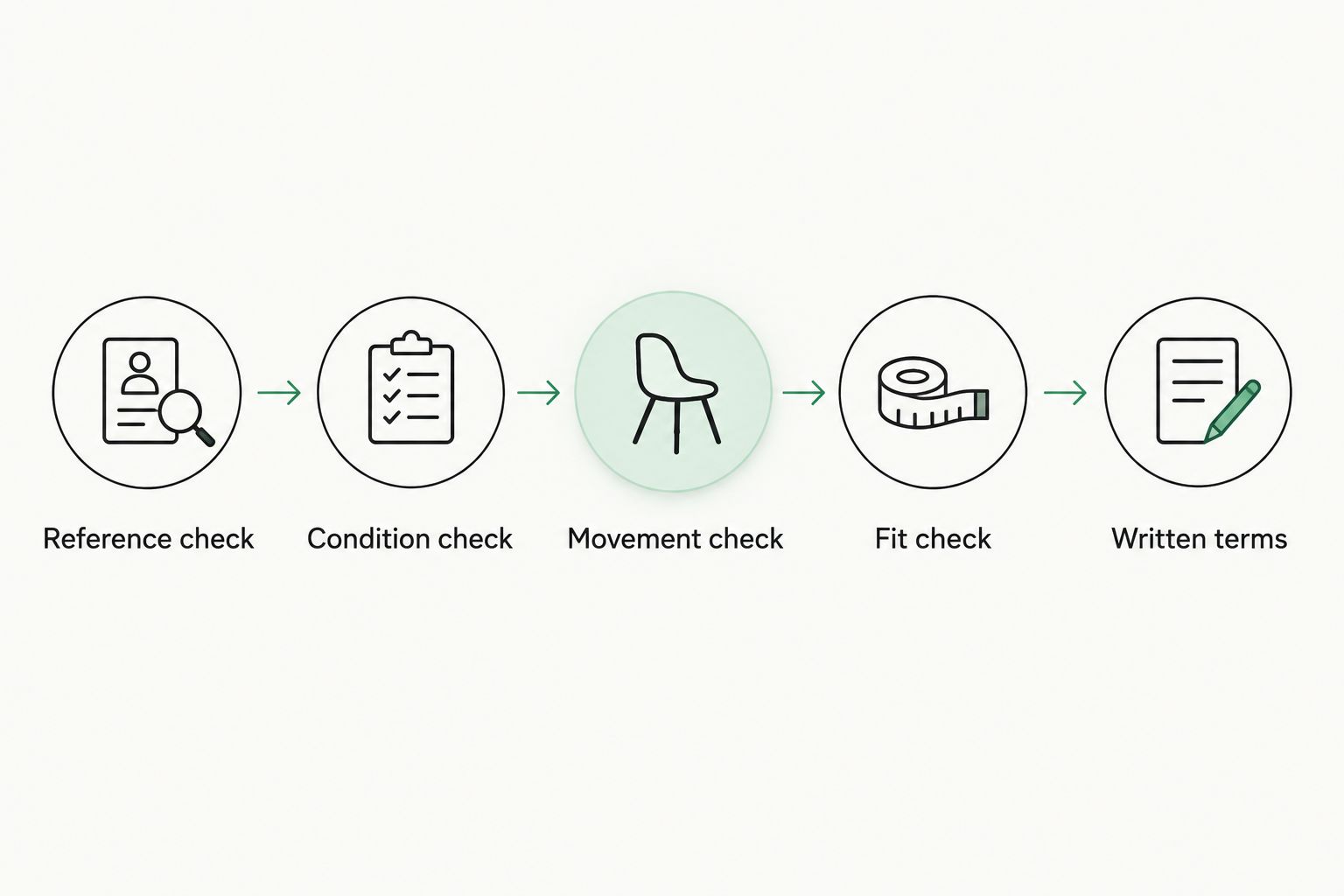
A useful comparison sheet records evidence beside each claim. If one seller supplies detailed photographs and a movement assessment while another supplies only a broad condition grade, the offers are not equally documented.
For the physical assessment, the guide to choosing the right watch case size explains why diameter alone does not settle fit. A watch you enjoy wearing has a stronger personal case than one you admire only in photographs.
Is a pre-owned Grand Seiko better value than a new one?
Pre-owned is the better choice only when the particular watch, its condition and its purchase terms suit you better. Do not assume an older example is automatically a saving or that a new example automatically justifies its difference in asking figure.
For a pre-owned watch, concentrate on originality, surface condition and movement health. Service evidence helps explain what has been done, but its absence calls for assessment rather than an automatic rejection. Packaging does not establish whether the watch is correct or healthy.
For a new watch, verify the seller’s status and the exact written terms that apply to your transaction. Do not transfer warranty or return assumptions from another retailer, another country or another reference.
A 2026 comparison should use contemporaneous information. An old retail screenshot and a current pre-owned listing do not establish a like-for-like difference.
What should you inspect on a polished Grand Seiko case?
Inspect the geometry, not just the shine. Grand Seiko case designs often depend on deliberate transitions between polished and brushed surfaces; the condition of those transitions matters when assessing an individual example.
Ask for photographs under diffuse light and from several angles. Look at edge definition, symmetry between corresponding lugs, visible dents and the relationship between adjacent surfaces. Reflections can conceal wear as readily as they reveal it.
Polishing alone does not settle desirability. The extent and quality of any refinishing, the reference involved and your collecting priorities matter more than a simple polished-or-unpolished label. Independent assessment is useful where photographs leave those questions unresolved.
Does a Grand Seiko hold its value?
No Grand Seiko reference comes with a guaranteed resale outcome. Evaluate the watch first as something you intend to own and wear, then investigate reference-specific transaction evidence if resale matters to your decision.
Distinguish advertised figures from completed sales, and match condition as closely as possible. A distinctive dial or limited-production description does not, by itself, demonstrate future demand or an achievable resale figure.
For a 2026 purchase, avoid treating an asking figure as an investment forecast. Originality, condition and a defensible purchase decision remain useful even when future market behaviour is unknowable.
FAQ
How do I find the current Grand Seiko price in Australia?
Identify the full reference, then check Grand Seiko’s current Australian information and obtain a written AUD quote for the specific watch. Keep new retail figures separate from pre-owned asking figures and completed transactions.
Is Grand Seiko quartz worth considering?
Grand Seiko 9F quartz is worth considering if accurate timekeeping and freedom from winding are your priorities. The standard 9F62 specification is ±10 seconds per year, but a pre-owned example still needs an assessment of its actual condition.
Is Spring Drive the same as an automatic mechanical watch?
Spring Drive is not the same as a conventional automatic mechanical movement. It uses mainspring power with quartz-controlled regulation rather than a conventional mechanical escapement; winding arrangements depend on the calibre.
How long does a Grand Seiko 9R65 run when fully wound?
Grand Seiko specifies an approximate power reserve of 72 hours for the 9R65. An individual pre-owned watch’s operation should be assessed rather than inferred from the published specification.
Does a Grand Seiko need its original box to be desirable?
A Grand Seiko does not need its original box to be desirable. Assess reference correctness, originality, condition, movement health, independent authentication and how well it wears.
Should I buy a Grand Seiko with no service history?
A Grand Seiko without service history needs a condition-led assessment, not an automatic rejection. Obtain an appropriate movement evaluation and understand any recommended work before committing.
Can I compare an overseas Grand Seiko listing with an Australian offer?
Compare an overseas Grand Seiko listing with an Australian offer only after matching the reference, condition, currency and transaction terms. Confirm applicable charges and arrangements rather than comparing the displayed figures alone.
One last thing
Before paying, write down what would make you choose this particular Grand Seiko over another example of the same reference. Your answer should identify something about the watch or the transaction: correct components, convincing condition evidence, suitable fit or clearly understood terms.
If your only reason is the asking figure, the comparison is unfinished. Resolve the watch-specific questions first; then decide whether the offer deserves your commitment.


