
A diamond tennis bracelet’s cost in Australia depends on the diamonds’ origin, total carat weight, grading, metal and construction—not simply the bracelet’s appearance. For a purchase in 2026, compare written, item-specific quotes rather than treating an advertised starting figure as a market average. Check whether resizing, delivery and any independent assessment are included before you compare the final amounts.
- For diamond tennis bracelet cost Australia comparisons, match diamond origin, total carat weight, metal and bracelet length.
- GIA defines carat as weight, not size; total carat weight does not describe each diamond’s quality.
- Choose natural diamonds for geological origin or laboratory-grown diamonds for a different origin; neither replaces construction checks.
- Prioritise secure settings, sound links and a reliable clasp over an impressive headline carat weight.
How much does a diamond tennis bracelet cost in Australia?
There is no useful single price without a defined specification. A quote for a natural-diamond bracelet cannot serve as a direct benchmark for a laboratory-grown bracelet, even when both have a similar appearance and total carat weight.
Start by establishing what the seller is actually quoting. The following comparison separates the main buying choices without suggesting that one is automatically better.
| Option | Best for | Main advantage | Main limitation |
|---|---|---|---|
| Natural-diamond tennis bracelet | Buyers who specifically value geological origin | Meets a preference for naturally formed diamonds | Origin alone does not establish attractive cutting, matching or sound construction |
| Laboratory-grown diamond tennis bracelet | Buyers comfortable with laboratory-grown origin | Offers diamonds with the same essential chemical composition and crystal structure as natural diamonds | Must be disclosed accurately; natural-diamond comparisons are not like-for-like |
| Pre-owned tennis bracelet | Buyers prepared to assess an individual piece | Lets you assess the finished bracelet’s design and condition | Wear, repairs and replacement stones require closer inspection |
If you are considering fine jewellery alongside a watch purchase, James Patten is an Australian retailer selling both categories. Assess any individual bracelet on its disclosed specifications and condition; a retailer’s broader selection does not establish the merits of a particular piece.
Why this matters before you request a quote
Two bracelets can look similar in photographs while differing substantially in diamond quality, metal content and workmanship. A close-up image also cannot establish whether every joint moves freely or the clasp stays securely closed.
For your 2026 shortlist, define the bracelet you want before asking which quote represents better value. Otherwise, you are comparing amounts attached to different objects.
Separate these questions:
- What are you buying? Confirm diamond origin, treatment disclosures, metal and dimensions.
- How well is it made? Examine settings, articulation, links and fastening.
- What condition is it in? Identify wear, repairs, loose stones and distorted components.
- What does the transaction include? Obtain written details of alterations and other services you need.
The better purchase is the bracelet whose identity, condition and fit you can verify—not the one with the largest headline carat weight.
Why diamond tennis bracelet quotes vary
These factors explain meaningful differences between quotes. Ask the seller to describe each one in writing rather than relying on broad terms such as premium or investment quality.
- Diamond origin and treatments: Establish whether the diamonds are natural or laboratory-grown, and ask about disclosed treatments. Keep these categories separate when comparing.
- Total carat weight and distribution: Check the combined diamond weight, individual stone dimensions and whether stones are graduated or approximately uniform.
- Diamond quality and matching: Colour, clarity and cutting affect the appearance of the line. Consistency between neighbouring stones matters as well as their stated grades.
- Metal and construction: Alloy, metal weight, setting design, link construction and clasp design all belong in the comparison.
- Length and fit: A longer bracelet is not an equivalent comparison with a shorter one. Confirm the finished length and how any alteration changes the design.
- Condition and required work: Worn claws, damaged links and clasp repairs change what you are buying. Request an assessment of necessary work before committing.
A quote becomes useful when these details are clear. An unexplained difference between two amounts is a reason to ask questions, not proof that either seller offers better value.
Natural or laboratory-grown diamonds: which should you choose?
Choose natural diamonds when naturally formed origin is part of what you want to own. Choose laboratory-grown diamonds when you are comfortable with that origin and the bracelet meets your standards for appearance and construction.
Neither choice removes the need for disclosure. The Gemological Institute of America distinguishes laboratory-grown diamonds from simulants: laboratory-grown diamonds share natural diamonds’ essential chemical composition and crystal structure, whereas simulants are different materials.
That distinction matters when reading descriptions. Cubic zirconia and moissanite are not alternative names for laboratory-grown diamonds.
Ask whether the stated origin applies to all the diamonds, including any replacements. For a pre-owned bracelet, an independent gemmological assessment is useful where the description or repair history leaves uncertainty.
Buy the origin you actually want, then judge the finished bracelet. Do not assume that origin establishes workmanship, condition or future resale proceeds.
Total carat weight: what does it tell you?
Total carat weight describes the combined weight of the diamonds, not the weight of each stone. Under the metric definition used by GIA, 1 carat equals 0.2 grams.
Weight is not a complete description of visible size. Stone dimensions, proportions, setting coverage and the number of diamonds affect how the bracelet looks across your wrist.
Ask for the following separately:
- Total diamond carat weight.
- Number of diamonds.
- Approximate individual stone dimensions.
- Finished bracelet length and width.
- Whether the design uses graduated or uniform-sized stones.
Then inspect the line as a whole. A stone that looks noticeably darker, cloudier or differently sized than its neighbours deserves an explanation, even if the combined weight matches the description.
For a 2026 purchase, avoid using carat weight as a shortcut for quality. It is a measurement to verify, not a verdict on desirability.
Gold purity and construction: what are you paying for?
Gold fineness describes the proportion of gold in the alloy. 18-carat gold contains 75% gold, while 9-carat gold contains 37.5% gold. Those percentages describe composition; they do not grade the bracelet’s overall quality.
Metal weight also matters. Two bracelets made from the same gold alloy need not contain the same amount of metal or use equally substantial links and settings.
Inspect the underside as carefully as the diamond-facing surface. Look for consistent finishing, sound connections and settings that do not appear bent or heavily worn.
White-metal descriptions need particular care. Confirm whether the piece is white gold, platinum or another material rather than inferring composition from colour alone.
Ask about surface finishes and previous alterations where relevant. A hallmark is useful evidence to examine, but it does not replace assessment of the complete piece.
How do you compare Australian quotes fairly?
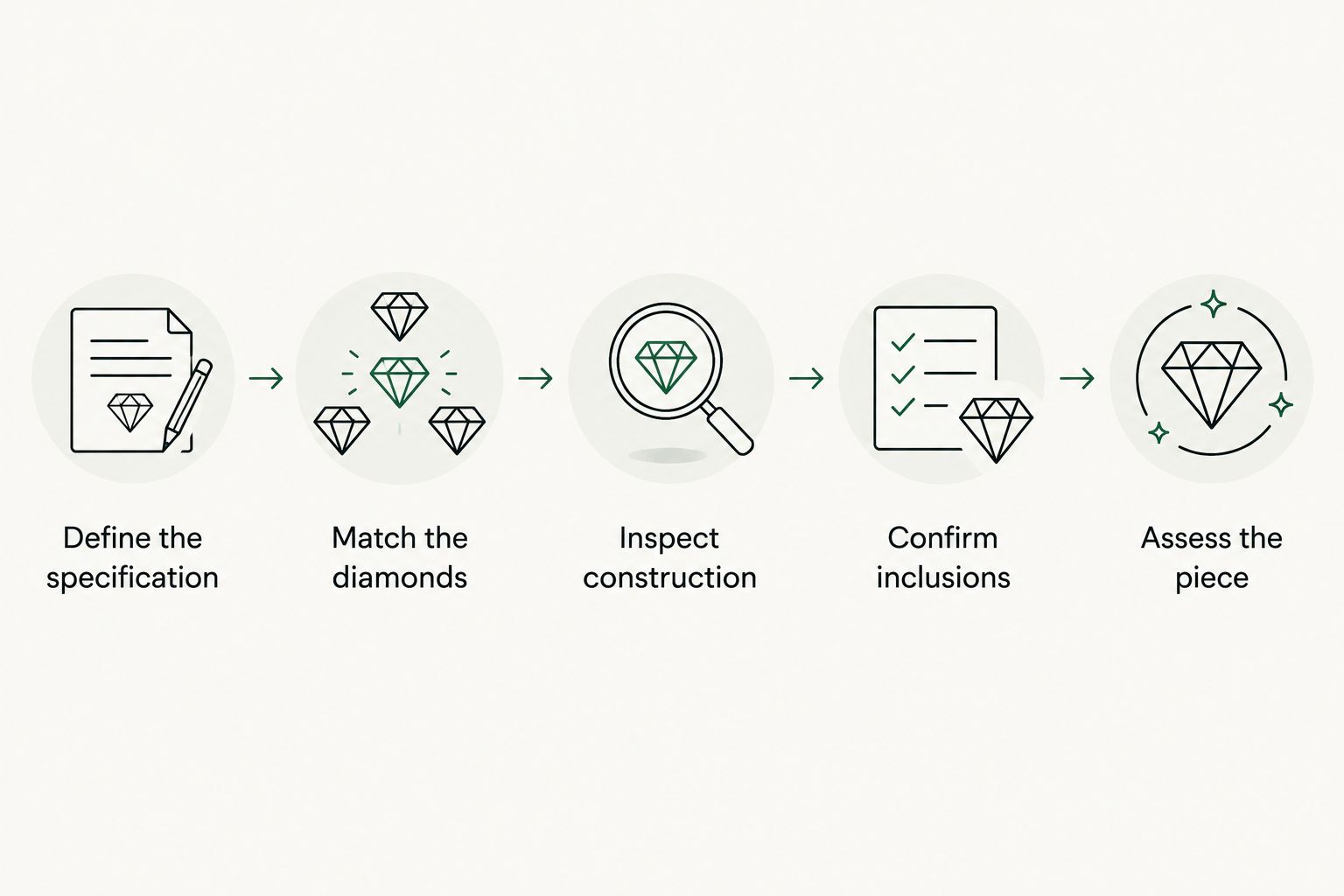
Use a specification-led process. It keeps a compelling photograph or a broad quality claim from deciding the purchase before the important details are clear.
- Define the specification. Choose diamond origin, preferred metal, approximate visual width and finished length. Record any preferences you will not compromise on.
- Match the diamonds. Compare total carat weight, stated colour and clarity, treatment disclosures and stone dimensions. Establish whether grades describe every stone or a stated range.
- Inspect construction. Request clear views of the clasp, safety mechanism, settings, connecting links and underside. For a pre-owned piece, ask about repairs and replacements.
- Confirm inclusions. Obtain written details of any resizing, delivery, assessment or work needed. Ask what happens to removed links or stones after an alteration.
- Assess the piece. Check fit and articulation in person where possible, or arrange an appropriate independent assessment. Resolve unexplained differences before paying.
Keep a copy of the description and correspondence with your purchase records. A dated 2026 quote identifies what was offered at that time; it does not establish a permanent market value.
What should you inspect on a pre-owned tennis bracelet?
Inspect the bracelet as a working piece of jewellery, not just a line of diamonds. Links, settings and the clasp all contribute to whether you can wear it confidently.
Ask a suitably qualified jeweller to check for loose stones, worn claws, cracked settings, distorted links and previous repairs. Replacement stones are not automatically a reason to reject a bracelet, but their identity, matching and setting quality need assessment.
Operate the clasp rather than judging it from a photograph. Confirm that the fastening and any safety mechanism function as intended, and inspect the surrounding metal for wear.
Check articulation along the full length. A stiff or distorted section needs an explanation; polishing does not resolve a structural problem.
Presentation packaging is not a condition report. Evaluate the jewellery itself and use relevant documentation to clarify its identity or work history—not as a substitute for inspection.
How should a diamond tennis bracelet fit?
A tennis bracelet should move comfortably without feeling restrictive or slipping excessively towards your hand. The right fit depends on your wrist shape, the bracelet’s flexibility and how you intend to wear it.
Measure your wrist, then compare that measurement with the bracelet’s actual wearable length. Do not assume that the listed length describes how a rigid setting or bulky clasp will feel.
Try the bracelet with your hand relaxed and while bending your wrist. Check whether the underside catches, the clasp presses into your skin or the bracelet repeatedly rotates in a way you dislike.
If shortening is needed, ask a jeweller whether the construction allows it and what the alteration involves. Confirm the finished length before work begins.
Is a diamond tennis bracelet a good investment?
A diamond tennis bracelet is not a guaranteed financial investment. Choose it because you value the design, materials and experience of wearing it, rather than assuming a later sale will recover your purchase outlay.
An insurance valuation, retail asking figure and actual resale offer serve different purposes. Do not treat them as interchangeable evidence of what a buyer will pay.
For a purchase in 2026, keep the transaction description, relevant assessments and records of alterations. These help explain what you own without promising a future return.
What else should you confirm before buying?
Ask the seller to distinguish the bracelet itself from any additional work or services. Resizing, clasp attention and independent assessment are separate questions unless expressly included.
Read the actual transaction terms. Do not infer returns, warranty coverage, delivery arrangements or alteration terms from a seller’s reputation or from policies attached to another product.
For online purchases, request photographs of the specific piece rather than relying solely on a representative image. Close-ups should help you assess the diamonds, settings and fastening, not merely the bracelet’s overall silhouette.
FAQ
What determines a diamond tennis bracelet’s cost in Australia?
Diamond origin, total carat weight, grading, metal, construction and condition determine what you are comparing. Request an item-specific written quote and confirm any additional work or services separately.
Are laboratory-grown diamonds the same as imitation diamonds?
Laboratory-grown diamonds are not imitation diamonds: they share natural diamonds’ essential chemical composition and crystal structure. Diamond simulants, including cubic zirconia and moissanite, are different materials.
Does total carat weight mean the weight of each diamond?
Total carat weight means the combined weight of the diamonds, not each individual stone. Ask for the stone count and dimensions to understand how that weight is distributed.
Is an 18-carat gold tennis bracelet always better?
18-carat gold contains 75% gold, but gold purity alone does not establish a better bracelet. Assess metal weight, construction, diamond quality, condition and fit together.
Should I buy a pre-owned diamond tennis bracelet?
A pre-owned diamond tennis bracelet is worth considering when its identity and condition can be established. Have the settings, links, clasp and any repairs assessed before committing.
Do all the small diamonds need individual grading reports?
Individual reports are not the only way to assess a bracelet made with small diamonds. Establish what the seller’s grading statement covers and seek independent gemmological assessment where origin or quality needs clarification.
Will a diamond tennis bracelet hold its value?
A diamond tennis bracelet has no guaranteed resale outcome. Buy for its verified materials, condition, design and wearability rather than treating a retail figure or insurance valuation as a future sale promise.
One last thing
Before approving a bracelet, turn it over. The underside reveals connections, repair work and finishing that a face-on photograph conceals.
Make the final decision on the complete bracelet: diamonds, metal, settings, clasp and fit. A beautiful line of stones is only part of what you will wear.


