
A diamond tennis bracelet needs an individual inspection before a jeweller can give you a reliable resizing time; there is no single turnaround that applies to every bracelet. The completion date must account for the workshop queue, the alteration itself and checks of the links, settings and clasp—not just the time spent shortening or lengthening it.
- For resize diamond tennis bracelet time, get an inspected completion date rather than relying on a general estimate.
- Shortening and lengthening require different assessments; matching links matter when adding length.
- Confirm the finished fit, stone-security checks and collection arrangements before authorising work.
- James Patten sells fine jewellery; confirm any resizing arrangements separately before purchasing.
How long does it take to resize a diamond tennis bracelet?
The useful answer is a confirmed collection date after inspection, not an assumed number of days. A jeweller needs to establish how your bracelet is constructed, what length change you want and whether existing wear requires attention before agreeing to a schedule.
For a bracelet you plan to wear to a 2026 event, give the jeweller the actual wearing date at the first enquiry. Ask whether the proposed completion date includes a final fitting and any transport between the shop and workshop.
The assessment should follow this sequence:
- Inspect construction. Establish how the articulated links connect, how the clasp attaches and whether the settings or joints need attention.
- Confirm fit. Agree on the intended finished length and how the bracelet should sit when your wrist moves.
- Agree scope. Identify whether the work involves removing links, adding matching sections, altering a clasp connection or addressing existing damage.
- Confirm schedule. Separate the workshop's working time from the full period between handing over the bracelet and collecting it.
- Check completion. Allow for inspection of the altered area, stone security, articulation and clasp function before accepting the result.
A telephone description helps start the conversation, but it does not show the condition of a joint or setting. Treat a preliminary estimate as provisional until the jeweller has examined the bracelet.
Why this matters
A tennis bracelet is a connected row of settings, not simply a chain that can be shortened wherever convenient. The alteration must preserve its movement, the security of the stones and the relationship between the bracelet ends and clasp.
Fit deserves the same attention as appearance. The distinctions in tennis bracelets for everyday elegance are relevant when deciding how you intend to wear the finished piece: occasional evening wear and regular wear still require a secure, comfortable fit.
Do not approve a rushed alteration simply because the bracelet closes around your wrist. You also need to know that it articulates properly and that the fastening works as intended.
Shortening a diamond tennis bracelet
Shortening usually centres on whether a jeweller can remove complete links and reconnect the bracelet appropriately. The important distinction is between a construction that permits that alteration and one that needs more involved work around the connections or clasp.
Ask the jeweller to show you the proposed finished fit before removing anything. Because a stone-set link has a fixed length, removing a complete section does not offer the continuous adjustment of a sliding fastening.
What to confirm before shortening
- Which links or sections the jeweller proposes to remove.
- Whether the alteration changes how the clasp sits beneath your wrist.
- Whether worn joints or loose settings need separate attention.
- Whether the finished bracelet will still move freely along its length.
- Whether all removed links and stones will be returned to you.
Keeping removed sections preserves useful material for a possible future alteration. It does not guarantee that reinstating them will be straightforward, so ask the jeweller to explain what would be involved.
For a 2026 purchase that needs shortening before you can wear it, settle these questions before agreeing to an event deadline. A bracelet's appearance in a photograph does not establish its alteration requirements.
Lengthening a diamond tennis bracelet
Lengthening needs a different assessment because the jeweller must establish how to add length without compromising the bracelet's structure or appearance. That can involve matching links, settings, metal and stones, depending on its construction.
Original spare links are useful when they are the correct components for that bracelet. Without them, ask whether suitable sections can be sourced or made, and whether the result will match the existing articulation and setting pattern.
Do not assume that a clasp extension is an equivalent substitute for matching links. Ask to see how the proposed solution affects balance, flexibility and the position of the fastening.
| Alteration | Best for | Main benefit | Main limitation to assess |
|---|---|---|---|
| Remove complete links | A bracelet that is too long and permits link removal | Retains the existing link style | Available length changes depend on the link dimensions |
| Add matching links | A bracelet that needs additional length | Continues the existing design when components match | Suitable components and connections need verification |
| Alter the clasp connection | A bracelet whose construction supports this approach | Addresses fit at the fastening area | Can change clasp position and the appearance of the underside |
These are assessment routes, not interchangeable instructions. Your jeweller should recommend the method that suits the actual bracelet, rather than choosing a method solely to meet a deadline.
Why diamond tennis bracelet resizing time varies
The factors that affect the schedule are practical: construction, condition, components and the work required. Ask which of these applies to your bracelet instead of accepting an unexplained turnaround.
- Link construction. The connection between settings determines where the bracelet can be separated and rejoined.
- Amount of alteration. Removing a section and adding a matching section involve different tasks and materials.
- Existing condition. Worn joints, damaged claws or a faulty clasp need assessment alongside the length change.
- Component matching. Additional links must suit the bracelet's dimensions, metal, settings and articulation.
- Workshop arrangements. Ask whether the inspecting jeweller performs the work or sends it elsewhere, and how that affects handover and collection.
- Final checks. The completed alteration needs assessment for fit, movement, fastening and stone security.
For work booked in 2026, request the workshop's current schedule rather than relying on an old review or someone else's experience. Another bracelet's completion time does not establish yours.
What should you send before the inspection?
Send clear photographs of the entire bracelet laid flat, the clasp open and closed, and both sides of the area you think needs alteration. Include close views of any damage, previous repair or section that does not move freely.
State whether you want the bracelet shorter or longer. If you have spare links, photograph those separately and explain whether they came from this bracelet.
Describe the fit, not just your wrist measurement
A wrist measurement gives the jeweller a starting point, but it does not describe your preferred drape. Explain whether the bracelet slides towards your hand, catches at the wrist or feels tight when you bend your hand.
Do not choose a finished length solely by copying another bracelet. Different link shapes, setting profiles and clasp designs sit differently, even when their measured lengths are similar.
Ask the jeweller to record the proposed finished length and the agreed alteration in writing. That creates a clear reference for approval and collection without replacing the need for an actual fitting.
What should a resizing assessment cover?
A useful assessment connects the fit you want with the work the bracelet can safely accept. It should also distinguish existing wear from the alteration you are authorising.
The priorities are fit, links, settings and clasp. Looking at all of them together prevents a length-only decision from overlooking an insecure fastening or damaged connection.
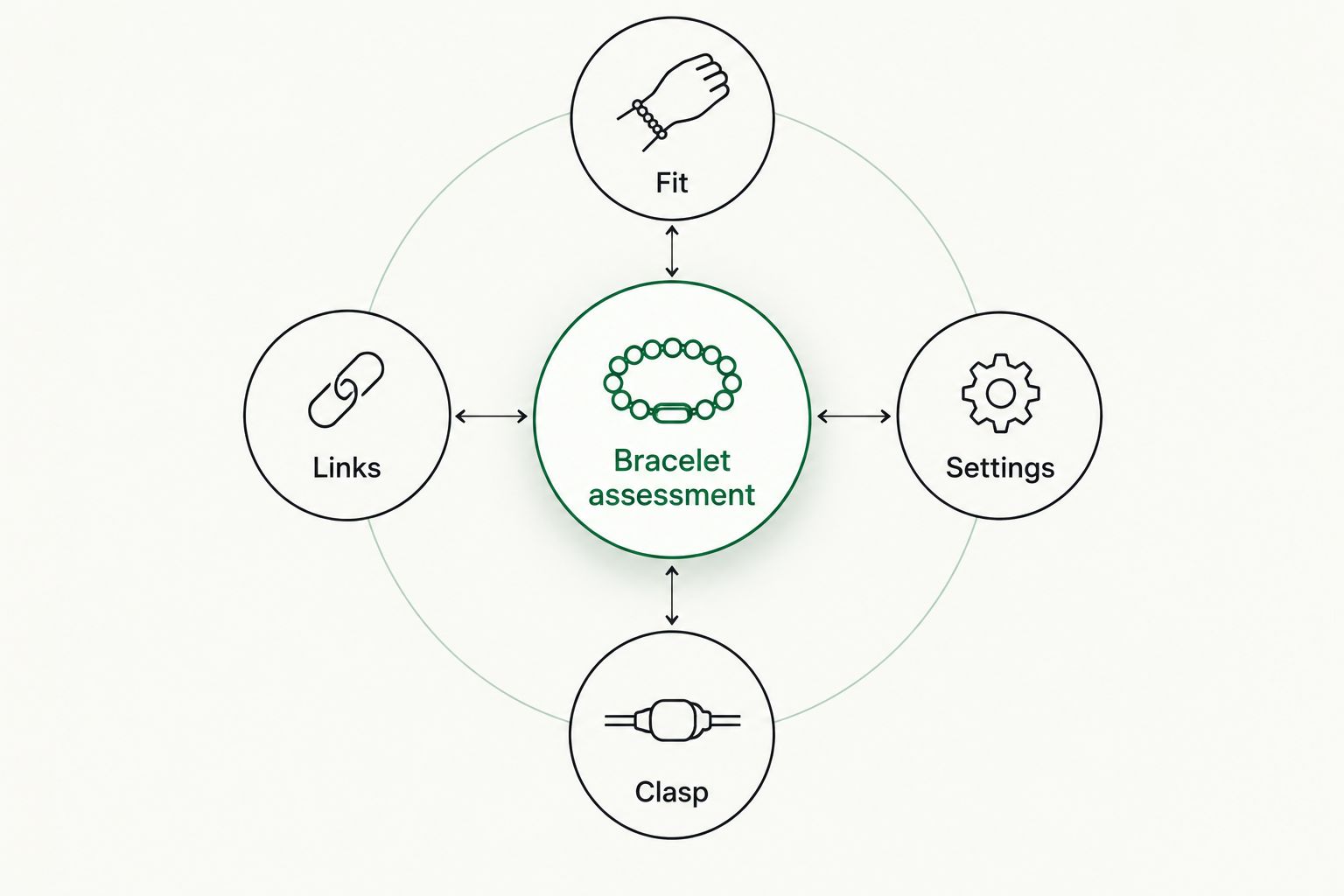
Before you approve the job, ask for a description of the proposed method and any separate repairs. If the jeweller identifies additional work after starting, agree on how approval will be requested before that work proceeds.
Also clarify what the jeweller will return with the bracelet. Removed sections belong in that conversation, as do any written details of the completed work that the workshop provides.
Can I have a diamond tennis bracelet resized while I wait?
Only rely on a while-you-wait arrangement when the jeweller confirms it after inspecting your bracelet. A simple-sounding request does not establish that the construction, condition or workshop schedule suits immediate work.
Ask whether the promised handover includes the completed checks and a fitting. If the answer covers only the alteration at the bench, it is not yet a complete collection arrangement.
Can I resize a diamond tennis bracelet before a wedding?
Use the wedding date as a deadline for planning, not as a reason to omit inspection. Tell the jeweller when you need to wear the bracelet and ask whether the confirmed schedule leaves room to check the fit before the event.
For a wedding in 2026, distinguish the ceremony date from any earlier travel or photography commitments. The bracelet needs to be back with you before the first occasion on which you intend to wear it.
Is shortening quicker than lengthening a tennis bracelet?
The direction of the alteration alone does not establish which job will finish sooner. Shortening requires a suitable removal and reconnection point; lengthening requires an appropriate way to add material or components.
Ask the jeweller to explain the work on your bracelet specifically. Existing damage can change the scope of either job, while matching components are a separate consideration when adding length.
What should you check when collecting the bracelet?
Try on the bracelet before treating the work as complete. Check the fit with your hand relaxed and with normal wrist movement, rather than judging it only while your arm rests flat on the counter.
Work through these checks with the jeweller:
- Fit: Does the bracelet sit as agreed without restricting movement or slipping excessively towards your hand?
- Articulation: Do the altered links move freely without a rigid or catching section?
- Clasp: Does the fastening engage properly, including any existing safety mechanism?
- Finish: Does the altered area sit consistently with the surrounding bracelet?
- Stone security: Has the jeweller checked the settings, particularly around the work area?
Ask the jeweller to demonstrate the fastening rather than forcing an unfamiliar clasp yourself. If something feels wrong, raise it during the collection fitting.
For your 2026 jewellery records, retain the work description and any returned components. Those records explain the alteration; they do not replace a future condition assessment.
Buying a bracelet that needs alteration
Assess fit before committing to a bracelet that will need resizing. Ask whether the intended alteration is feasible, who will assess it and when you can obtain a confirmed completion date.
James Patten is an Australian retailer for buyers of fine jewellery and new or pre-owned luxury watches. Confirm any alteration arrangements separately; a jewellery listing does not establish a resizing service, method or turnaround.
Do not select a bracelet on the assumption that every length problem has an easy solution. The better purchase is a piece whose construction, condition and achievable fit suit the way you intend to wear it.
FAQ
How many days does it take to resize a diamond tennis bracelet?
Get the number of days from the jeweller after an inspection. A reliable completion date accounts for the alteration, workshop schedule, any required components and final checks.
Can every diamond tennis bracelet be made smaller?
Do not assume every diamond tennis bracelet can be made smaller by the same method. A jeweller must assess its link construction, clasp connections and condition before recommending an alteration.
Can a diamond tennis bracelet be made longer without spare links?
A jeweller must establish whether suitable additional sections or another appropriate alteration are possible. Matching the metal, settings and articulation is part of that assessment.
Should I measure my wrist before asking about resizing?
Yes, provide your wrist measurement as a starting point and describe how the bracelet currently fits. Confirm the finished fit with the jeweller rather than relying on the measurement alone.
Will resizing damage my diamond tennis bracelet?
The risk depends on the bracelet's construction, condition and proposed method. Ask the jeweller to explain those risks and the checks required before authorising the work.
Should I keep the links removed from a tennis bracelet?
Yes, ask for removed links and stones to be returned. They preserve original components for assessment if you later consider another alteration.
Can I wear my bracelet as soon as I collect it?
Complete the fitting and ask the jeweller to confirm the bracelet is ready to wear before leaving. Check the clasp operation and raise any stiffness, catching or fit concern immediately.
One last thing
Ask where the clasp will sit after resizing, not just how long the bracelet will be. A finished length that looks right on paper still needs to work with the bracelet's drape and fastening position on your wrist.


