
Luxury watch case design changes both wrist comfort and visual presence: a round Rolex Datejust 1601 and a rectangular Cartier Tank Anglaise distribute their shapes differently, so diameter alone cannot describe how either wears. Lug reach, case thickness, underside curvature and crown position determine where the watch rests, moves or presses against your skin.
- Luxury watch case design determines wrist contact and visual presence; diameter alone is not a fit verdict.
- Compare lug reach, case thickness and bracelet articulation before choosing a larger or smaller watch.
- Rolex Datejust 1601 and Cartier Tank Anglaise illustrate why different case shapes need different fit assessments.
- For pre-owned watches, assess original geometry, condition and movement health rather than packaging.
How does case design change the feel of a luxury watch?
The best-fitting case follows your wrist without requiring an excessively tight strap to keep it stable. A watch that looks balanced from above can still press into your hand, rock on its caseback or catch a shirt cuff.
Start with the distinctions below, then use the guide to choosing the right watch case size to separate measurements from wearing impressions.
| Case feature | What it changes | Useful advantage | Trade-off to check |
|---|---|---|---|
| Round outline | Creates a continuous perimeter around the dial | Best for buyers seeking a familiar, balanced outline | Long lugs can extend well beyond the apparent diameter |
| Rectangular outline | Adds length along the wrist | Best for buyers who prefer an elongated silhouette | Width alone understates the space the watch occupies |
| Cushion outline | Combines rounded corners with broad shoulders | Best for buyers seeking substantial visual presence | Broad corners can feel larger than the dial suggests |
| Low case profile | Reduces height above the wrist | Best for wearing beneath close-fitting cuffs | Thinness does not resolve uncomfortable lugs or crown contact |
| Raised case profile | Places more of the watch above the wrist | Best for buyers who deliberately want a pronounced side profile | Check rocking, sleeve clearance and balance |
These are fit characteristics, not a ranking of quality. A substantial sports case is not inherently less comfortable than a slim dress case; the contact points and attachment system decide the result.
Why this matters
An overhead photograph hides much of the information your wrist needs. It shows the outline and dial, but not necessarily the caseback projection, downward lug angle or first bracelet link's freedom of movement.
For a 2026 purchase, request front, side and underside views of the actual watch. A reference photograph explains the design; photographs of the individual example help establish its present condition.
Separate attraction from suitability. You can admire a dramatic case and still find that its crown position or bracelet attachment does not suit your wrist.
Round cases: read the lugs as well as the dial
A round watch gives you an easily understood diameter, but that figure excludes the lugs extending towards the strap. Straight, projecting lugs and short, downward-curving lugs create different contact patterns even when the central case looks similar.
The supplied product information identifies a Rolex Datejust 1601 example as 36mm. That measurement is a useful starting point, not proof of comfort: inspect the lug tips, bracelet connection and caseback before deciding whether the watch sits naturally.
Look at the watch with your arm relaxed rather than raised towards your face. The lug tips should not create uncomfortable pressure, and the bracelet should turn around your wrist rather than remain rigid beyond it.
Choose a round case for its complete outline, not simply its diameter. A restrained dial does not cancel out an awkward attachment or a protruding crown.
Rectangular cases: assess length before judging width
Rectangular cases change the relationship between dial area and wrist coverage. A narrow watch can still occupy substantial space from top to bottom, while corners make its outline more pronounced than a similarly narrow round case.
The Cartier Tank Anglaise is a useful reference for this distinction. Judge its full length, side profile and bracelet connection rather than translating its width into an imagined round-watch equivalent.
The advantage is a clearly defined, elongated silhouette. The limitation is that a front-facing photograph does not establish whether the underside follows your wrist or bridges above it.
Best for buyers who prefer a shaped case: consider a rectangular watch when its length and curvature suit your wrist. Do not assume that a narrower case automatically feels smaller.
Cushion cases: broad shoulders change visual weight
A cushion case places rounded corners around a broadly square outline. Those shoulders add visible material outside the dial, giving the watch a different presence from a round case with a similar central opening.
Panerai Luminor Marina PAM00217 provides a concrete design reference. Its case outline and projecting crown-protection structure deserve separate attention during a fit assessment; the dial view alone does not describe its lateral footprint.
The attraction is a distinctive outline with substantial visual presence. The compromise is that the case sides and crown protection need room beside your wrist and hand.
Best for buyers who want a pronounced case silhouette: assess a cushion case with your wrist bent as well as relaxed. A shape that looks balanced at rest still needs to remain comfortable when you reach or type.
Why the feel of luxury watch case design varies
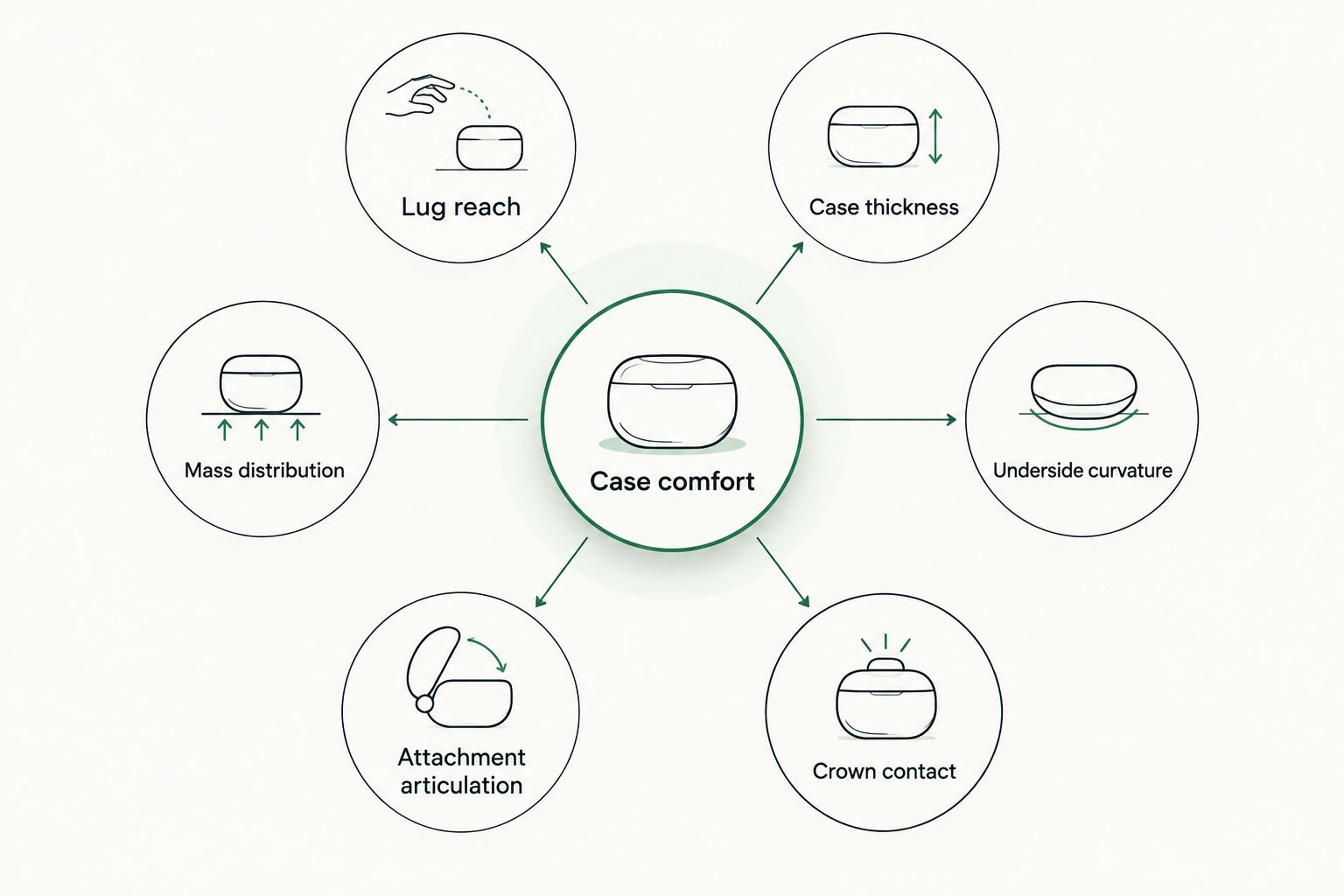
Watch comfort results from several interacting features. Assess these six factors together rather than treating any single measurement as a pass or fail.
- Lug reach: The distance between the outer lug tips determines how far the watch extends along your wrist. Long, flat lugs demand a different fit assessment from curved ones.
- Case thickness: Height changes sleeve clearance and how far the watch projects above your wrist. Check the crystal and caseback as well as the central case band.
- Underside curvature: The shape touching your skin determines whether pressure spreads across the underside or concentrates around a smaller contact area.
- Crown contact: A crown, crown guard or chronograph pusher can meet the back of your hand when your wrist bends. Test that movement directly.
- Attachment articulation: A stiff strap or projecting first bracelet link adds to the effective footprint. The connection must follow your wrist, not just look proportionate.
- Mass distribution: Weight concentrated above a narrow contact area feels different from weight spread across a broader case and bracelet. Assess stability without overtightening.
A strap adjustment changes how securely a watch sits, but it cannot reshape the case. If tightening the strap is the only way to stop rocking, reassess the caseback, lug geometry and attachment rather than accepting pressure as normal.
What actual watch measurements tell you
The supplied product descriptions give three useful examples: a 36mm Rolex Datejust 1601, a 43mm Bulova Classic Sutton 97A169 and a 44mm IWC Aquatimer Chronograph IW376805. These figures describe case diameter, not comparative comfort.
| Watch example | Stated diameter | Best for examining | What remains to verify |
|---|---|---|---|
| Rolex Datejust 1601, silver-dial example | 36mm | A smaller-diameter round-case starting point | Lug condition, bracelet articulation and underside fit |
| Bulova Classic Sutton 97A169 | 43mm | The wrist coverage of a larger round case | Thickness, lug reach and strap behaviour |
| IWC Aquatimer Chronograph IW376805 | 44mm | The physical presence of a dive chronograph | Side profile, pusher clearance and balance on your wrist |
The comparison does not establish that the Datejust is more comfortable or that the Aquatimer is too large. It establishes which questions to ask next.
For your 2026 shortlist, distinguish a stated specification from a personal fit observation. Ask for missing dimensions rather than inferring them from dial photographs or model reputation.
How do you assess case comfort before buying online?
Use this sequence to turn photographs and specifications into a useful shortlist. Do not make the purchase decision from the front view alone.
- Establish the reference. Match the stated model and reference to the watch pictured. Confirm which dimensions apply to that exact version rather than another watch in the collection.
- Inspect the profile. Request a side view showing the crystal, case band, lugs and caseback. Look for the parts that extend above, below and beyond the central case.
- Check the attachment. Examine the first bracelet links or the strap where it leaves the lugs. Identify whether that connection bends down promptly or projects outwards.
- Compare a known fit. Use a watch you already wear comfortably as a physical reference. Compare its shape and contact points, not merely its stated diameter.
- Resolve uncertainty. Ask for missing measurements and condition evidence. When an in-person assessment is possible, test wrist movement and cuff clearance rather than relying on a stationary mirror view.
These checks reduce guesswork; they do not make a photograph equivalent to wearing the watch. A wrist photograph also needs context because perspective changes apparent proportions.
How does pre-owned case condition change the assessment?
Original case geometry matters independently of cosmetic brightness. Polishing removes material, so inspect lug definition, bevel transitions and the separation between brushed and polished surfaces rather than treating shine as evidence of quality.
Rounded edges do not, by themselves, establish how much work a case has received. Compare the individual watch with reliable reference-specific examples, and seek an informed assessment where the finish or proportions are unclear.
For a pre-owned purchase in 2026, request evidence of:
- Reference-correct case construction and identifiable markings.
- Clear views of lug tips, case flanks, crown and caseback.
- Disclosed refinishing, damage or component replacement where known.
- Movement health and service evidence where available.
- Independent authentication rather than assumptions based on appearance.
A box cannot be worn, and original papers do not establish present movement health. Their absence does not make an otherwise desirable watch unsuitable; assess the watch itself and the evidence supporting it.
James Patten Fine Watches sells new and pre-owned luxury watches; when comparing its listings, apply the same reference, condition and wearability checks to each individual example. The strongest purchase case is the watch's verified condition and suitability for your wrist, not its packaging.
Does a smaller case always feel more comfortable?
A 36mm Rolex Datejust 1601 is not automatically more comfortable than a larger watch. A smaller case can still have uncomfortable crown contact, an unsuitable bracelet fit or a caseback that concentrates pressure.
Choose the smaller option when its actual geometry suits you, not because a diameter threshold promises comfort. Wrist shape matters alongside wrist circumference.
Can a larger dive chronograph work for daily wear?
A 44mm IWC Aquatimer Chronograph IW376805 needs a direct assessment of wrist coverage, side profile and control clearance. Its stated diameter alone cannot determine whether it suits daily wear.
For daily use in 2026, test the movements you actually make: reaching across a desk, fastening a seatbelt and putting on a jacket. Decide whether the watch remains stable without restricting your wrist.
FAQ
What's the most important feature in luxury watch case design?
The most important feature is how the complete case contacts and follows your wrist. Assess lug reach, underside curvature, thickness and crown position together rather than choosing by diameter alone.
Does a rectangular watch wear larger than a round watch?
A rectangular watch cannot be compared with a round watch by width alone. Its length, corners and underside shape also determine wrist coverage and comfort.
Is a 36mm Rolex Datejust always suitable for a small wrist?
A 36mm Rolex Datejust is a useful starting point, not a guaranteed fit. Check the particular watch's lug reach, bracelet articulation and crown contact against your wrist.
Will a heavier watch feel better made?
Weight is not proof of better construction or condition. Judge case finishing, reference correctness and movement health separately from whether you enjoy the watch's weight.
Can changing the strap improve an uncomfortable watch?
Changing the strap can improve articulation and stability when the existing strap is the problem. It cannot change case thickness, lug reach or a crown position that presses into your hand.
Does a polished pre-owned case mean the watch is in better condition?
A polished surface does not establish better condition. Inspect case geometry and finish transitions, then consider movement health, originality and service evidence where available.
Do original box and papers prove a watch will be a good purchase?
Original box and papers do not prove present condition, authenticity or comfort. Evaluate the watch itself through reference correctness, independent authentication, movement health and real-world wearability.
One last thing
Ask to see the watch resting sideways, not only facing the camera. That view reveals the caseback projection, lug drop and crystal height that an attractive dial photograph leaves out.
Before buying in 2026, write down the feature that makes your current watch comfortable—or uncomfortable. That specific observation is a better starting point than deciding that every watch above or below a certain diameter must fit the same way.


