
The Rolex Explorer’s clear hour markers and straightforward time display show what still matters in luxury field watch design: quick reading, secure fit and controls that work comfortably on your wrist. For a pre-owned example, reference correctness, dial and case condition, movement health and independent authentication matter more than military-inspired styling.
- Luxury field watch design works when legibility and wearability lead; the Rolex Explorer is a useful benchmark.
- Compare individual references, not just model names: case proportions, dial details and condition change the wearing experience.
- Vintage character and dependable daily use require separate checks; attractive ageing does not establish mechanical health.
- Choose complications for tasks you actually perform, not as evidence that a watch is more capable.
Field-watch design in luxury watches: what still matters?
A field-inspired luxury watch should make telling the time effortless without making the watch uncomfortable to wear. Start with the hands, hour markers and minute track, then assess the case, crown and strap as a connected system. Decoration belongs behind those priorities.
The Rolex Explorer provides a useful reference point without being the only valid answer. If that restrained approach appeals, the distinctions in choosing a Rolex Explorer for daily wear are more useful than treating every Explorer as interchangeable.
| Design approach | Best for | Main advantage | Trade-off to examine |
|---|---|---|---|
| Modern Explorer-style simplicity | Buyers prioritising immediate time reading | A restrained display keeps attention on the hands and hour markers | A simple dial does not establish fit, authenticity or mechanical condition |
| Vintage field-inspired design | Collectors who value period details | Dial typography, proportions and surface ageing give individual character | Originality and practical low-light readability need separate assessment |
| Complication-led sports design | Buyers who actually use elapsed-time or additional-zone displays | Extra information serves a defined task | More hands, scales and controls demand closer attention to readability |
These are design choices, not a ranking of quality. A chronograph suits a buyer who uses its timing function; a simpler watch suits someone who wants fewer competing elements. Neither description establishes the condition of a particular example.
Why this matters
For a purchase in 2026, separate the appeal of field-watch styling from evidence of everyday usefulness. A dark dial, textile strap or brushed case establishes an appearance, not resistance to water, impacts or magnetism.
That distinction matters particularly with pre-owned watches. A visually appealing example still needs an assessment of its movement and components, while honest surface wear deserves a different response from corrosion, damaged threads or compromised seals. Buy the watch you can evaluate, not the capability its styling suggests.
Readability: start with the hands, not the dial colour
A black dial is not automatically easy to read. Examine whether the hour and minute hands remain distinct against every part of the dial, including printed text, polished markers and any additional displays. Reflections deserve attention too.
Ask for photographs taken straight on and at an angle in ordinary light. A carefully lit image establishes appearance under that lighting; it does not establish how quickly you will read the time outside or beneath an office light. Look for separation between the hands and background rather than simply a dramatic photograph.
The minute hand deserves particular scrutiny. Check whether its tip makes the minute track easy to follow, whether the hour hand is clearly shorter, and whether the seconds hand creates visual confusion. Decorative detailing is a disadvantage when it obscures the information you use most.
Treat luminous appearance and luminous performance separately
Cream-coloured luminous material creates a particular visual effect, but colour alone does not establish age or originality. Nor does an attractive daytime dial establish useful visibility after dark.
For a vintage example, ask whether the dial or hands have been refinished, replaced or relumed. Those interventions are not interchangeable, and each needs an explanation appropriate to the reference. If night-time reading matters, request a demonstration rather than assuming the luminous material still performs as intended.
Fit: diameter is only the starting point
Rolex offers the Explorer in 36 mm and 40 mm case sizes, providing a useful illustration of why one design language does not produce one wearing experience. Neither diameter is inherently correct for you. Compare how the case sits, where the lugs finish and whether the bracelet holds the watch securely without excessive tension.
A smaller case can still feel awkward if the strap resists bending around your wrist. A larger case can sit comfortably when its shape and attachment points suit you. Case thickness, underside shape, crown position and bracelet articulation all belong in the same assessment.
For contrast, the supplied description of the IWC Aquatimer Chronograph reference IW376805 specifies a 44 mm stainless-steel case, internal rotating dive bezel, chronograph and day/date display. That is a different design proposition, not a field watch merely because it presents as a substantial tool watch.
For your 2026 shortlist, write down the measurements you need to verify rather than relying on the apparent size in photographs. Choose the watch that stays settled on your wrist, not the diameter that sounds most appropriate.
Why field-watch practicality varies
Practicality comes from the interaction of the watch’s components. These factors explain why similarly styled watches deserve different buying decisions:
- Dial contrast: Hands and markers must remain distinguishable across the dial, not just against its plainest area.
- Case fit: Lug shape, thickness and underside profile affect whether the watch sits securely and clears clothing.
- Crown access: A crown needs to be usable without digging into your wrist during normal movement.
- Strap security: Correct attachment, sound stitching or links, and a secure buckle or clasp matter more than the strap’s visual style.
- Movement health: Winding feel, setting behaviour and assessed timekeeping determine whether the watch is ready for regular use.
- Water resistance: Reference specifications and the individual watch’s present sealing condition are separate questions.
Do not let strength in one area excuse a weakness elsewhere. Excellent dial contrast does not compensate for an uncomfortable case, and a secure bracelet does not establish movement health.
Check the individual watch before choosing the aesthetic
Use this sequence when evaluating a pre-owned field-inspired watch in 2026. It keeps cosmetic appeal from becoming a substitute for evidence.
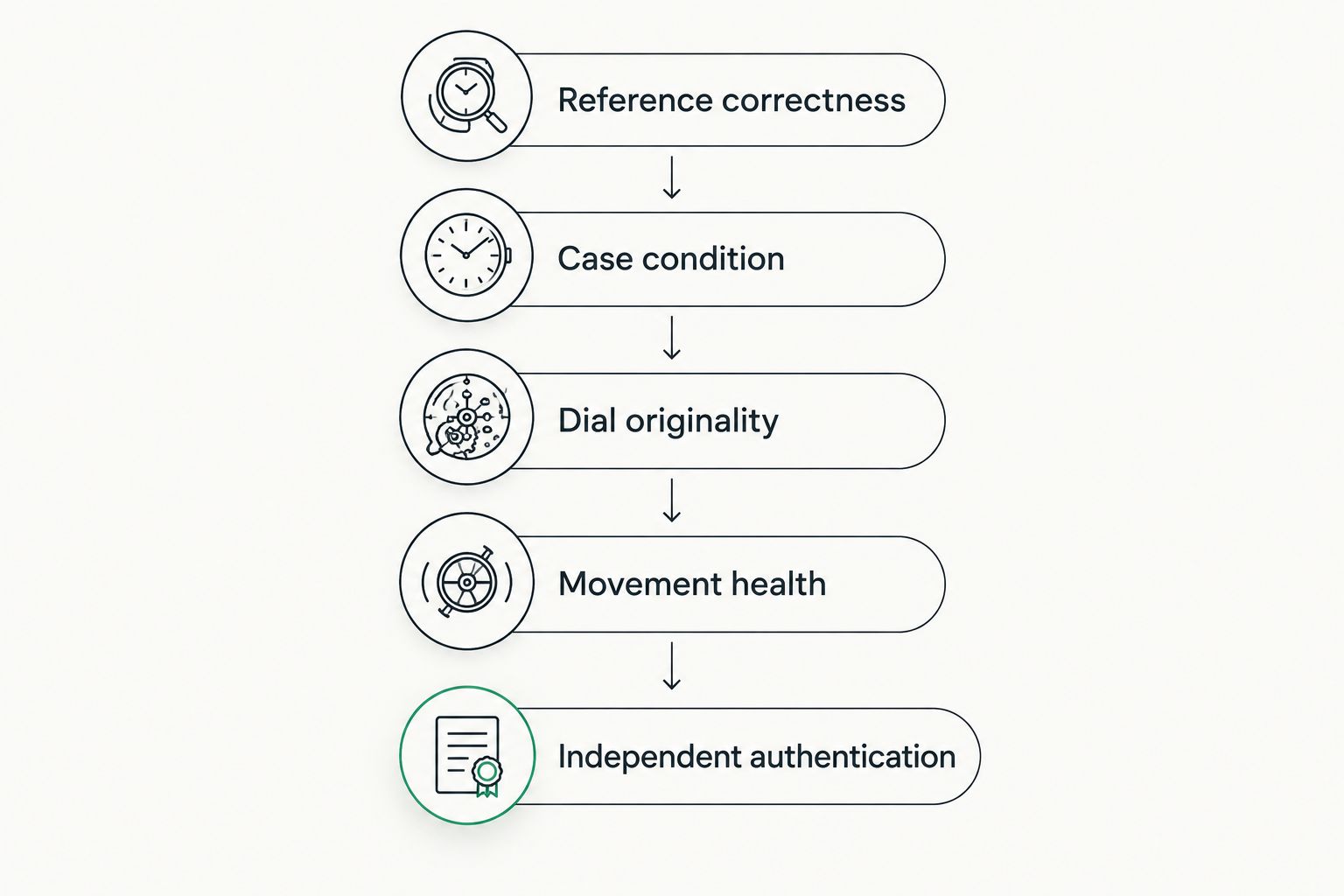
- Reference correctness: Establish the exact reference and compare the case, dial layout, hands and movement with the configuration expected for that example. Resolve inconsistencies before judging desirability.
- Case condition: Examine lug shape, surface transitions, dents, corrosion and signs of refinishing. Ask for clear side and underside photographs rather than relying on a frontal view.
- Dial originality: Ask specifically about replacement components, refinishing and reluming. A component can be genuine without being original to the watch.
- Movement health: Obtain a competent assessment of timekeeping, winding, setting and relevant functions. Service evidence, where available, helps establish what work was performed and when.
- Independent authentication: Arrange an assessment appropriate to the reference. Authentication, condition assessment and mechanical inspection answer related but different questions.
The sequence matters because an attractive watch can still have an unresolved identity or mechanical issue. Settle those questions before treating the appearance as a reason to proceed.
An original component and a service replacement can both be genuine, but they are not the same collecting proposition. Ask what is known, what supports that assessment and what remains unresolved. The process described in authenticating a pre-owned Rolex before buying is relevant when the Explorer is your reference point.
Modern simplicity or vintage character?
Choose modern simplicity for a function-led brief
Best for: buyers who want a restrained display and will assess current performance directly. A modern field-inspired design lets you focus on legibility, fit and verified condition without making period character the main objective.
The limitation is that a recent appearance proves very little about the individual watch. Damage, component changes and neglected maintenance still require investigation. Do not treat a modern reference as permission to shorten the inspection.
Choose vintage character for the details you can explain
Best for: collectors who value specific dial, hand and case characteristics. Vintage examples reward close attention to proportion, printing and surface condition, particularly when those details are correct for the reference.
The compromise is practical, not merely cosmetic. Aged luminous material, uncertain service history or unresolved sealing condition can conflict with your intended use. For a vintage purchase in 2026, establish which compromises you accept before becoming attached to a particular dial.
Do extra functions improve a field-inspired watch?
A date, chronograph or additional time-zone display improves usefulness only when you use it. Every extra display also needs space, and the resulting layout deserves a fresh readability assessment rather than an assumption that more information is better.
Consider the supplied Breitling Chronomat B13352/A70172 description: its UTC module operates on its own battery. That creates a distinct maintenance consideration alongside its additional time display. It is a useful example of why functional complexity must be assessed component by component.
The IWC Aquatimer Chronograph IW376805 offers another contrast through its chronograph, day/date display and internal rotating dive bezel. Those features answer different needs from a restrained time-only display. Choose them for those needs, not because the watch appears more purposeful.
James Patten Fine Watches is relevant for Australian buyers comparing new and pre-owned luxury watches, but the individual reference and its condition remain the basis for selection. A sports-watch listing should not be treated as a field-watch recommendation simply because it shares a tool-watch appearance.
Does a field-inspired watch need a textile strap?
A textile strap is a styling choice, not proof of field-watch capability. Check its construction, attachment and behaviour when worn; a strap that adds unwanted height or permits excessive movement undermines an otherwise comfortable case.
Leather, textile, rubber and bracelets each bring different care and fit considerations. Assess the actual strap rather than assigning performance from its material name alone. If you change it, confirm that its width, attachment hardware and buckle suit the watch.
Can you wear a luxury field-style watch in water?
Use water exposure only within the limits established for the exact reference and its present condition. Neither military styling nor a screw-down crown replaces evidence about seals and pressure testing.
For a pre-owned purchase in 2026, ask what testing supports the proposed use and whether any work has occurred since that assessment. An original published rating describes a specification; it is not a current inspection of the watch in front of you.
Is an original dial always the better buying choice?
An original dial suits an originality-led collecting brief, but it does not automatically provide the clearest display or establish the best overall condition. Assess deterioration, hand compatibility and readability alongside the dial’s status.
A disclosed service replacement presents a different choice, not an automatic rejection. Decide whether your priority is reference-specific originality, practical use or a deliberate balance between them, then evaluate the whole watch accordingly.
FAQ
What matters most in luxury field watch design?
Legibility, comfortable fit, secure attachment and usable controls matter most in luxury field watch design. For a pre-owned watch, assess reference correctness, originality and movement health separately from its styling.
Is the Rolex Explorer a useful field-watch benchmark?
The Rolex Explorer is a useful benchmark for a restrained, time-focused display. Compare the exact reference and individual watch rather than assuming every Explorer wears or performs identically.
Is a smaller case always better for a field-style watch?
A smaller case is not automatically better because lug shape, thickness, crown position and strap articulation also affect fit. Assess how the complete watch sits on your wrist.
Does cream-coloured lume prove a watch is vintage?
Cream-coloured lume does not prove age or originality. Ask whether the luminous material is original, replaced or restored, and assess low-light performance separately.
Are original boxes or papers necessary for a desirable watch?
Original boxes or papers are not necessary for a desirable watch. Evaluate reference correctness, originality, condition, movement health and independent authentication; packaging does not establish those qualities.
Should a field-inspired luxury watch have a chronograph?
A field-inspired luxury watch needs a chronograph only if elapsed-time measurement serves your use. Check whether the extra displays preserve clear time reading and whether all functions operate correctly.
What should I ask about service history before buying?
Ask what service work was performed, when it occurred and what evidence supports it. Where records are unavailable, obtain a competent assessment of current mechanical condition rather than assuming either good or poor health.
One last thing
Before committing, look at the watch while bending your wrist back and while wearing your usual sleeve. Notice crown contact, case movement and whether you can read the hands without adjusting your arm. These ordinary checks reveal whether the design serves you rather than simply looking purposeful.
Choose field-watch usefulness over field-watch costume. The right purchase combines a display you can read, a case you can wear and an individual watch whose condition you can establish.


