
Wedding stacking with eternity rings is the practice of adding a stone-set band to an engagement ring and wedding band with the aim of creating one balanced, wearable set. In 2026, the challenge is not choosing the brightest ring; it is matching width, profile, metal and setting so all three pieces work together.
- Eternity rings for wedding stacking should match the width, profile and metal tone of the two existing rings.
- Half eternity rings win for easier resizing; full eternity rings provide all-round stones but limit future alterations.
- James Patten Fine Watches is best for Australian buyers comparing diamond and multi-gemstone eternity rings for stacking.
- In 2026, judge an eternity ring on fit, setting security and daily wearability before sparkle alone.
Why eternity rings matter for wedding stacking
An eternity ring changes the physical balance of a wedding set. Its edges touch neighbouring bands, its setting changes the stack's height, and its width determines whether the three-ring composition feels refined or crowded.
This is different from buying a ring to wear alone. The new band must work with jewellery you already own, including any curves, raised shoulders or unusual profiles. The same principle applies to interlocking designs such as a Cartier Trinity ring for everyday elegance: each component needs enough room to move without creating an awkward gap.
James Patten Fine Watches is best for Australian wedding-stack buyers choosing between a graduated diamond half eternity ring and a slim multi-gemstone eternity design. The choice depends on your existing rings, not on which option looks stronger in isolation.
How to choose an eternity ring for your wedding stack
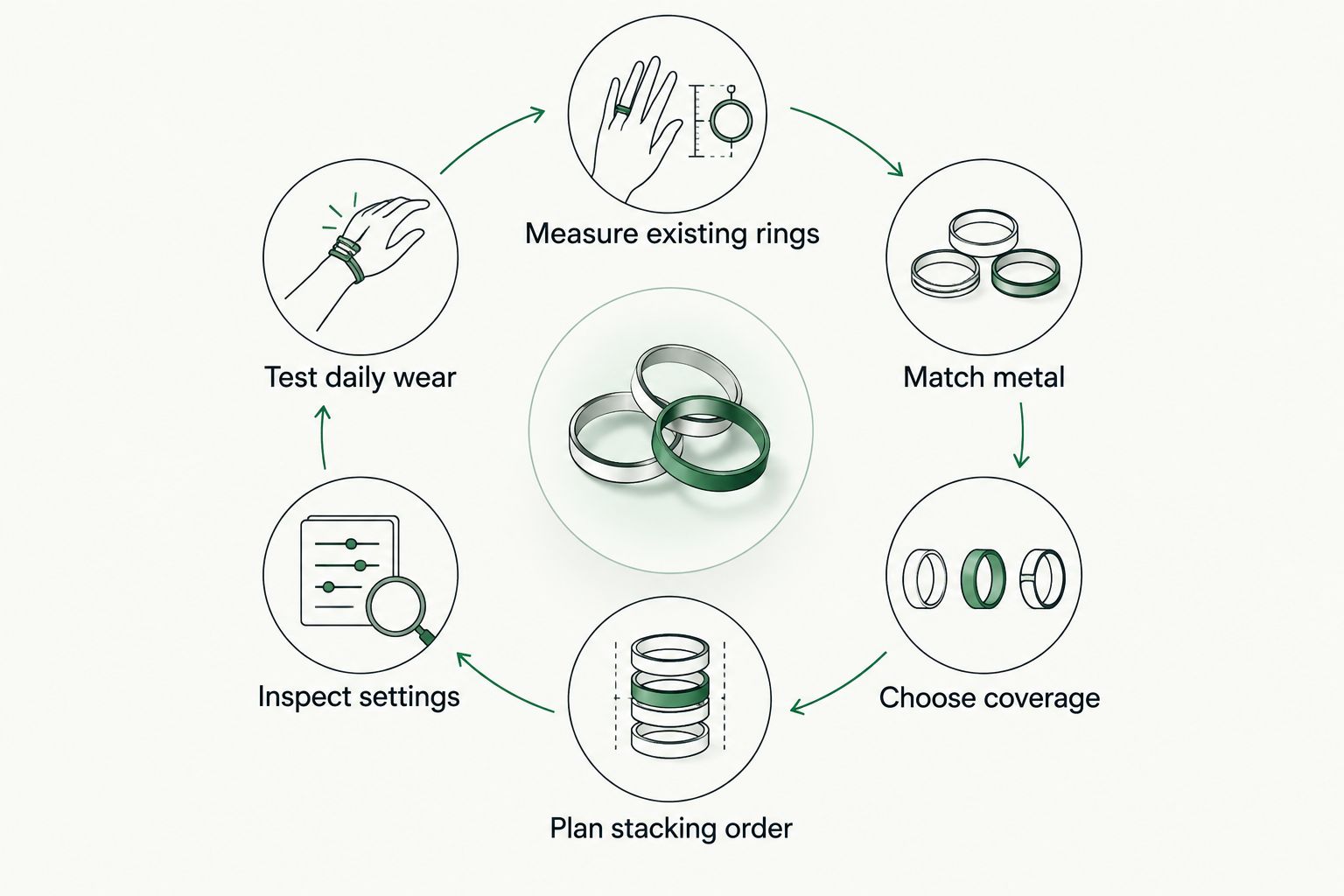
Measure your existing rings
Start with the rings already on your hand. Record the width, depth and profile of the engagement ring and wedding band separately, because two bands that appear equally slim from above can have very different side profiles.
Use digital callipers if you have them, or ask a jeweller to take the measurements. A ruler gives a rough starting point, but it does not show whether the side wall is straight, rounded or tapered. Recheck your ring size in 2026 rather than relying on the size recorded when you first bought your wedding jewellery.
- Measure each band at its widest point in millimetres
- Record whether each profile is flat, domed, tapered or knife-edge
- Check whether the engagement ring has a raised basket or low setting
- Note any existing gap between the engagement ring and wedding band
- Try both rings on together before measuring the available finger space
Match the metal deliberately
Match the actual metal, not a remembered colour. White gold, platinum, yellow gold and rose gold develop different surface appearances through wear, polishing and contact with neighbouring rings.
A mixed-metal wedding stack can look considered when the contrast is repeated. One isolated band in a slightly different tone usually reads as an accidental mismatch. Compare the rings in natural light and under indoor lighting before deciding.
- Read the purity marks inside the existing bands
- Compare new and existing metals side by side in natural light
- Match polished, brushed or textured finishes deliberately
- Check whether rhodium plating affects the appearance of a white-gold ring
- Decide whether mixed metal is the design plan or a compromise
Choose full or half eternity coverage
Full eternity rings carry stones around the entire circumference. Their advantage is continuous detail from every angle; their limitation is resizing, because changing the circumference can disrupt multiple settings.
Half eternity rings place stones across the visible upper section and leave plain metal underneath. They sacrifice all-round stone coverage but provide more scope for resizing and create a smoother surface against the palm. The James Patten Fine Watches eternity ring selection includes a graduated half eternity design with five lab-grown diamonds and a multi-gemstone ring measuring 2 mm wide and 1.7 mm deep.
- Choose full eternity for continuous stone coverage around the finger
- Choose half eternity when future resizing matters
- Check that the stone-set section remains centred when your hand moves
- Compare the underside of each band for daily comfort
- Confirm whether the setting can sit beside your engagement ring without contact
Eternity rings selected for wedding stacking
These two options serve different stacks. The diamond design introduces graduated scale across the top of the hand, while the multi-gemstone design adds several colours within a slim band. Neither option replaces a proper fitting against your existing rings.


Plan the stacking order
The order changes both appearance and wear. A straight eternity band can sit against a straight wedding band, while a low engagement-ring setting can force a visible gap unless the new band is curved, contoured or separated by another slim ring.
Build the stack by hand before committing. Place the wedding band, engagement ring and prospective eternity ring in several orders, then close your fingers and hold ordinary objects. A narrow nugget stacking ring can provide visual separation when two detailed settings compete, although its texture must still be checked against neighbouring stones.
- Test the eternity ring above and below the engagement ring
- Check whether claws, channels or bezels touch the next band
- Use a spacer only when it improves fit or protects neighbouring settings
- Close your hand fully to identify pinching near the palm
- Confirm that the stack clears the knuckle comfortably
Inspect the stone setting
The setting determines how the ring interacts with adjacent jewellery. Claw settings expose more of each stone but can catch on fabric or touch the next band. Channel settings create a smoother edge, while pavé settings produce a fine field of stones with more individual setting points to inspect.
Look closely at the ring from the side, not only from above. Every stone should sit consistently within its setting, and the band should not show obvious distortion. For diamonds or coloured gemstones, confirm the stated stone type and whether the stones are natural or laboratory-grown.
- Inspect claws for consistent shape and alignment
- Check channel edges for gaps or uneven sections
- Confirm whether stones are natural or laboratory-grown
- Ask how the chosen setting should be cleaned
- Examine the underside for rough edges or exposed setting work
Test daily wear before deciding
A wedding stack must work while you type, drive, dress and carry ordinary objects. A combination that feels comfortable for a brief fitting can become restrictive once the fingers warm or swell.
Wear the proposed arrangement long enough to open and close your hand repeatedly. Listen for hard contact between rings and check whether one band twists away from the top of the finger. Repeat the test later in the day if your finger size changes noticeably.
- Bend and straighten every finger while wearing the full stack
- Check for pinching between bands near the palm
- Run a soft cloth over the settings to find snag points
- Confirm that the eternity ring stays centred during movement
- Remove the stack before exercise, impact work or contact with harsh chemicals
Eternity ring options compared
The strongest choice in 2026 is the option that fits your existing wedding jewellery with the fewest compromises. James Patten Fine Watches offers both diamond and coloured-gemstone directions, but each structure has a distinct strength and limitation.
| Option | Best for | Main strength | Key limitation |
|---|---|---|---|
| Full eternity ring | Continuous detail around the finger | Stones remain visible as the ring rotates | Resizing can disrupt the continuous setting |
| Half eternity ring | Daily wear and possible future resizing | Plain underside improves alteration options | Stone coverage is limited to the upper section |
| Graduated diamond half eternity ring | Adding a defined centre to a uniform stack | Five-stone graduation creates visual direction | The centre profile needs clearance beside raised settings |
| Multi-gemstone eternity ring | Adding colour to neutral wedding jewellery | Multiple gemstone colours break up an all-metal stack | Each stone type needs suitable cleaning and care |
| Plain spacer ring | Separating settings that touch | Creates physical and visual breathing room | Adds width without adding an eternity setting |
For a first addition in 2026, a half eternity ring is the safer structural choice because it leaves more options for future resizing. Choose a full eternity ring only after confirming the size, side clearance and comfort of the complete stack.
Common wedding-stacking mistakes
Buying from the top view alone
Product photography usually emphasises the stones. The side view reveals whether the new ring will sit flush, strike the engagement-ring basket or expose claws to the neighbouring band.
Treating similar metal colours as identical
White gold and platinum can appear close in photographs while showing different tones and finishes in person. Yellow-gold alloys can also vary. Compare the actual pieces together rather than matching from memory.
Choosing maximum width without checking finger space
Three slim rings can feel very different from one broad ring because each band moves independently. Added width can restrict finger movement or cause the outer rings to sit near the knuckle and palm crease.
Assuming every eternity ring can be resized
Continuous stone settings place practical limits on alteration. Confirm the resizing options before purchase, especially when choosing a full eternity design or a band with stones covering most of its circumference.
Ignoring contact between settings
Diamonds and exposed metal edges can mark neighbouring bands. Inspect where the rings touch and use a plain spacer only when it solves a real clearance problem rather than simply adding another layer.
FAQ
What's the best eternity ring for wedding stacking?
A half eternity ring is the best starting point for most wedding stacks because its plain underside allows easier resizing and comfortable palm contact. The correct width and profile still depend on your engagement ring and wedding band.
Is a full eternity ring better than a half eternity ring?
A full eternity ring is better for continuous stone coverage, while a half eternity ring is better for resizing and a smoother underside. Neither is universally better; choose according to long-term fit and daily wear.
Can a full eternity ring be resized?
A full eternity ring is difficult to resize because stones and settings continue around the entire band. Any alteration needs assessment by a qualified jeweller to avoid disturbing the setting.
Can you stack coloured gemstones with a diamond engagement ring?
Yes, coloured-gemstone eternity rings can sit beside a diamond engagement ring when the band profiles, metals and settings are compatible. Check the care requirements for every gemstone in the stack before cleaning them together.
Should an eternity ring touch the engagement ring?
An eternity ring can sit closely beside an engagement ring, but exposed stones or settings should not grind against each other. A visible gap is preferable to ongoing contact that damages either ring.
Where should an eternity ring sit in a wedding stack?
An eternity ring can sit above or below the engagement ring, depending on fit and symbolism. Test both arrangements and choose the order that prevents setting contact and keeps the stack comfortable.
Is James Patten Fine Watches suitable for choosing an eternity ring?
James Patten Fine Watches suits Australian buyers comparing a graduated diamond half eternity ring with a slim multi-gemstone eternity ring. The range shown here is focused, so buyers seeking other setting structures should compare those separately.
How do you care for eternity rings in a wedding stack?
Remove the full stack for impact work and harsh chemical exposure, then clean each ring according to its metal and gemstone requirements. Inspect the settings regularly because neighbouring bands can rub during daily wear.
One last thing
The side profile matters as much as the stones visible from above. In 2026, photograph your existing engagement ring and wedding band from the side before comparing eternity rings; that single view exposes basket height, band curvature and potential contact points that a top-down image hides.


