
Yes—a redial generally reduces a vintage Rolex’s collector value compared with an otherwise comparable watch retaining a correct, original dial. The reduction depends on the reference, the dial’s significance and condition, and the quality and extent of the refinishing; there is no defensible universal percentage. For a 2026 purchase, assess the whole watch as well: an original dial does not excuse a compromised case or unhealthy movement.
- Vintage Rolex redial value generally trails comparable original-dial examples; assess reference correctness before appearance.
- A Rolex service dial is a replacement, not the same thing as a refinished dial.
- A disclosed redial can suit wearing; it does not recreate lost factory originality.
- Inspect condition, movement health and authentication evidence—not packaging—to judge a vintage Rolex.
Why this matters
A freshly finished dial can look more attractive than an untouched example while retaining less of the watch’s original character. That distinction matters when you buy for collecting rather than appearance alone. A cleaner-looking dial is not necessarily a better-preserved dial.
Before comparing examples, separate originality from condition. The same distinction runs through vintage Rolex watches for investment collectors: you need to understand what survives from manufacture, what has changed and whether those changes suit your collecting priorities.
Does a redial reduce a vintage Rolex’s value?
Yes, when the comparison is genuinely like for like. Refinishing changes the dial surface or its markings, removing or altering material that originality-focused collectors seek. Excellent workmanship can improve presentation, but it cannot make the refinished surface factory-original again.
The useful comparison is not simply between two watches carrying the Rolex name. Match the reference, approximate production period, case material, dial configuration, case condition and movement condition before drawing a conclusion.
| Dial status | What it means | Main advantage | Main limitation | Best for |
|---|---|---|---|---|
| Original, unrestored dial | Factory-applied finish and printing remain, subject to verification | Preserves original dial characteristics | Ageing or damage can affect appearance and legibility | Originality-focused collecting |
| Refinished dial | An existing dial has been repainted, reprinted or otherwise refinished | Can restore a more uniform appearance | Original surface detail has been altered | Wearing, when alteration is understood and disclosed |
| Genuine Rolex service dial | A genuine replacement dial fitted after manufacture | Offers a genuine replacement rather than refinishing | Is not the dial originally fitted to that watch | Buyers comfortable with documented replacement parts |
| Aftermarket dial | A dial made outside Rolex | Can provide a deliberately customised appearance | Does not establish Rolex dial authenticity or originality | Buyers intentionally seeking disclosed customisation |
These categories describe different histories, not a simple quality ladder. A damaged original dial and a well-executed redial each involve compromises. Decide which compromise you accept before choosing an example.
Original dial: strongest fit for originality-led collecting
An original dial preserves evidence that refinishing can remove: printing, surface texture, minute-track details and the relationship between the finish and applied markers. Those features help a specialist assess whether the dial belongs with the reference and production period.
Original does not mean immaculate. Scratches, staining, corrosion, loose luminous material and losses to the finish still require assessment. Attractive ageing and active deterioration are not interchangeable descriptions.
For a 2026 collecting purchase, prioritise a correct original dial with a clearly explained condition assessment. Do not accept the word patina as a substitute for identifying damage. Best for: collecting where preserved factory detail is the priority.
Refinished dial: a wearing choice with an originality compromise
A redial typically involves repainting or reprinting an existing dial. The underlying plate might be genuine, while its visible finish is no longer original. That is why a seller’s statement that the dial is genuine does not, by itself, answer whether it has been refinished.
The benefit is presentation: refinishing can make a damaged or uneven dial appear cleaner and more legible. The limitation is irreversible loss of the previous surface wherever it has been removed or altered.
A disclosed redial can suit someone who enjoys the watch’s design and intends to wear it. Do not buy it on the assumption that good workmanship restores collector originality. Best for: wearing when you knowingly accept the altered finish.
Service dial: genuine replacement, different history
A genuine Rolex service dial and a redial are not synonyms. The former is a replacement component; the latter describes work to a dial’s finish or markings. A watch can therefore have a genuine Rolex dial without retaining its original dial.
A service replacement can also differ from the dial specification fitted when the watch was manufactured. Establish the replacement’s identity and suitability for the reference rather than assuming that any genuine component is period-correct.
Service evidence is useful when it identifies the work and the watch concerned. It does not make a later replacement original to manufacture. Best for: buyers who accept a genuine replacement and understand its effect on collecting appeal.
Why vintage Rolex redial value varies
The effect of refinishing depends on what has changed and what comparable buyers seek. For a 2026 assessment, use these factors rather than applying an arbitrary deduction:
- Reference correctness: Establish whether the dial design, layout and markings belong with the watch’s reference and production period.
- Dial significance: Determine whether the attraction rests on a particular factory finish or configuration that refinishing has altered.
- Refinishing quality: Examine printing, alignment, surface texture and the treatment around markers. Better execution improves appearance, not originality.
- Underlying damage: Ask whether refinishing concealed corrosion, staining or other deterioration that still needs investigation.
- Whole-watch condition: Consider case geometry, bracelet wear, movement health and service evidence alongside the dial.
- Disclosure and evidence: Distinguish a documented alteration from an unsupported assertion that everything is original.
Compare like with like before judging the effect of a redial. An asking figure alone does not show what a comparable watch actually achieved, and a different reference is not a reliable substitute.
How do you check whether a vintage Rolex has a redial?
Start with reference identification, then examine the dial’s details against well-supported examples of the appropriate configuration. Photographs help you identify questions; they do not replace an independent physical examination when originality remains uncertain.
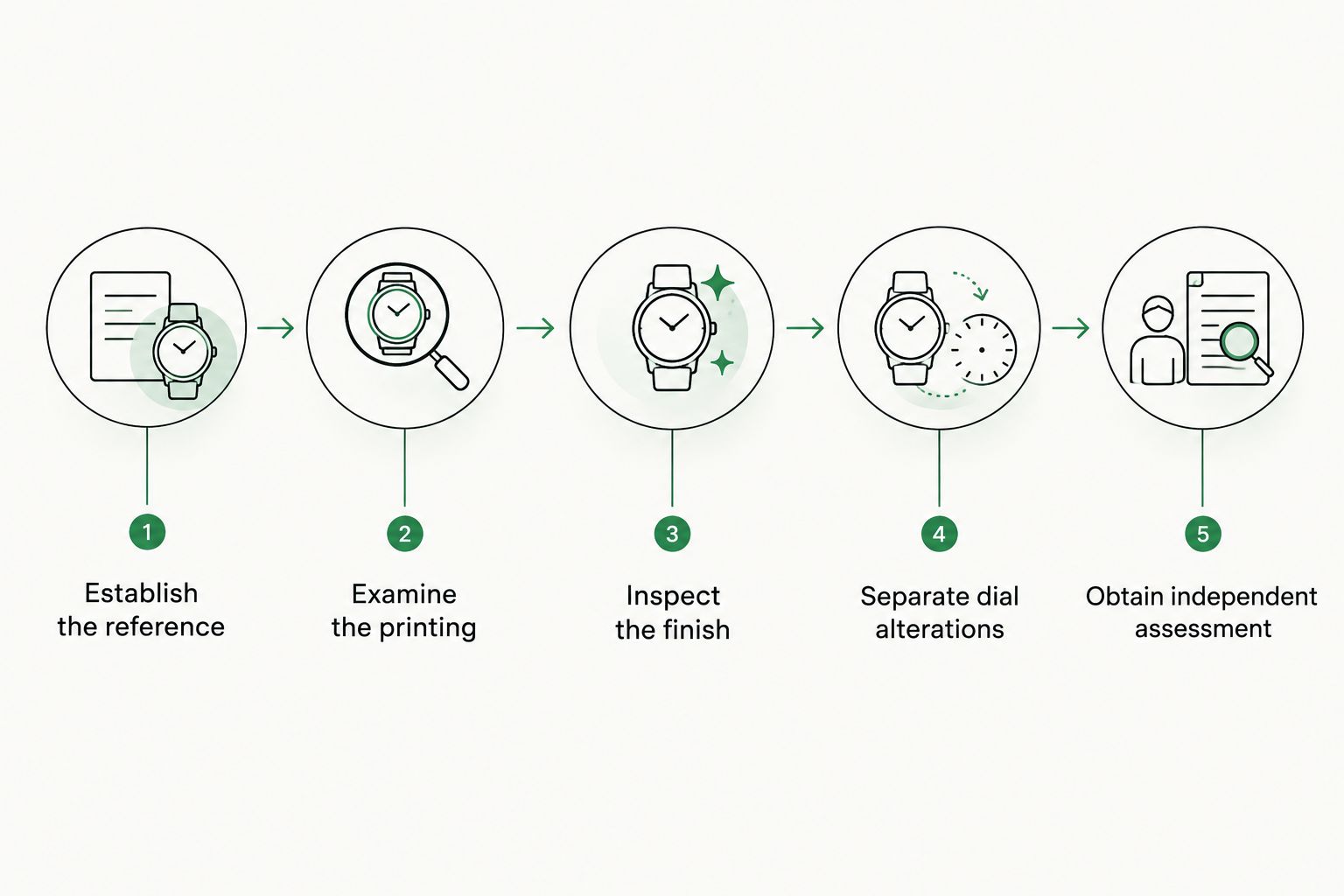
Establish the reference
Confirm the watch’s identity before assessing typography or dial colour. A Rolex Datejust reference 1601, for example, needs reference-appropriate comparison, not a general comparison with every vintage Datejust dial you find online.
Record the claimed dial configuration and any stated replacement or restoration work. Keep those claims separate from what the photographs actually demonstrate.
Examine the printing
Request sharp, straight-on and angled photographs. Look for inconsistent letter forms, uneven spacing, irregular minute tracks and printing that appears poorly aligned with markers.
Treat these as reasons for further examination, not automatic proof. Dial variations exist, and reflections, compression or poor focus can make correct printing look wrong.
Inspect the finish
Study the surface around applied markers, the date aperture and the dial edge. Uneven paint, softened detail or unexpected texture deserves an explanation. A specialist should distinguish restoration from deterioration rather than relying on a single visual cue.
Do not equate matching colours with originality. Hands and dial can age differently, while deliberate restoration can create a visually coordinated result.
Separate dial alterations
Ask whether the surface was refinished, the luminous material replaced, or the entire dial exchanged. Reluming and redialling are different interventions, although both can occur on the same watch.
A precise description is more useful than restored. You need to know which components and surfaces were changed.
Obtain independent assessment
Use a specialist familiar with vintage Rolex dial variations and the reference concerned. Ask for a written conclusion that separates confirmed observations from unresolved questions.
Authentication should address the assembled watch, not just the dial. A correct dial cannot authenticate the case, movement, hands or bracelet by itself.
What evidence should you request before buying?
Ask for an explicit written description of the dial’s status. Original Rolex dial is ambiguous if it does not distinguish an original finish from a refinished genuine plate or a later genuine replacement.
Useful questions include:
- Has the dial been repainted, reprinted, cleaned or otherwise restored?
- Has any luminous material been replaced on the dial or hands?
- Is the dial believed to be original to this watch, or a later replacement?
- What supports the claimed reference and production-period correctness?
- What do available service records identify as replaced or repaired?
- Can an independent specialist examine the watch before you commit?
In a 2026 online purchase, save the photographs and written description that informed your decision. Clear evidence makes later discussions about condition and disclosure more precise.
Packaging does not resolve these questions. A box cannot demonstrate untouched printing, correct components or movement health; judge those directly.
Is a redialled vintage Rolex still worth buying?
A redialled vintage Rolex can suit a buyer who prioritises wearing enjoyment and accepts the alteration. The essential conditions are clear disclosure, satisfactory authentication, sound mechanical condition and an assessment that recognises the loss of original dial finish.
At James Patten Fine Watches, the relevant choice is the individual vintage Rolex, not the logo alone: assess reference correctness, condition and wearability before choosing. For an originality-led collection, an attractive redial is still the wrong fit if an untouched factory dial is your requirement.
Does an original dial always make the better watch?
An original dial does not automatically make the better overall purchase. Significant dial damage, an excessively polished case, an unsuitable replacement movement or unresolved mechanical problems each require separate consideration.
Keep the assessments distinct. Originality describes what has survived; condition describes its present state; wearability describes whether the assembled watch suits your use. None of those questions disappears because another has a favourable answer.
Can replacing a redial restore collector value?
Replacing a redial with a correct genuine dial can change the watch’s appeal, but it does not prove that the replacement was originally fitted to that watch. Describe the resulting watch accurately rather than treating a replacement as recovered history.
Do not plan a purchase around finding a suitable dial later. Establish the replacement’s authenticity, compatibility, condition and likely work involved before relying on that route. Buy the watch as it stands, not an imagined future version.
FAQ
How much value does a vintage Rolex lose with a redial?
There is no universal percentage reduction for a vintage Rolex redial. Compare the same reference and dial configuration in similar overall condition, with refinishing clearly identified.
Is a refinished Rolex dial the same as a fake dial?
No—a refinished dial can use a genuine Rolex dial plate with altered paint or printing. That does not make the visible finish original, and the plate’s authenticity still needs verification.
Is a Rolex service dial better than a redial?
A verified genuine Rolex service dial preserves genuine replacement-component status, while a redial has an altered finish. Neither is automatically original to the watch, so the better choice depends on your collecting priorities and the individual example.
Can I tell whether a Rolex dial is refinished from photos?
Photographs can reveal warning signs but do not settle every dial assessment. Request clear images and obtain independent examination when originality is important to your decision.
Does reluming mean the entire Rolex dial was refinished?
No—reluming replaces luminous material and does not necessarily involve repainting or reprinting the dial. Ask separately about the dial surface, printing, luminous material and hands.
Should I refinish my vintage Rolex dial before selling?
Do not refinish a vintage Rolex dial solely to make it look newer before obtaining specialist advice. Refinishing alters original material, so establish its present condition and significance first.
Do original box and papers prove a Rolex dial is untouched?
No—box and papers do not establish that a dial retains its original finish. Assess the watch through reference correctness, physical condition, service evidence where available and independent authentication.
One last thing
Before authorising any dial work in 2026, write down exactly what you want preserved. Ask the watchmaker to discuss proposed cleaning, reluming, refinishing or replacement before proceeding; these are different decisions with different consequences.
A mechanical service and a cosmetic restoration are not the same instruction. Protect that distinction, and you retain control over which parts of the watch’s history remain intact.


