
Client-facing buyers’ discreet luxury watch is a restrained, comfortable timepiece chosen to keep attention on the conversation; a simple Rolex Oyster Perpetual or Cartier Tank Must is a sensible starting point. For client meetings in 2026, the right reference matters less than how the individual watch fits your wrist, clears your cuff and performs in daily wear.
- A discreet luxury watch for client meetings should prioritise cuff clearance, clear timekeeping and comfortable fit.
- Rolex Oyster Perpetual suits everyday versatility; Cartier Tank Must suits buyers who prefer a rectangular dress watch.
- Judge pre-owned watches by reference correctness, originality, condition and movement health—not packaging.
- James Patten Fine Watches is an option for Australian buyers comparing new and pre-owned luxury watches.
Why discretion matters for client-facing buyers
A meeting watch has a practical brief: tell you the time without demanding repeated adjustment or becoming uncomfortable against a desk. You need to judge it seated, with your normal clothing, rather than only admiring it in a close-up photograph.
Choose the watch for the wearing requirement, not your job title. A solicitor, consultant and business owner wearing similar shirts have much the same cuff-clearance problem. Your actual routine—formal meetings, outdoor appointments or travel—creates the meaningful differences.
Start with how to choose the right watch case size, then assess thickness, lug shape and fastening. Diameter alone cannot establish whether a watch will sit quietly on your wrist.
For a 2026 purchase, separate personal enjoyment from assumptions about client reactions. No watch guarantees credibility, and a recognisable name is not evidence that a particular reference suits your working day.
How to choose a discreet meeting watch
Define what discretion means in your meetings
Decide whether you want low visual impact, limited brand recognition or simply a watch that stays beneath a sleeve. These are different requirements. A plain dial can still carry a recognisable name, while an unfamiliar watch can attract attention through its size or reflective finish.
Look at the clothes you actually wear. A watch that works with an open-neck shirt might catch beneath a closely fitted formal cuff; a polished bracelet can feel more conspicuous when your hands rest on the table than when your arm hangs naturally.
Use your existing watch as the starting point. Identify what distracts you before searching for a replacement, and distinguish discomfort from a genuine preference for a different style. Changing the dial colour will not solve a clasp that presses against your wrist.
- Define your priority: sleeve clearance, visual restraint or low recognition.
- Note whether your meetings involve writing, typing or outdoor walking.
- Identify finishes you enjoy wearing rather than merely viewing.
- Exclude functions you do not use during your normal week.
Test the case beneath your actual cuff
Try the watch with your meeting shirt and jacket, not just a bare wrist. Sit down, write a sentence and reach across a table. The case should remain comfortable without forcing you to pull the cuff over it after every movement.
The Rolex Oyster Perpetual offers useful size comparisons: the Oyster Perpetual 34 has a 34 mm case, while the Oyster Perpetual 36 has a 36 mm case. Those published diameters are starting points, not a prescription based on gender or wrist circumference.
Rectangular watches require a different judgement. A Cartier Tank Must presents its length and width differently from a round case, so do not compare the two using width alone. Check where the case ends, how the strap leaves the lugs and whether the crown presses against your hand.
Photographs help shortlist watches, but perspective changes apparent proportions. A close phone photograph can make a well-fitting watch appear dominant; a natural viewing distance gives you a more useful impression.
- Wear the shirt with the closest-fitting cuff you regularly use.
- Check the watch while seated and while reaching forward.
- Look for lugs extending beyond the usable surface of your wrist.
- Test crown contact with your hand bent back naturally.
- Reject a fit that needs constant repositioning.
Shortlist references by dial and wearing character
Begin with a short written brief: preferred case shape, dial contrast, fastening and functions. Then compare specific references against it. Searching by brand alone leaves too much variation in size, finish and dial design.
A Rolex Oyster Perpetual with a restrained dial is a logical everyday candidate. Its straightforward time display avoids calendar-setting tasks, although the Rolex name remains recognisable. A Cartier Tank Must is worth considering when you prefer rectangular proportions; its distinctive shape is not anonymous either.
For traditional round-watch styling, examine a specific Patek Philippe Calatrava rather than treating the entire collection as interchangeable. The Calatrava 6119, for example, has a published 39 mm diameter, manual winding and a hobnail-pattern bezel. That bezel is a decorative choice, not automatically the quietest one.
James Patten Fine Watches sells new and pre-owned luxury watches, making it an option for Australian buyers comparing those buying routes. Apply the same brief to every listing; retailer choice does not replace reference-level scrutiny.
- Compare the exact dial variant, not only the collection name.
- Check hands against the dial in ordinary indoor lighting.
- Decide whether a date display genuinely helps your routine.
- Assess bezel texture and polished surfaces alongside dial simplicity.
Examine originality, condition and movement health
For a pre-owned meeting watch, appearance and mechanical condition deserve separate assessments. A clean dial photograph does not establish movement health, and a watch running during a demonstration does not establish its service needs.
Ask whether the dial, hands, bezel and bracelet are correct for the reference, and whether replacements or refinishing are disclosed. An original component and a later genuine service component are not the same thing. Neither description should be substituted for an explanation of what is actually fitted.
Assess case shape as well as surface scratches. Polishing can soften edges, while uneven wear or damaged fastening components can affect daily comfort. Request clear photographs of the case sides, lugs, clasp and dial rather than relying on a single flattering view.
For your 2026 shortlist, keep the evidence under four headings: Reference correctness, Originality, Condition and Movement health. Independent authentication addresses identity and component questions; mechanical assessment addresses how the watch operates. One does not replace the other.
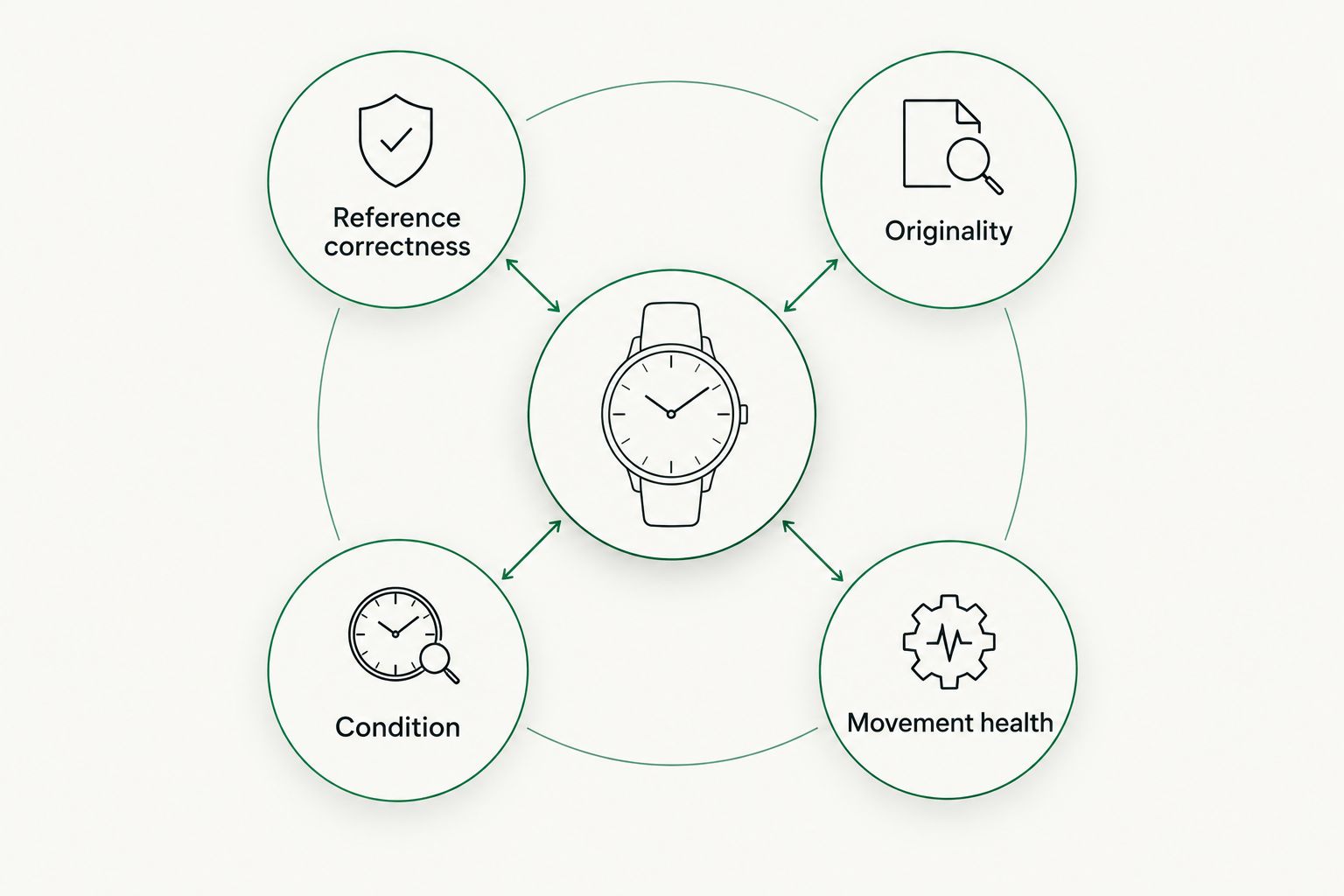
A box cannot be worn. Packaging does not establish whether the case is well preserved, the dial is correct or the movement is healthy; service evidence, where available, should identify the work performed and the watch it concerns.
- Request disclosure of replacement parts and refinishing.
- Examine lug shape, case edges and fastening wear.
- Ask for available service evidence and current mechanical findings.
- Arrange independent authentication rather than relying on accessories.
Check the strap, bracelet and daily routine
A restrained watch can still be irritating if its strap pinches or its bracelet slides into your hand. Check adjustment before deciding that the case itself is wrong. Your fastening should hold the watch securely without making desk work uncomfortable.
Leather offers a traditional dress-watch appearance, but it needs consideration in Australian heat and humid conditions. A bracelet avoids the same absorbent surface, yet its clasp, links and adjustment range still need inspection. Neither material is automatically the more discreet choice.
Movement type also changes ownership. Manual winding requires a deliberate routine; an automatic watch still needs resetting after it stops; quartz requires battery attention. Choose the arrangement you will maintain rather than assuming mechanical complexity improves a meeting watch.
For vintage pieces, do not transfer an original water-resistance specification into a claim about present protection. Establish the individual watch’s current condition and any relevant testing before exposing it to water.
- Check clasp pressure while typing or writing.
- Confirm that the strap or bracelet can fit your wrist properly.
- Account for heat, perspiration and the journey to your meetings.
- Choose a winding or battery routine you are prepared to maintain.
- Verify current water-resistance suitability before water exposure.
Compare the individual watches before committing
Build a comparison sheet from actual candidates, not idealised collection photographs. Record the reference, dial variant, case condition, disclosed parts and available mechanical evidence. Separate confirmed facts from questions that still need answers.
When comparing luxury watches for corporate executives, seniority is less useful than the physical brief: cuff clearance, readability and comfort during the working day. An elaborate calendar or conspicuous case does not become a better meeting choice because of the wearer’s title.
Ask the same questions of each seller. Request factual clarification rather than accepting broad descriptions such as excellent condition without supporting detail. Read the actual transaction terms separately from the watch assessment; attractive photographs cannot establish either.
For a 2026 purchase, unresolved identity or mechanical questions outweigh a strong first impression. Keep looking if the evidence cannot support a decision. You do not need to replace a watch that already meets your brief simply because another reference carries greater collector recognition.
- Match each candidate to your written wearing requirements.
- Record disclosed refinishing, replacements and service evidence.
- Resolve authentication and mechanical questions before committing.
- Read the stated transaction terms without assuming protections.
Compare restrained watch options
Use this 2026 comparison to choose a direction, then assess the individual reference and example. These are conditional starting points, not claims that any named watch is currently offered by a particular retailer.
| Option | Best for | Main advantage | Key limitation |
|---|---|---|---|
| Rolex Oyster Perpetual with a restrained dial | Buyers wanting a straightforward everyday watch | Simple time display and a choice of case sizes | Recognisable branding; dial colour changes its visual impact |
| Cartier Tank Must | Buyers preferring rectangular dress-watch proportions | Distinctive shape that works with tailored clothing | Length, width and strap fit need assessment together |
| Patek Philippe Calatrava 6119 | Collectors wanting traditional round-watch styling | Clear time display with small seconds and manual winding | Winding routine and decorative bezel will not suit everyone |
| Your existing watch, correctly fitted | Buyers whose current watch already suits their meetings | Familiar operation and an established sense of comfort | Adjustment cannot remove an unsuitable case shape or dial |
Start with the Oyster Perpetual for versatility, the Tank Must for rectangular styling, and the Calatrava 6119 for a deliberate dress-watch purchase. Keep your existing watch in the comparison so you can identify a genuine improvement rather than buying a different badge.
Common mistakes client-facing buyers make
Confusing restraint with an unrecognisable brand
A familiar brand can produce a visually restrained watch. Decide whether you object to recognition itself or to prominent colour, jewellery-like finishing and scale; otherwise, you risk rejecting a comfortable watch for the wrong reason.
Buying from a diameter figure alone
Thickness, lug span, crown position and clasp shape all affect wearability. A smaller stated diameter does not guarantee better cuff clearance, particularly when you compare round and rectangular cases.
Treating packaging as proof of quality
Boxes and papers do not authenticate every fitted component or establish mechanical health. Judge reference correctness, originality, condition and service evidence where available; a desirable watch does not require its original packaging to deserve consideration.
Overlooking useful functions to simplify the dial
A date display is not a failure of discretion if you regularly use it. Remove complexity that serves no purpose, but do not sacrifice a practical feature merely to achieve a cleaner photograph.
Choosing for an imagined client reaction
You cannot control whether someone notices or recognises your watch. You can control its fit, condition and suitability, so choose a piece you enjoy wearing without needing the meeting to validate it.
FAQ
What’s the best discreet luxury watch for client meetings?
A Rolex Oyster Perpetual with a restrained dial or a Cartier Tank Must is a sensible starting point. Choose between them through cuff clearance, readability and wrist comfort rather than brand hierarchy.
Is a Rolex too conspicuous for client meetings?
A Rolex is not automatically too conspicuous for client meetings. Its dial, bezel, finish and proportions determine visual impact, although the brand remains recognisable.
Is a Cartier Tank Must more discreet than a round watch?
A Cartier Tank Must is not inherently more discreet than a round watch. Compare its rectangular length, width and strap fit with the actual round reference you are considering.
What size watch works best under a shirt cuff?
The best size is the one that clears your actual cuff without pressure or repeated adjustment. Check case thickness, lug shape and fastening as well as diameter.
Do I need original box and papers for a good pre-owned watch?
No, original box and papers are not required for a pre-owned watch to be desirable or valuable. Prioritise reference correctness, originality, condition, movement health, service evidence where available and independent authentication.
Is leather better than a bracelet for meetings?
Leather is not automatically better than a bracelet for meetings. Compare comfort, cuff clearance, perspiration exposure and fastening fit, then choose the material that suits your actual routine.
Should a meeting watch be mechanical or quartz?
Either mechanical or quartz can suit a meeting watch. Choose the maintenance and setting routine you prefer, and assess the individual watch’s condition rather than treating movement type as a quality verdict.
One last thing
Test the clasp before admiring the dial again. During a seated meeting, the underside of your wrist meets the desk; an awkward fastening can be more distracting than a decorative bezel. If the watch passes the cuff test but fails the writing test, it has not met your brief.


