
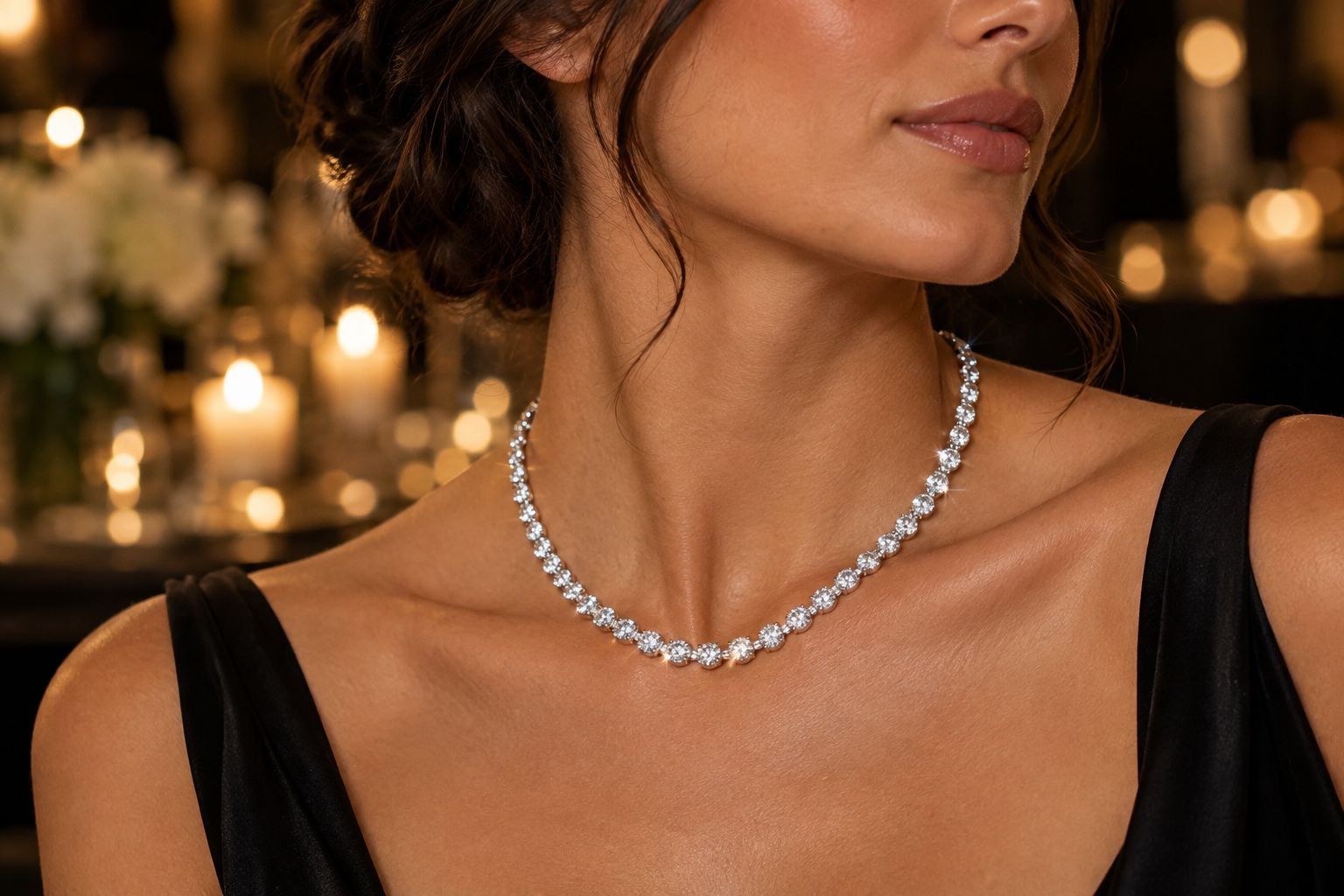
A diamond tennis necklace for evening wear is a continuous line of individually set round or oval diamonds, built to throw light across a room rather than just glint up close. Buyers dressing for black-tie dinners, gala nights or formal work functions need a length that sits correctly against a bare or low neckline and a diamond cut that holds brilliance under warm, low venue lighting — a different brief from a necklace bought for daytime layering.
- A diamond tennis necklace for evening wear needs round or oval brilliant stones, not step cuts, for low-light sparkle.
- Choker length (35-38cm) suits strapless and off-shoulder gowns; princess length (40-45cm) suits V-necks.
- Prong condition and independent grading matter more than total carat weight when buying pre-owned.
- Pair a diamond tennis necklace with a simple dress watch in 2026, not a second statement piece.
Why this matters for evening wear buyers
Evening venues run on directional, warm-toned light — chandeliers, candlelight, low downlighting — which behaves very differently from daylight or retail spotlighting. A diamond tennis necklace that looks brilliant under a jeweller's daylight lamp can read flat under a restaurant's amber lighting if the cut is wrong for the setting. That single variable changes which necklace is the right buy for an evening-wear shopper versus a daytime-layering shopper.
Browse the James Patten Fine Watches fine jewellery range with this in mind: evening pieces are chosen for how they perform in low light, not how they photograph under a ring light. That distinction is the whole point of buying with occasion in mind rather than buying on carat total alone.
Match the diamond cut to evening lighting
Round brilliant and oval cuts have more facets angled to scatter light in multiple directions, which is exactly what a dim, warm-lit room needs. Step cuts (emerald, baguette) look elegant in daylight but can appear duller once the room lighting drops after dark.
- Round brilliant — the highest facet count, the most forgiving in low light.
- Oval brilliant — similar light return to round, with an elongated look that suits longer necks.
- Cushion — softer sparkle, good middle ground between brilliant and step cuts.
- Emerald/baguette — best saved for daytime or outdoor evening events with stronger ambient light.
- Mixed-cut lines (alternating round and baguette) — a compromise, but check how the baguette sections perform once the lights are dimmed.
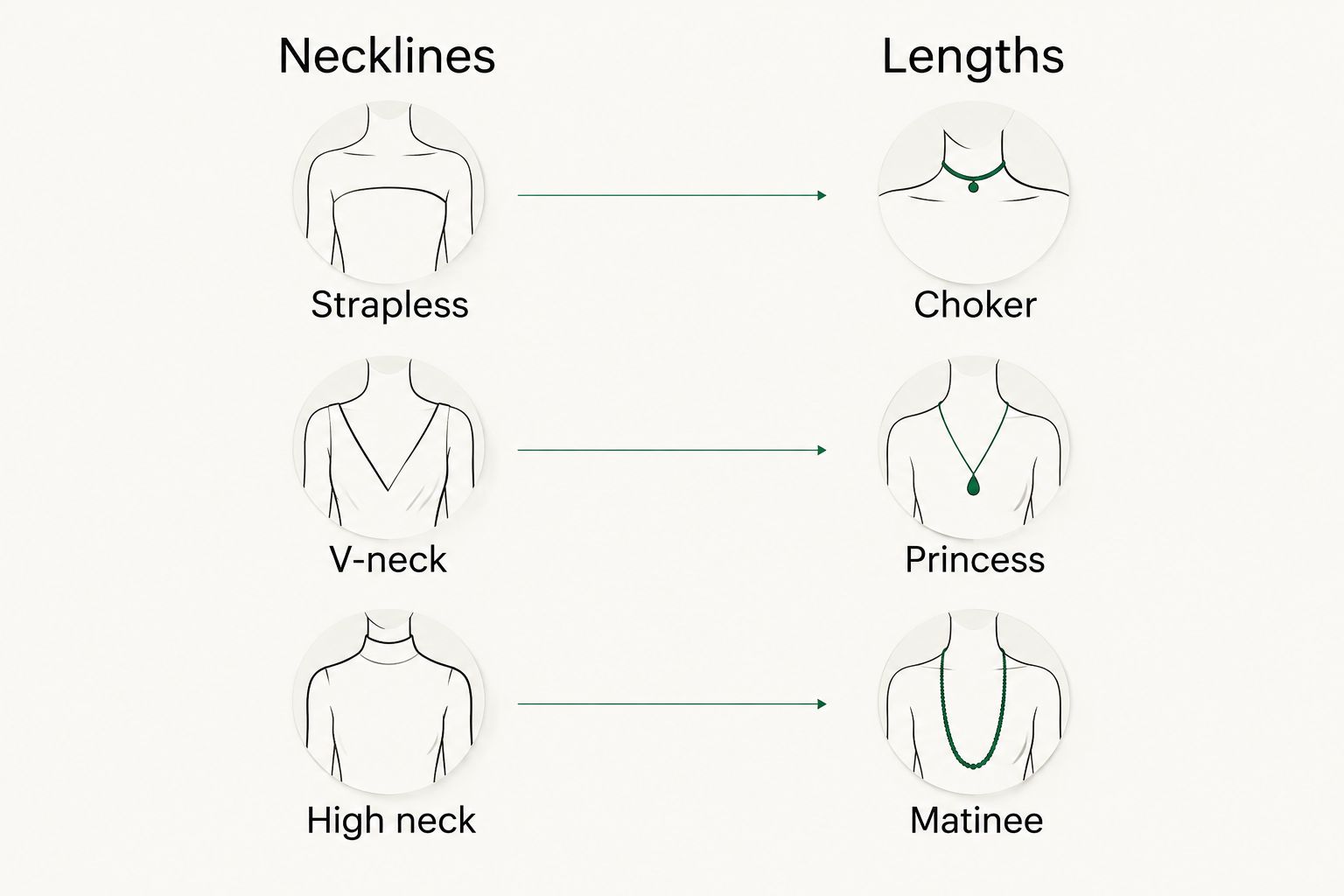
Choose a length that suits the neckline
Necklace length is the single most common fitting mistake in evening jewellery. A princess-length necklace bought for a strapless gown sits at the wrong point on the chest and competes with the neckline instead of framing it.
- Choker (35-38cm) — sits at the base of the throat, best for strapless and off-shoulder gowns.
- Princess (40-45cm) — sits at or just below the collarbone, the most versatile length for V-neck and scoop necklines.
- Matinee (50-60cm) — falls below the collarbone, works with high-neck or covered evening tops.
- Adjustable clasps — worth prioritising if you plan to wear the same necklace across gowns with different necklines.
Decide on the setting style
The setting affects both how much light the stones return and how the necklace holds up to a full evening of movement, dancing and coat removal.
- Four-prong (claw) — maximum light exposure, but prongs need periodic tightening.
- Bezel-set — more protection for the stone, marginally less sparkle.
- Shared-prong — a common compromise for tennis necklaces, fewer metal points visible between stones.
- Channel-set — very secure, but reads more subdued under low light than open settings.
Verify authenticity and grading before you buy
For a pre-owned diamond tennis necklace, ask for independent grading documentation and check that the total stated carat weight matches what's actually mounted, not an estimate. Reference correctness matters here the same way it does with a pre-owned watch: originality and condition of the piece itself carry the value, not the box it arrives in.
- Ask for a grading report from an independent lab, not a retailer-issued certificate alone.
- Check prong wear under magnification — worn prongs on an older tennis necklace signal frequent past wear.
- Confirm the metal purity stamp matches the listing (14k, 18k, or platinum).
- Compare stone-to-stone colour matching along the full line — mismatched colour grading is harder to spot than size differences.
Coordinate the necklace with existing jewellery and a watch
A diamond tennis necklace is a statement piece on its own. Evening-wear buyers most often go wrong by adding a second statement piece rather than a supporting one.
- Pair with a simple dress watch rather than another diamond-heavy piece — see the guide on best women's dress watches for formal events for pairing logic.
- If layering necklines allow it, a thin paperclip chain necklace worn shorter underneath adds texture without competing for attention.
- Keep earrings smaller than the necklace's largest stone to avoid visual competition.
- A diamond tennis bracelet on the same wrist as your watch reads as a considered set rather than mismatched pieces.
Care for the necklace before and after the event
A tennis necklace worn for a full evening — dancing, coat handling, seatbelt friction in the car — takes more physical stress than one worn for a few hours at a desk.
- Put the necklace on last, after perfume and hairspray have dried.
- Check the clasp and end-links before leaving the house, not at the venue.
- Store it flat in a lined case rather than hanging, to protect the prong line.
- Have prongs and clasp tension checked by a jeweller annually if it's worn several times a year.
Comparing tennis necklace options for evening wear
| Option | Best for | Key limitation |
|---|---|---|
| Four-prong tennis necklace | Maximum brilliance under low light | Prongs need periodic tightening |
| Bezel-set tennis necklace | Everyday-to-evening crossover wear | Slightly less sparkle than open settings |
| Graduated tennis necklace | V-neck and plunging necklines | Less flexible for layering with other chains |
| Lab-grown diamond tennis necklace | Buyers prioritising size over resale value | Generally weaker resale value than natural stones |
A diamond tennis necklace built for evening wear is a four-prong or shared-prong round-brilliant line in choker or princess length — that's the combination evening dressers keep coming back to in 2026.
Common mistakes evening-wear buyers make
- Buying by carat total alone. A necklace with a lower total carat weight but stronger cut grade will out-sparkle a heavier one with poor cut under venue lighting.
- Choosing the wrong length for the neckline. Princess length on a strapless gown sits in the wrong place and undercuts the whole look.
- Over-stacking with other statement pieces. A bold cocktail ring plus a wide bracelet plus a tennis necklace crowds an evening look that should have one clear focal point.
- Skipping a pre-event clasp check. A loose clasp caught mid-evening is the single most common jewellery failure at formal events, and it's avoidable with a five-minute check beforehand.
- Ignoring resale characteristics on a piece meant to last. Lab-grown and natural diamonds behave differently on resale — worth knowing before treating the necklace as a long-term piece rather than a one-event buy.
FAQ
What's the best diamond tennis necklace length for evening wear?
Choker length (35-38cm) is best for strapless and off-shoulder evening gowns because it sits at the base of the throat rather than competing with the neckline. Princess length (40-45cm) suits V-neck and scoop necklines instead.
Is a diamond tennis necklace too casual for black-tie?
No — a round-brilliant, prong-set diamond tennis necklace in choker or princess length is appropriate for black-tie when it's the single statement piece in the outfit. It becomes too casual only when paired with competing jewellery or worn with everyday chain styling.
How much does a diamond tennis necklace cost in 2026?
Cost depends on total carat weight, cut grade, metal and setting style, so figures vary widely between pieces. Check current listings directly for accurate pricing rather than relying on a general figure.
Are lab-grown diamond tennis necklaces suitable for evening wear?
Yes, lab-grown diamond tennis necklaces perform the same optically as natural stones of the same cut and clarity under evening lighting. The trade-off is resale value, which tends to run lower for lab-grown stones than natural ones over time.
Can I wear a diamond tennis necklace with a watch?
Yes, a simple dress watch pairs well with a diamond tennis necklace as long as the watch isn't heavily diamond-set itself. Two diamond-heavy pieces at once tend to compete rather than complement.
How do I know if a pre-owned tennis necklace is genuine?
Ask for independent grading documentation and check that the stated total carat weight matches the mounted stones under inspection. Prong wear, metal purity stamps and stone-to-stone colour matching are the details worth checking beyond the certificate.
What setting is best for a diamond tennis necklace worn often?
Bezel-set or shared-prong settings hold up better to frequent wear than open four-prong settings because there's less metal exposed to catch on fabric and hair. Four-prong settings return more light but need more frequent tightening checks.
Should the necklace match my earrings and rings?
Metal tone should match across your pieces, but scale shouldn't — keep earrings and rings smaller in visual weight than the necklace so it stays the focal point of the outfit.
One last thing
The tennis necklaces that photograph best at 2026 evening events aren't always the highest carat weight in the room — they're the ones with matched colour grading across every stone in the line, which is a harder thing to source than raw size and rarely shows up in a listing's headline carat figure. Ask to see the stones side by side before you commit, not just the total weight on the tag.


