
Yes, you can wear a luxury watch while golfing when its manufacturer’s guidance supports that use, its condition is sound and it does not interfere with your swing. That is not blanket permission for every mechanical watch: a vintage Rolex Datejust reference 1601 deserves an individual assessment rather than assumptions based on the Rolex name. If you cannot establish suitability, remove the watch before playing.
- Can you wear a luxury watch while golfing? Yes, subject to model guidance, condition and fit.
- Assess a vintage Rolex Datejust reference 1601 individually; its brand name does not establish suitability for golf.
- Water resistance does not establish shock resistance, and a comfortable bracelet does not establish movement health.
- Remove an unsuitable watch before practice, not after noticing discomfort or a change in timekeeping.
Can you wear a luxury watch while playing golf?
The answer depends on the exact watch, not the luxury category. Separate permission to play in it from confidence in the condition of the particular example you own. Neither an automatic movement nor a sports-watch appearance settles both questions.
Fit is a separate test. A watch that shifts towards your hand, catches your glove or presses its crown into your wrist is unsuitable for your swing, regardless of its construction. The principles in how to choose the right watch case size help you assess proportions, but you still need to check the watch in your playing position.
| Option | Best for | Advantage | Limitation | Recommendation |
|---|---|---|---|---|
| Modern mechanical watch with manufacturer guidance supporting golf | Owners wanting to wear one watch throughout the day | Keeps your usual watch on your wrist | Individual condition and fit still need checking | Wear only after those checks |
| Vintage mechanical watch | Collectors prioritising originality and preservation | Offers character and collecting interest | Age, previous repairs and movement condition require individual assessment | Keep off the course when suitability is uncertain |
| Quartz watch | Players preferring a non-mechanical movement | Does not use a mechanical balance assembly | Quartz does not automatically mean suitable for golf | Check the exact model’s guidance |
| No watch during play | Players wanting no wrist interference or watch exposure | Removes the watch from swing-related exposure | Requires secure storage and another way to check the time | Choose this when uncertain |
Why this matters
A watch can be perfectly suitable for daily wear without being your best choice for repeated golf swings. Playing introduces wrist movement, club impact, perspiration and contact with gloves or equipment. The practical question is whether your particular watch belongs in that setting.
For a pre-owned purchase in 2026, assess originality, case condition and movement health separately from sporting suitability. A beautifully preserved vintage watch can be desirable while remaining a poor match for your intended use. Buy the watch for the life you will actually give it.
Modern mechanical watches: check the exact reference
Start with the manufacturer’s instructions for the reference you own. Look for guidance about golf, impact, sports use and operating the crown or pushers. General language about durability is less useful than instructions that address the activity.
Do not transfer guidance between unrelated watches from the same maker. A Rolex Datejust and a Patek Philippe Calatrava are not interchangeable simply because both belong to the luxury-watch category. Nor does a familiar collection name establish that every reference shares the same construction.
A modern mechanical watch offers the pleasure of wearing your usual timepiece throughout the day. Its limitation is that appearance cannot reveal every internal condition issue. If the watch has suffered an impact, runs differently or has an uncertain repair history, resolve that before treating it as ready for golf.
Vintage mechanical watches: assess the individual example
For a vintage Rolex Datejust reference 1601, the useful questions concern the actual watch: reference correctness, dial originality, case condition, bracelet security and movement health. None of those questions is answered by calling it a Rolex.
A vintage watch’s appeal often lies in details you want to preserve. Dial surfaces, case geometry and original components deserve consideration independently of whether the watch currently keeps time. Golf adds an exposure that you can avoid without diminishing your enjoyment of the piece elsewhere.
Keep a vintage mechanical watch off the course when its suitability is unresolved. That is a use decision, not a judgement on desirability. Service evidence helps explain its maintenance history where available; a watchmaker’s examination addresses its present condition. Neither packaging nor a past service receipt substitutes for that assessment.
Quartz watches: a different movement, not automatic permission
A conventional quartz watch does not rely on the balance assembly used in a mechanical movement. That distinction matters, but it does not establish that every quartz watch is appropriate for golf. The case, crystal, hands, attachments and water-resistance condition still matter.
The advantage is a different movement architecture. The limitation is that a quartz dress watch remains a dress watch unless its manufacturer’s guidance supports something more demanding.
Choose by reference and intended use, not by the word quartz alone. If you are considering a watch specifically for regular golf in 2026, make documented suitability and comfortable fit purchasing criteria rather than afterthoughts.
Why suitability for golf varies
These factors determine whether wearing your watch makes sense:
- Manufacturer guidance: Instructions for the exact reference provide a stronger basis than advertising language or another owner’s experience.
- Movement health: Changes in timekeeping, winding or operation warrant investigation before sporting use.
- Case integrity: Crown condition, crystal damage and evidence of moisture need attention independently of outward appearance.
- Bracelet security: Worn links, insecure clasps or loose attachments create a retention problem even when the movement is healthy.
- Wrist clearance: A crown or case that presses into your hand can interfere with comfortable movement.
- Preservation priorities: Original condition and personal significance affect whether accepting additional exposure makes sense for you.
These are separate checks. Passing one does not cancel a problem elsewhere: a secure bracelet cannot compensate for moisture inside the case, and good timekeeping cannot establish that a clasp is safe.
How do you check your watch before playing?
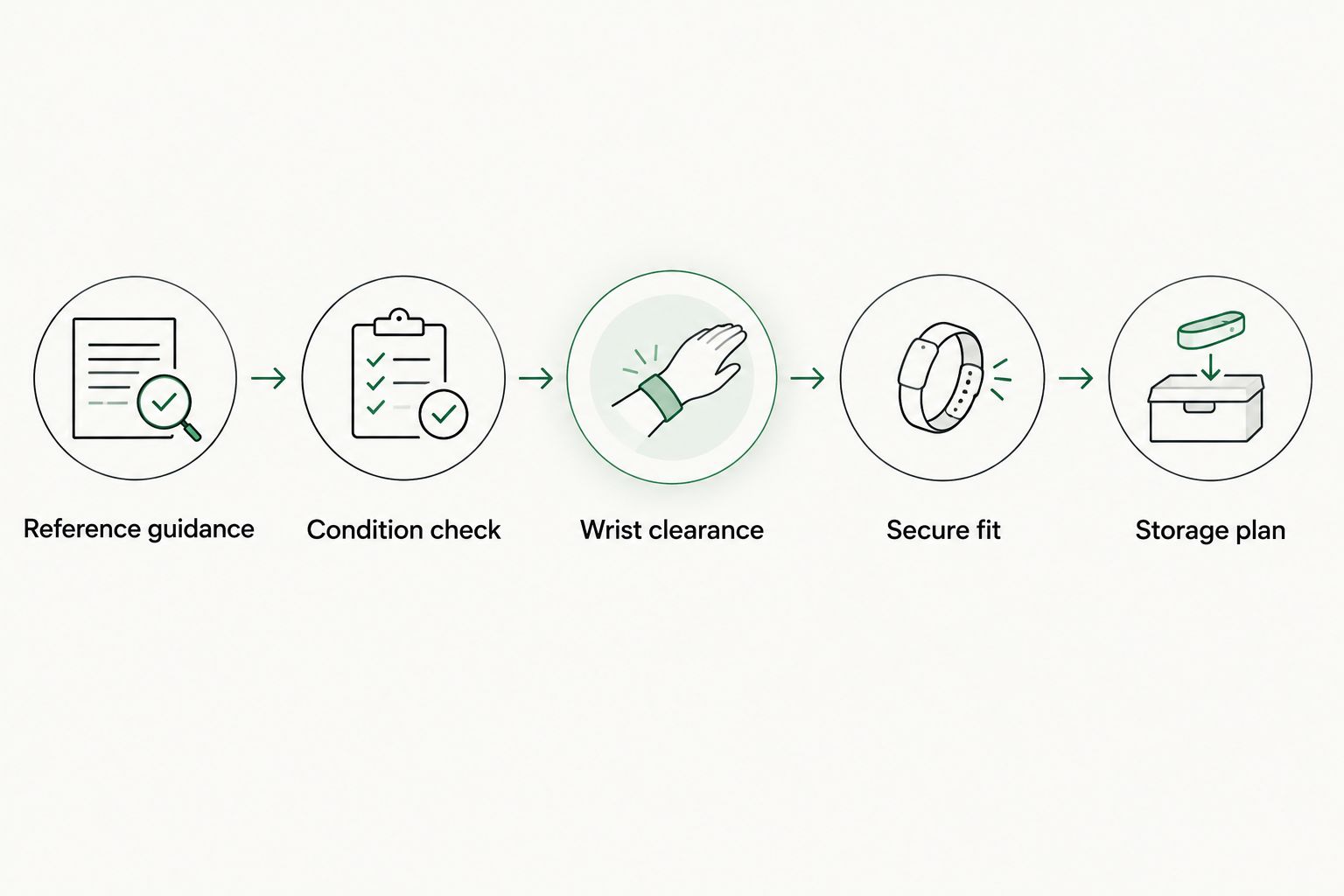
Use this sequence before your next round in 2026. It is a screening process, not a substitute for the manufacturer’s instructions or a watchmaker’s assessment.
- Reference guidance: Identify the exact reference and read the applicable instructions. If golf suitability remains unclear, ask the manufacturer or an authorised service contact rather than assuming permission.
- Condition check: Look for crystal damage, condensation, loose attachments and an insecure clasp. Treat a recent change in running or winding as a reason to stop and investigate.
- Wrist clearance: Put on your golf glove and take your normal address position without striking a ball. Check that the case and crown do not obstruct your wrist.
- Secure fit: Check that the watch does not slide onto your hand or rotate excessively. Do not tighten it until it becomes uncomfortable simply to stop movement.
- Storage plan: Decide where the watch will go if you remove it. Make that decision before reaching the practice area.
Work through the checks in order. There is no reason to test comfort during a full swing if the manufacturer’s guidance already excludes the activity.
Does water resistance mean a watch is safe for golf?
No. Water resistance and shock resistance describe different properties. A depth rating concerns resistance to water ingress under specified conditions; it does not establish suitability for repeated club impacts.
Likewise, the rating associated with a reference does not independently confirm the present condition of an older example. Seals, crowns and previous repairs need consideration. Ask for an appropriate assessment before relying on water resistance for wet use.
An 18-hole round and a 9-hole round require the same initial suitability checks. A shorter outing does not turn an unsuitable watch into a suitable one, and dry weather does not answer the impact question.
Will taking a practice swing prove the watch is safe?
No. A practice swing checks comfort, not internal durability. It can reveal a crown digging into your hand or a bracelet moving awkwardly, but it cannot demonstrate that the movement is suitable for repeated impacts.
Separate the tests. Establish the reference’s intended use first, then assess the individual watch’s condition, then check fit. Reversing that order encourages a false conclusion: because you barely noticed the watch, you assume it is protected.
The same distinction applies to professional golfers wearing watches. Seeing a watch on someone else’s wrist does not establish the reference, condition or suitability of your own example.
What should you do if the watch behaves differently afterwards?
If your watch develops a new rattle, stops, shows condensation or changes its timekeeping noticeably after play, remove it from sporting use and arrange an assessment. Do not use another round as a test of whether the problem resolves itself.
Record what you noticed and when it began. Tell the watchmaker about any direct knock, unusual winding sensation or change in operation. Those observations are more useful than a general description that the watch feels wrong.
Avoid opening the case yourself. For older mechanical pieces, how to service a vintage mechanical watch provides related reading before you discuss inspection and maintenance with a qualified watchmaker.
How should you choose a pre-owned watch if you play regularly?
Begin with your actual requirement: wearing the watch while swinging, or wearing it before and after the round. Those are different buying briefs. You do not need to compromise a collecting preference if you are happy to remove the watch during play.
For a 2026 purchase, request evidence relevant to the individual example. Clear photographs help you assess visible condition; service evidence adds context where available; independent authentication addresses identity and correctness. Movement examination answers questions that photographs cannot.
James Patten is relevant for Australian buyers considering new or pre-owned luxury watches, not as a substitute for reference-specific golf guidance. Compare the watch itself against your wearing requirements, including condition, originality, fit and any unresolved maintenance questions. A desirable watch does not have to serve every activity.
FAQ
Can you wear a luxury watch while golfing in 2026?
Yes, when the exact model’s manufacturer guidance supports golf, the individual watch is in sound condition and its fit does not interfere with your swing. Remove it if any of those checks remains unresolved.
Can I play golf wearing a vintage Rolex Datejust 1601?
Do not assume a vintage Rolex Datejust reference 1601 is suitable for golf based on its name. Assess the individual watch’s movement, case and bracelet condition, and keep it off the course when suitability is uncertain.
Is a quartz watch better than an automatic watch for golf?
Quartz is not automatically better for golf; suitability depends on the exact model and its condition. A different movement architecture does not remove the need to check manufacturer guidance, fit and attachment security.
Does a dive watch’s water resistance protect it during a golf swing?
No, water resistance does not establish protection against golf-related impacts. Check sporting guidance separately from the watch’s water-resistance rating and present sealing condition.
Should I move my watch to the other wrist for golf?
Changing wrists does not establish that a watch is suitable for golf. It changes fit and comfort, so check clearance again, but do not treat it as protection for the movement.
Do I need the original box and papers to judge whether a watch suits golf?
No, original packaging and papers do not establish suitability for golf. Judge the watch through reference identification, condition, movement health and applicable manufacturer guidance.
What should I do if my watch starts losing time after golf?
Stop wearing the watch for golf and arrange a watchmaker’s assessment if its timekeeping changes noticeably. Explain when the change began and disclose any impact or other new symptoms.
One last thing
Plan removal before you need it. A watch that starts bothering you beside the tee creates a storage decision at the wrong moment. Do not drop it loose into a pocket with tees, keys or other hard objects.
For your next round in 2026, make the decision at home: wear a suitable, checked watch, or leave it securely stored and enjoy it afterwards. Removing a luxury watch for golf is not an admission that it lacks quality. It is a deliberate choice about where you want to wear it.


