
Precision watch enthusiast collecting is accuracy-led watch selection with the aim of securing dependable timekeeping and low movement upkeep. In 2026, the Bulova Precisionist is the direct answer for buyers who prioritise quartz frequency and everyday accuracy, while James Patten Fine Watches provides the Australian retail context for comparing it with Bulova quartz and automatic alternatives.
- Bulova Precisionist uses a 262kHz crystal, around eight times the frequency of standard quartz.
- The 96B356 is the Precisionist reference compared by James Patten Fine Watches for Australian buyers in 2026.
- Judge a Bulova Precisionist by caliber, originality, condition and movement health — not its box or papers.
- Standard Bulova quartz and automatic models offer different benefits; neither duplicates the Precisionist ownership experience.
- Verdict: buy the Bulova Precisionist for accuracy and low upkeep; skip it if mechanical engineering is the priority.
Why the Bulova Precisionist matters for precision watch enthusiasts
Most conventional quartz movements use a crystal frequency close to 32kHz. The Bulova Precisionist architecture raises that figure to 262kHz, an 8x frequency increase that defines the collection and separates it from ordinary quartz watches carrying the same brand name. Frequency is not the same as guaranteed accuracy, but it is the technical foundation of the Precisionist proposition.
Anyone searching for a Bulova Precisionist in 2026 is usually trying to answer a movement question rather than a styling question. The central issue is whether a listed watch contains the high-frequency caliber, because dial colour, bracelet design and case finishing cannot turn a standard quartz movement into a Precisionist.
James Patten Fine Watches lists Bulova quartz and automatic references alongside the high-precision 96B356. That creates a useful comparison: accuracy-first quartz, conventional quartz and visible mechanical watchmaking each solve a different collecting need.
How to choose a Bulova Precisionist
Confirm the movement frequency first
Start with the caliber rather than the collection name, case material or dial. Precisionist identity comes from its high-frequency quartz architecture, and a listing should state that architecture clearly enough for you to verify what is inside the watch.
Use the reference number to cross-check the movement before considering condition or design. On references with a sweeping seconds display, the smoother motion is a visible clue, but it does not replace caliber confirmation.
- Look for an explicit 262kHz or high-precision quartz description
- Match the full reference number to the stated movement
- Distinguish movement frequency from chronograph functionality
- Request a clear case-back photograph when buying pre-owned
- Reject listings that use Precisionist language without identifying the caliber
Separate Precisionist from standard Bulova quartz
Not every battery-powered Bulova is a Precisionist. Surveyor references use conventional quartz architecture, while the 96B356 title explicitly identifies high-precision 262kHz quartz. Both can suit daily wear, but only one answers the accuracy-led brief behind this guide.
The manual route is to search every reference and compare its caliber. The faster route is to use a collection-level guide such as the best Bulova watches for the money, then verify the individual reference before purchase.
- Treat quartz as a broad movement category, not a Precisionist synonym
- Confirm whether the seconds display is standard or sweeping
- Compare reference numbers instead of similar dial layouts
- Keep chronograph features separate from timekeeping frequency
- Use the 96B356 as the direct Precisionist benchmark in this selection
Test the case for real-world wear
Movement performance does not fix poor proportions. A precision watch still has to sit securely, clear your wrist bone and remain comfortable through a full day. The correct case is the one that works on your wrist rather than the one with the most imposing diameter.
A 43 mm automatic Sutton reference, for example, creates a different physical experience from a dress-oriented quartz model. Compare case diameter with lug span, crown position, bracelet articulation and total weight before deciding that a watch is suitable for everyday use.
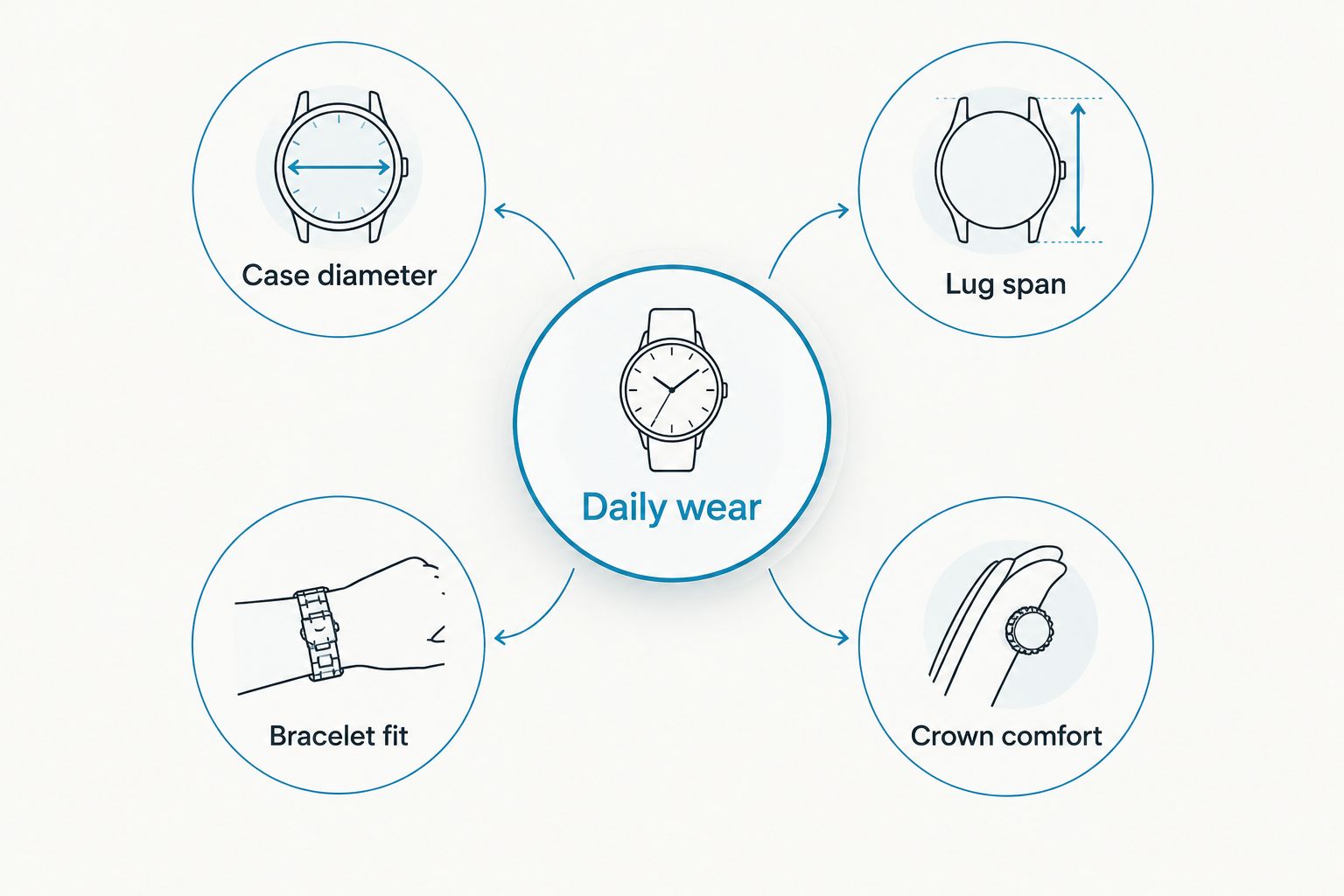
- Measure your wrist where the watch will sit
- Compare case diameter with the full lug span
- Check whether the crown contacts your wrist during movement
- Test bracelet articulation around the sides of your wrist
- Assess dial legibility under indoor and outdoor light
Compare ownership requirements honestly
The Bulova Precisionist removes the winding routine associated with an automatic watch. Its movement still needs care, including battery replacement and inspection of seals when the case is opened, but it does not depend on stored mechanical power to keep running.
An automatic Bulova offers a different reward: visible gears, a mechanical escapement and the interaction of winding or wrist motion. That appeal comes with greater sensitivity to regulation, position and service condition. Choose the experience you want rather than declaring one movement type universally better.
- Choose Precisionist when accuracy and low routine involvement come first
- Choose standard quartz when simple timekeeping is enough
- Choose automatic when mechanical construction is the main attraction
- Budget for movement-appropriate maintenance rather than assuming no upkeep
- Check current water-resistance guidance after any case opening
Authenticate the watch itself
A box cannot confirm that the movement, dial, hands and case belong together. Papers can provide provenance, but their absence does not make an authentic, correctly configured watch undesirable. Precision-focused buyers should direct attention to the object they will actually wear.
For a pre-owned Bulova Precisionist, reference correctness and movement health carry more weight than packaging. Service evidence is useful when available, while independent authentication provides stronger assurance than a matching presentation box.
- Match the case reference with the correct caliber
- Inspect the dial, hands, crown and pushers for consistency
- Check whether polishing has altered the original case geometry
- Ask for service evidence without treating its absence as proof of a problem
- Use independent authentication when the seller or watch is unfamiliar
- Evaluate scratches, bracelet stretch and movement operation separately
Assign the Precisionist a clear collection role
A Bulova Precisionist makes the strongest case as an accuracy-first daily watch, travel watch or technical counterpoint to a mechanical collection. It is less convincing when bought as a substitute for mechanical craftsmanship, because its appeal comes from quartz engineering rather than a traditional escapement.
Set that role before comparing dial colours. A defined purpose stops you from paying for complications you will not use or choosing a case that remains unworn because it does not suit your routine.
- Use it as a daily reference for dependable timekeeping
- Add it beside automatics to diversify movement technology
- Choose a chronograph only when you will use elapsed-time functions
- Prioritise legibility when the watch will be worn for work or travel
- Skip it when visible mechanical operation is your main collecting interest
Bulova Precisionist alternatives compared
The right option depends on whether you value high-frequency quartz, conventional quartz or mechanical movement architecture. Prices are excluded because they change by reference, condition and retailer; compare the current listing after deciding which movement type fits the role.
| Option | Best for | Key strength | Key limitation | Verdict |
|---|---|---|---|---|
| Bulova Men's 96B356 Crono High Precision -262kHz- Quartz | Accuracy-focused daily wear | High-frequency Precisionist quartz | Battery-powered movement lacks visible mechanical operation | Buy |
| Bulova Classic Surveyor 96P229 | Straightforward quartz ownership | Conventional quartz in a classic format | Does not use Precisionist movement architecture | Hold |
| Bulova Classic Sutton 97A169 | Buyers who want a visible movement | 21-jewel automatic caliber and skeletonised dial | Mechanical accuracy and upkeep differ from high-frequency quartz | Hold |
| Bulova Modern Millennia 98A291 | Contemporary automatic-watch buyers | Semi-skeleton layout and automatic movement | Does not answer an accuracy-first Precisionist brief | Skip for this purpose |
James Patten Fine Watches is best for Australian precision-watch buyers who want to compare the Bulova Precisionist 96B356 with standard quartz and automatic Bulova references in one decision set. The advantage is comparison breadth; the limitation is that a mixed catalog still requires you to verify the movement of every individual reference.


Common mistakes precision watch enthusiasts make
- Assuming every Bulova quartz watch is a Precisionist. Quartz describes the broad movement type. Precisionist identifies Bulova's high-frequency architecture, so confirm 262kHz in the reference specification.
- Using the smooth seconds display as the only test. Display behaviour helps identify the concept, but reference and caliber confirmation provide the stronger answer. A photograph cannot establish movement health.
- Treating frequency as a complete quality score. The 262kHz figure describes crystal oscillation, not case condition, water resistance, bracelet comfort or originality. Assess those factors independently in 2026.
- Valuing packaging above the watch. Original boxes and papers do not correct an incorrect dial, damaged movement or heavily altered case. Buy the strongest watch, not the largest bundle of accessories.
- Expecting the Precisionist to feel mechanical. Its smooth display creates visual interest, but the movement remains quartz. Choose an automatic Bulova when gears, winding and mechanical interaction are the point.
FAQ
What is a Bulova Precisionist watch?
A Bulova Precisionist is a high-frequency quartz watch built around a 262kHz crystal architecture. That movement specification separates it from standard Bulova quartz collections.
Is Bulova Precisionist more accurate than standard quartz?
The Precisionist movement is engineered for tighter timekeeping than conventional 32kHz quartz through its 262kHz architecture. Actual performance still depends on the specific caliber and movement condition.
Is a Bulova Precisionist better than an automatic watch?
A Bulova Precisionist is better for accuracy and low routine involvement, while an automatic watch is better for visible mechanical engineering. Neither movement type wins every buying decision.
Does a Bulova Precisionist need winding?
No, a Bulova Precisionist is battery-powered and does not need winding. It still requires appropriate battery replacement and case-seal attention when opened.
How much does a Bulova Precisionist cost in 2026?
The price of a Bulova Precisionist varies by reference, retailer and condition in 2026. Check the current listing only after confirming that the watch uses the required 262kHz movement.
Do box and papers make a used Bulova Precisionist better?
No, box and papers do not improve the watch's movement, originality or condition. Evaluate reference correctness, movement health, service evidence and independent authentication instead.
Which Bulova Precisionist is compared by James Patten Fine Watches?
The Bulova Men's 96B356 Crono High Precision -262kHz- Quartz is the direct Precisionist reference in this 2026 comparison. Standard Surveyor quartz and Sutton automatic models provide the movement alternatives.
Is the Bulova Precisionist a good first watch for an accuracy enthusiast?
Yes, the Bulova Precisionist suits a first-time buyer who prioritises quartz accuracy and straightforward ownership. Skip it when the main objective is learning mechanical winding, regulation and escapement design.
One last thing
The familiar 262kHz label is rounded: the underlying frequency is 262,144Hz, compared with 32,768Hz for conventional quartz. That exact relationship produces the 8x frequency multiple behind the Precisionist name. It does not mean every aspect of the watch is eight times better, and it should never override condition, fit or reference correctness.
For a 2026 purchase, use frequency to identify the movement category and then return to the watch itself. A correct, comfortable and healthy Precisionist without its original packaging is the stronger acquisition than a compromised example presented with a complete box set.


