
Best overall for changing time zones: Rolex GMT-Master II 126710; best for an uncluttered dial: IWC Pilot’s Watch Mark XX; best for analogue flight calculations: Breitling Navitimer B01 Chronograph 43. This 2026 comparison from James Patten Fine Watches separates useful pilot-watch functions from aviation styling, with recommendations based on the watch itself rather than its packaging.
- The best luxury watches for pilots depend on time-zone tracking, dial clarity and the functions you actually use.
- Rolex GMT-Master II 126710 is the strongest default for pilots who regularly change time zones.
- IWC Pilot’s Watch Mark XX suits buyers prioritising an uncluttered dial over additional complications.
- Breitling Navitimer B01 Chronograph 43 combines elapsed-time measurement with a circular slide rule.
- Inspect originality, case condition and movement health before choosing any pre-owned pilot’s watch.
Why the pilot-watch distinction matters
A watch that looks like a cockpit instrument does not necessarily show a second time zone. A chronograph measures elapsed time; a GMT watch displays another hour reference; a slide rule performs analogue calculations. These are different jobs.
For Australian buyers, the practical question is whether you need local time alongside UTC, a readable everyday watch, or a mechanical chronograph to enjoy outside the cockpit. Aviation history alone cannot answer that question. None of these watches replaces required flight instruments or approved operational procedures.
Choose the function before the brand. Then assess whether the particular example is authentic, mechanically sound and comfortable enough to wear through a long day.
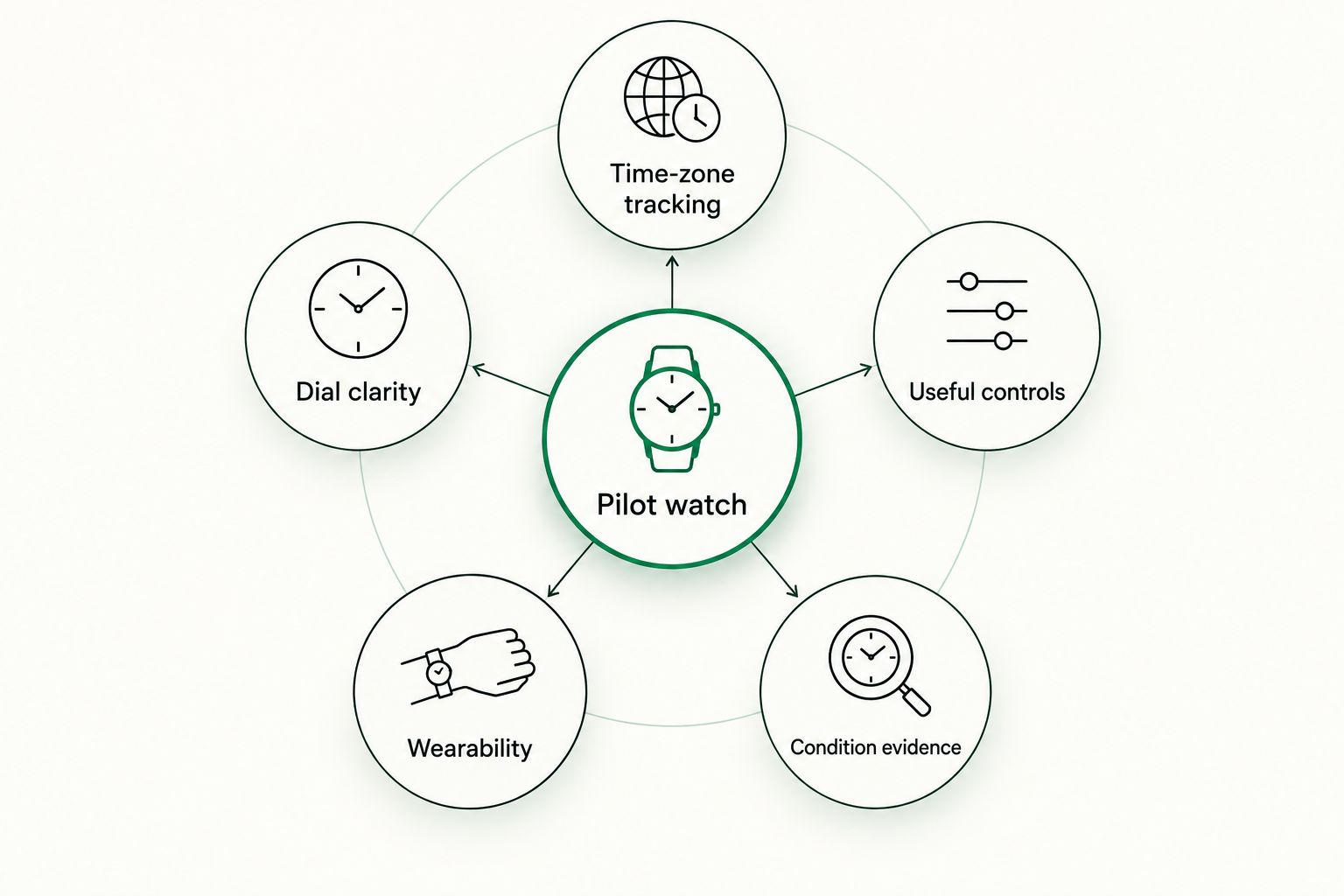
What makes the best luxury watches for pilots?
- Time-zone tracking: A separate hour indication helps you distinguish local time from another reference. Check how the hands adjust, not merely whether the dial says GMT.
- Dial clarity: Contrast, hand shape and a readable minute track matter more than the number of scales printed on the dial.
- Useful controls: Crowns, pushers and rotating bezels should perform functions you understand and will use. More controls also mean more components to inspect.
- Wearability: Diameter is only the starting point. Case thickness, lug shape, bracelet articulation and clasp position determine how the watch sits under a sleeve.
- Condition evidence: Reference correctness, originality, movement health and service evidence where available carry more weight than presentation accessories.
These criteria explain why a simple IWC and a complicated Breitling both belong here. They answer different requirements rather than competing for the same buyer.
Pilot’s watches at a glance
The model-specific dimensions below distinguish the selected references, not every watch in each collection. Confirm the full reference before applying these specifications to a pre-owned example.
| Watch | Best for | Standout feature | Key limitation |
|---|---|---|---|
| Rolex GMT-Master II 126710 | Regular time-zone changes | Independently adjustable local-hour hand and 24-hour bezel | No chronograph |
| IWC Pilot’s Watch Mark XX | Uncluttered everyday reading | Clear time-and-date display in a 40 mm case | No second-time-zone display |
| Breitling Navitimer B01 Chronograph 43 | Analogue calculation enthusiasts | Chronograph and circular slide rule in a 43 mm case | Dense dial requires familiarisation |
| Omega Speedmaster Professional, calibre 3861 | Hands-on mechanical timing | Manually wound chronograph in a 42 mm case | No independently adjustable local-hour hand |
| Breitling Chronomat B13352 with A70172 UTC module | Collectors wanting a separate UTC display | Automatic chronograph paired with a quartz module | Both timekeeping systems need assessment |
1. Rolex GMT-Master II: best for regular time-zone changes
The Rolex GMT-Master II 126710 combines a 40 mm case, a 24-hour hand and a rotating 24-hour bezel. Its independently adjustable local-hour hand lets you change local time without resetting the reference-time indication.
That distinction earns the Rolex its overall recommendation. For a pilot travelling between time zones, changing the local hour is more directly useful than having a stopwatch or calculation scale. The bezel also gives you another way to relate the displayed hours to a chosen time zone.
Rolex GMT-Master II pros:
- Local-hour adjustment suits repeated time-zone changes.
- The 24-hour indication distinguishes daytime from night-time.
- The rotating bezel adds flexibility without chronograph subdials.
Rolex GMT-Master II cons:
- It does not measure elapsed time as a chronograph.
- Reading multiple time zones requires a consistent setting routine.
- Pre-owned examples need careful checks of the dial, hands, bezel and bracelet against the reference.
Best for: Buyers who regularly need local time alongside UTC or home time.
For a 2026 purchase, examine case edges, bracelet condition and correct GMT operation rather than relying on the model’s reputation. Ask an independent specialist to assess authenticity and movement health. An attractive bezel does not establish either.
Verdict: Buy for time-zone travel; skip if your priority is elapsed-time measurement.
2. IWC Pilot’s Watch Mark XX: best for an uncluttered dial
The IWC Pilot’s Watch Mark XX keeps the display focused on hours, minutes, seconds and date. Its 40 mm case offers a useful comparison point against the larger chronographs here, although the wrist fit still depends on lug shape and the chosen strap or bracelet.
The Mark XX suits someone who wants the instrument-watch approach without a dial full of calculation scales. You read the time first. It is not a substitute for a GMT watch when you want two time references visible together.
IWC Pilot’s Watch Mark XX pros:
- The display avoids chronograph subdials and slide-rule scales.
- Distinctive hands and numerals support quick visual recognition.
- Time-and-date operation keeps the setting routine straightforward.
IWC Pilot’s Watch Mark XX cons:
- No dedicated second-time-zone indication.
- No chronograph for measuring elapsed intervals.
- A clean dial does not guarantee comfortable fit; try the specific configuration.
Best for: Buyers prioritising immediate readability and restrained aviation styling.
When inspecting a pre-owned Mark XX, confirm the reference and compare the dial, hands and case with the correct configuration. Check crown operation, date change and timekeeping. Service evidence is useful when it describes work on the actual watch, rather than making a general claim about its condition.
Verdict: Buy for a clear everyday display; skip if simultaneous local time and UTC are essential.
3. Breitling Navitimer B01 Chronograph 43: best for analogue calculations
The Breitling Navitimer B01 Chronograph 43 combines a mechanical chronograph with a circular slide rule. The selected version has a 43 mm case, giving its multiple scales more room than a smaller dial would provide.
The slide rule is a working calculation tool, not simply decoration. It can support multiplication, division and related calculations, but you need to understand the scales and interpret their results correctly. That learning requirement is part of the appeal for an enthusiast, and a drawback for someone seeking instant readability.
Breitling Navitimer B01 Chronograph 43 pros:
- A chronograph measures elapsed time.
- The circular slide rule offers analogue calculation functions.
- The calculation scales give the design a purpose beyond aviation styling.
Breitling Navitimer B01 Chronograph 43 cons:
- The dial is busier than the Mark XX or GMT-Master II.
- Slide-rule use requires practice and careful reading.
- The 43 mm case needs a wrist-fit assessment rather than an assumption based on photographs.
Best for: Collectors who will learn and enjoy the slide rule alongside the chronograph.
For a pre-owned example in 2026, inspect the scale printing, rotating bezel action and chronograph start, stop and reset functions. Confirm the complete reference: the Navitimer name covers different sizes, movements and displays. Do not transfer one version’s specifications to another.
Verdict: Buy for the calculation functions; skip if a dense dial slows your time reading.
4. Omega Speedmaster Professional: best for hands-on mechanical timing
The Omega Speedmaster Professional with calibre 3861 is a manually wound chronograph in a 42 mm case. It uses a tachymeter scale rather than the Navitimer’s circular slide rule, and it does not provide a dedicated GMT display.
Its place here is functional rather than a claim that spaceflight history makes it the ideal cockpit watch. Choose the Speedmaster because you want to wind a mechanical watch and operate an elapsed-time chronograph. Those are tangible ownership experiences.
Omega Speedmaster Professional pros:
- The chronograph measures elapsed intervals.
- Manual winding gives you a direct mechanical interaction.
- The tachymeter scale supports average-speed calculations over a known distance.
Omega Speedmaster Professional cons:
- Regular manual winding is an ownership requirement.
- No independently adjustable local-hour hand or dedicated GMT display.
- Several Speedmaster references look similar but differ in movement and construction.
Best for: Collectors who enjoy manual winding and conventional chronograph operation.
Check that the movement matches the reference being offered. Inspect the dial, hands, bezel and case for correctness, then have the chronograph’s operation assessed. Reset alignment alone is not a complete movement-health check; timing and functional inspection belong together.
Verdict: Buy for mechanical chronograph ownership; skip if you want an automatic travel watch.
5. Breitling Chronomat with UTC module: best for a separate time display
The Breitling Chronomat B13352 paired with the A70172 UTC module takes a different approach to displaying another time reference. The automatic chronograph and separate quartz module put distinct timekeeping systems into the same wearing arrangement.
For a collector, that separation is the attraction. You can dedicate the module to UTC while reading another time on the main watch. The configuration also creates inspection requirements that do not exist on a conventional single-movement GMT watch.
Breitling Chronomat with UTC module pros:
- The module provides a physically separate time display.
- The main chronograph handles elapsed-time measurement.
- The configuration offers a distinct alternative to a central GMT hand.
Breitling Chronomat with UTC module cons:
- Both the automatic movement and quartz module need checking.
- Module attachments and bracelet fit deserve close inspection.
- The additional display changes the wearing footprint and sleeve clearance.
Best for: Collectors who specifically want the separate UTC-module configuration.
Before choosing this James Patten Fine Watches listing, request evidence addressing the main watch and module individually. Confirm the reference pairing, module operation, attachment condition and bracelet fit. Do not treat a working chronograph as proof that the quartz display is healthy, or vice versa.
Verdict: Buy after both systems and the attachment are verified; hold if either remains unassessed.
How the ranking works
This 2026 ranking puts usable functions ahead of heritage or visual presence. The Rolex takes the default recommendation because local-hour adjustment directly addresses time-zone travel; the IWC wins the simpler-reading slot; the remaining choices serve specific timing, calculation or collecting interests.
The ranking does not certify an individual watch or establish a seller’s service standard. A sound example of the right reference is the objective. A compromised example does not become a better purchase because its model ranks first.
Inspect the watch, not the presentation
- Reference correctness: Establish which version you are assessing before comparing specifications.
- Originality: Identify replacement or refinished components and understand their significance.
- Case condition: Look at edge definition, lug shape, surface wear and evidence of polishing.
- Movement health: Seek a functional assessment, including any chronograph or GMT mechanisms.
- Wearability: Check clasp position, bracelet articulation and whether the watch remains centred on your wrist.
Independent authentication and service evidence where available support this assessment. Original packaging cannot establish movement health, and missing packaging does not make an otherwise desirable watch unsuitable.
Which pilot’s watch should you choose?
Choose the Rolex GMT-Master II 126710 if changing time zones is your defining requirement. Choose the IWC Pilot’s Watch Mark XX if you want an uncluttered everyday display and do not need another time zone visible.
The Navitimer is the more purposeful choice for someone who enjoys analogue calculations. The Speedmaster suits hands-on chronograph ownership. The Chronomat UTC configuration belongs on your shortlist only when its separate display is something you genuinely want to wear.
For your 2026 purchase, settle that functional question before judging photographs. James Patten Fine Watches buyers should apply the same condition and authentication checks to every candidate, including the linked Chronomat.
FAQ
What’s the best luxury watch for a pilot who travels internationally?
The Rolex GMT-Master II 126710 is the strongest default here for regular time-zone changes. Its independently adjustable local-hour hand lets you update local time while retaining another time reference.
Is a GMT watch more useful than a chronograph for pilots?
A GMT watch is more useful when your priority is reading local time alongside UTC or home time. A chronograph serves a different purpose: measuring elapsed intervals. Choose according to the function you actually need.
Is the Breitling Navitimer easy to read?
The Breitling Navitimer B01 Chronograph 43 has a denser display than the IWC Pilot’s Watch Mark XX. Its chronograph and slide-rule scales provide additional functions, but require familiarisation rather than offering the simplest time-only reading.
Does the IWC Mark XX show a second time zone?
The IWC Pilot’s Watch Mark XX does not have a dedicated second-time-zone display. It suits buyers who want a clear time-and-date watch rather than a GMT complication.
Is the Omega Speedmaster Professional automatic?
The Omega Speedmaster Professional with calibre 3861 is manually wound. Confirm the exact reference when buying because the wider Speedmaster collection includes different movements and configurations.
Does a pre-owned pilot’s watch need its original box and papers?
Original box and papers are not required for a pilot’s watch to be desirable. Evaluate reference correctness, originality, condition, movement health and independent authentication; packaging is not proof of quality.
What should I check on a Breitling Chronomat with a UTC module?
Check the main chronograph, quartz UTC module and their attachment separately. Confirm the reference pairing, inspect bracelet fit and seek evidence of each system’s operation before deciding.
One last thing
Set the watch as you intend to use it before deciding whether the display works for you. For a GMT model, distinguish local time from your chosen reference; for a chronograph, practise reading elapsed minutes rather than admiring the subdials.
A complication earns its place only when you can read and operate it confidently. That practical check often reveals more about suitability than another photograph of the dial.


