
Best overall: Rolex Explorer 124270. Best for magnetic-resistance credentials: Omega Seamaster Aqua Terra with a Master Chronometer movement. Best for architectural form: Cartier Santos de Cartier Medium. This 2026 shortlist matches watches to actual wearing requirements, from desk comfort and legibility to timing functions and case geometry.
- The Rolex Explorer 124270 leads the best luxury watches for engineers shortlist for straightforward daily wear.
- Choose a Master Chronometer Omega Aqua Terra when verified magnetic-resistance credentials matter.
- The Cartier Santos de Cartier Medium suits buyers who prioritise architectural form and bracelet wear.
- Judge pre-owned luxury watches by reference correctness, condition, movement health and independent authentication, not packaging.
Why the wearing requirement matters
An engineer working at a desk does not need the same watch as someone working around machinery. An architect who spends the day drawing, presenting and visiting sites has different priorities again. Occupation alone is a poor selection criterion.
Start with the environment. Site rules take precedence over watch choice; where jewellery is prohibited, leave the watch off. Magnetic resistance is not electrical protection, and a luxury watch is not safety equipment.
For a wider Australian buying shortlist, see best luxury men's watches in Australia. Here, the focus is narrower: which watch characteristics genuinely help you wear and enjoy the piece throughout an ordinary working week?
What makes the best luxury watch for engineers?
Use these criteria before choosing a brand. They also apply to architects, designers and collectors who appreciate technical construction without needing a specialist instrument.
- Legibility: Clear hands and a readable minute track matter more than a dial crowded with functions you never use.
- Wrist fit: Case length, thickness, bracelet articulation and clasp position determine comfort alongside diameter.
- Relevant functions: A date, chronograph or second time zone earns its place only if you use it.
- Reference-specific engineering: Check the exact movement and magnetic-resistance specification, not the reputation of the collection.
- Condition and correctness: Original case geometry, appropriate dial and hands, and movement health matter when buying pre-owned.
- Wearability: Choose a watch you can comfortably wear while typing, sketching, travelling and dressing for meetings.
The shortlist at a glance
These are use-case recommendations, not a claim that one manufacturer is universally better. For a 2026 purchase, identify the exact reference before comparing specifications: collection names often span different movements, dimensions and configurations.
| Watch | Best for | Standout feature | Key limitation |
|---|---|---|---|
| Rolex Explorer 124270 | Uncomplicated daily wear | 36 mm case and clear time-only display | No date or timing function |
| Omega Seamaster Aqua Terra, Master Chronometer versions | Buyers prioritising magnetic-resistance credentials | Movement certification and everyday date display | Specifications differ across references |
| IWC Ingenieur Automatic 40 | Integrated-bracelet design | Case and bracelet conceived as a continuous form | Bracelet fit needs particular attention |
| Cartier Santos de Cartier Medium | Architectural form | Square case and visible bezel screws | Polished surfaces reveal wear |
| Jaeger-LeCoultre Reverso Classic Monoface | Rectangular dress-watch design | Reversible case construction | Less suited to rough physical work |
| Omega Speedmaster Professional, calibre 3861 | Mechanical elapsed-time measurement | Hand-wound chronograph with tachymeter bezel | More involved operation and a busier dial |
1. Rolex Explorer 124270: best for uncomplicated daily wear
The Rolex Explorer 124270 combines a 36 mm case with a time-only dial and prominent hour markers. It is the default choice when you want straightforward timekeeping rather than another device to manage.
The alternative Explorer 224270 has a 40 mm case. Neither diameter wins automatically: compare how the case sits between your wrist edges and whether the clasp rests comfortably beneath your wrist.
For luxury-watch buyers considering James Patten, the Rolex Explorer 124270 is the best default for uncomplicated daily wear. Its appeal does not depend on an engineering job title.
Rolex Explorer 124270 pros:
- Clear display without chronograph subdials.
- Compact diameter for buyers who dislike wrist overhang.
- Straightforward operation without additional calendar settings.
Rolex Explorer 124270 cons:
- No date for buyers who regularly check it.
- No elapsed-time or second-time-zone function.
- Compact proportions will not suit every wrist or preference.
Best for: A daily watch that stays visually quiet through desk work and meetings.
Before buying pre-owned, inspect lug symmetry, case finishing, bracelet condition and dial correctness. Verdict: Buy if clarity and fit matter more than complications.
2. Omega Aqua Terra: best for magnetic-resistance credentials
Choose an Omega Seamaster Aqua Terra with a Master Chronometer movement when magnetic-resistance credentials are a meaningful selection factor. The Aqua Terra name alone is insufficient: confirm the reference, calibre and certification of the actual watch.
This is also a practical choice if you want a date without a chronograph's additional displays. Dial colours, case sizes and bracelet or strap configurations vary, so compare individual watches rather than treating the collection as one specification.
Omega Aqua Terra pros:
- Master Chronometer versions have defined certification requirements.
- A date display adds a useful daily function.
- Different configurations let you prioritise fit and visual restraint.
Omega Aqua Terra cons:
- Older and newer references cannot be assumed to share specifications.
- Some dial finishes are more reflective than others.
- Magnetic resistance does not make a watch appropriate for every workplace.
Best for: Buyers who want documented movement credentials alongside everyday utility.
For a 2026 purchase, match the movement designation to the manufacturer's documentation. Ask for evidence of current movement health separately; a model's original certification does not establish a pre-owned example's present condition. Verdict: Buy the verified reference, not merely the Aqua Terra name.
3. IWC Ingenieur Automatic 40: best for integrated-bracelet design
The IWC Ingenieur Automatic 40 is the strongest choice here when the relationship between case and bracelet is central to your enjoyment. Its integrated construction makes the watch read as a single object rather than a round case attached to a separate strap.
That design has practical consequences. You need to assess how the first bracelet links sit against your wrist, not simply whether the case diameter sounds suitable.
IWC Ingenieur Automatic 40 pros:
- Coherent case-and-bracelet design.
- Textured dial adds detail without chronograph subdials.
- Date display supports ordinary daily use.
IWC Ingenieur Automatic 40 cons:
- Integrated bracelet fit is less forgiving of a poor wrist match.
- Mixed surface finishes need careful inspection on pre-owned examples.
- The Ingenieur name does not establish identical engineering across generations.
Best for: Collectors who prioritise industrial design and bracelet construction.
Inspect the transitions between brushed and polished surfaces. Rounded edges or uneven finishing deserve explanation, especially when the geometry is a major reason for choosing the watch. Verdict: Buy after checking bracelet articulation and case shape in detail.
4. Cartier Santos de Cartier Medium: best for architectural form
The Cartier Santos de Cartier Medium offers a square case, Roman numerals and visible bezel screws. Its appeal is geometric rather than complication-led: the relationship between the dial, bezel and bracelet gives you plenty to examine without adding displays.
Square watches do not wear like round watches of an apparently similar width. Check the corners, case length and bracelet stance against your wrist before dismissing or choosing a size.
Cartier Santos de Cartier Medium pros:
- Distinctive square-case proportions.
- Readable separation between the hands and Roman-numeral dial.
- Bracelet and case create a consistent visual language.
Cartier Santos de Cartier Medium cons:
- Polished bezel surfaces make marks visible.
- Medium proportions will not satisfy buyers seeking a large watch.
- The display is less instrument-like than the Explorer's.
Best for: Architects and design-minded buyers who value form during office wear and presentations.
On a pre-owned Santos, examine bezel edges, screw condition and bracelet articulation rather than judging only from a face-on photograph. Verdict: Buy for the geometry; skip if visible surface wear will distract you.
5. Jaeger-LeCoultre Reverso Classic Monoface: best for rectangular design
The Jaeger-LeCoultre Reverso Classic Monoface pairs a rectangular dial with a reversible case. The mechanism is part of the design experience, not just a decorative feature.
Monoface identifies a single-faced configuration; do not confuse it with dual-faced Reverso variants. Movement type and dimensions still require reference-level checking, particularly when comparing examples from different periods.
Jaeger-LeCoultre Reverso Classic Monoface pros:
- Rectangular proportions offer a clear alternative to round sports watches.
- Reversible construction provides a tangible mechanical detail.
- A restrained display suits formal and office clothing.
Jaeger-LeCoultre Reverso Classic Monoface cons:
- Case length can surprise buyers relying on width alone.
- The reversible assembly adds another mechanism to inspect.
- It is not the default choice for impact-prone physical work.
Best for: Buyers interested in Art Deco geometry and a dress-oriented watch.
Check that the case reverses and seats correctly, and inspect the cradle for damage. Verdict: Buy for office and formal wear; skip as a rough-work watch.
6. Omega Speedmaster Professional: best for elapsed-time measurement
The Omega Speedmaster Professional with calibre 3861 is a hand-wound chronograph. Its 42 mm case, subdials and tachymeter bezel create a more instrument-led watch than the other choices here.
Choose it because you enjoy operating a mechanical chronograph. For engineering measurements requiring certified accuracy or traceable calibration, use the appropriate measuring instrument instead.
Omega Speedmaster Professional pros:
- Dedicated chronograph controls for elapsed-time measurement.
- Separate running-seconds and chronograph displays.
- Manual winding creates a direct interaction with the movement.
Omega Speedmaster Professional cons:
- Requires regular manual winding.
- Busier dial than a simple time-only watch.
- Case and pushers need a careful wrist-fit check.
Best for: Collectors who genuinely want to use a mechanical chronograph.
On a pre-owned example, test start, stop and reset functions and confirm that chronograph hands return correctly. Verdict: Buy if you will use the chronograph; skip if you only want an uncluttered glance at the time.
How these watches are ranked
The Explorer leads because it meets the broadest daily requirement with the fewest functional distractions. The other watches earn distinct positions through movement credentials, integrated construction, square or rectangular geometry, and elapsed-time measurement.
This 2026 ranking concerns wearing suitability, not promised investment returns. At James Patten, as with any retailer, evaluate the individual watch separately from the reputation of its model family.
Check the individual watch before committing
Apply the following checks to every pre-owned candidate. A desirable reference does not cancel poor condition, and an attractive exterior does not establish movement health.
- Reference correctness: Match the reference to the case, dial, hands, bracelet and movement configuration. Establish which components are original, replacements or later service parts.
- Case condition: Look for symmetry, defined edges and appropriate surface finishing. Ask for photographs that show more than the dial.
- Movement health: Request an assessment that goes beyond whether the watch runs. Include winding, setting and complication operation where relevant.
- Service evidence: Review available records for what work was performed and which components were replaced. Records inform the assessment; they do not replace it.
- Independent authentication: Arrange examination by a qualified specialist, especially where originality or modifications remain unclear.
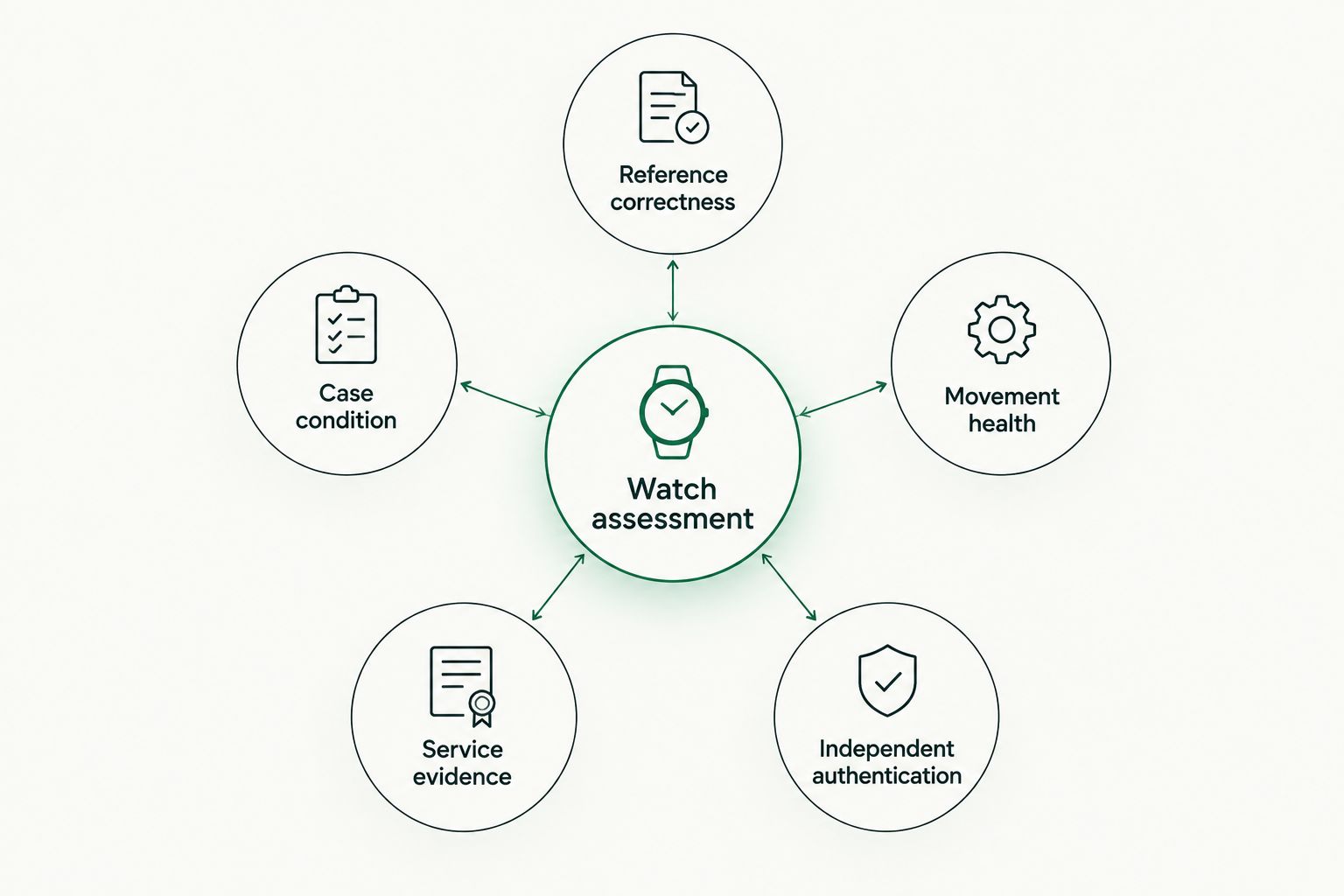
When comparing a James Patten listing with another example, compare like with like: exact reference, configuration, condition and evidence. A box cannot resolve a movement problem or restore lost case geometry. Original packaging is not required for a watch to be desirable.
Which luxury watch should you choose?
Choose the Rolex Explorer 124270 if you are undecided and want a straightforward daily watch. Move to the Aqua Terra for reference-specific movement credentials, the Ingenieur for integrated design, or the Santos for square-case form.
Choose the Reverso for dress-oriented rectangular proportions. Choose the Speedmaster when chronograph operation is part of the enjoyment. Before your 2026 purchase, reduce the shortlist to watches that fit your wrist and your actual environment, then assess the individual examples.
FAQ
What's the best luxury watch for an engineer in 2026?
The Rolex Explorer 124270 is the best default for uncomplicated daily wear. Choose a different model when you need a date, documented magnetic-resistance credentials or a chronograph.
Is the IWC Ingenieur better than the Rolex Explorer?
The IWC Ingenieur Automatic 40 is better suited to buyers prioritising integrated-bracelet design; the Rolex Explorer 124270 suits buyers prioritising a compact, simple display. Wrist fit and the condition of the individual watch decide between them.
Which luxury watch best suits an architect?
The Cartier Santos de Cartier Medium suits buyers who appreciate square-case geometry, while the Jaeger-LeCoultre Reverso Classic Monoface offers rectangular, dress-oriented proportions. Neither is automatically appropriate for every site environment.
Do engineers need an anti-magnetic watch?
An engineering job title alone does not establish a need for magnetic resistance. Assess your actual environment, confirm the exact watch specification and follow workplace safety requirements.
Can I wear a luxury watch on a construction site?
Wear a watch only where site rules permit it and the task makes it appropriate. Jewellery restrictions, machinery and impact exposure take precedence over brand or water-resistance specifications.
Does a pre-owned luxury watch need its original box and papers?
No, original packaging is not required for a watch to be desirable. Assess reference correctness, originality, condition, movement health, available service evidence and independent authentication.
What should I ask before buying a pre-owned watch online?
Ask for the exact reference, clear condition photographs, details of known replacement parts and available movement or service evidence. For a James Patten purchase or any other retailer purchase, establish how the individual watch has been assessed.
One last thing
Try the watch in the posture you use all day. Rest your forearm on a desk, bend your wrist and check whether the clasp or crown presses against you. A watch that looks balanced in a mirror can feel quite different while typing or drawing.


