
Best overall: Grand Seiko SBGA211 Snowflake. Best for mechanical-movement collectors: SLGH005 White Birch. Best for quartz precision: SBGX261. The best Grand Seiko watches for collectors in 2026 also include the SBGA413 Shunbun for its distinctive dial and the SBGW231 for compact, hand-wound simplicity.
- The best Grand Seiko watches start with the SBGA211 Snowflake for titanium construction, Spring Drive and a textured dial.
- Choose the SLGH005 White Birch for mechanical watchmaking; choose the SBGX261 for quartz precision.
- The SBGA413 Shunbun suits dial-focused collectors; the SBGW231 suits compact dress-watch collections.
- Assess pre-owned Grand Seiko watches through originality, condition, movement health and independent authentication—not packaging.
Why this matters
Grand Seiko offers three different collecting experiences: conventional mechanical movements, Spring Drive and high-accuracy quartz. Choosing between them matters more than choosing a dial colour. You are deciding how the watch keeps time, how you interact with it and what kind of servicing it requires.
For Australian buyers comparing watches in 2026, wrist fit deserves equal attention. A titanium case changes the wearing experience, while case thickness and lug shape influence how a watch sits under a cuff. Start with how to choose the right watch case size, then compare the actual references rather than their photographs alone.
James Patten Fine Watches’ Grand Seiko buying guide separates those decisions from the condition of any individual watch. An appealing reference does not excuse a damaged dial, softened case edges or an unexplained movement problem.
What makes the best Grand Seiko watches?
- Movement character: Decide whether you want mechanical escapement operation, Spring Drive’s continuously gliding seconds hand or quartz regulation.
- Reference correctness: Check that the dial, hands, case, movement and bracelet correspond to the exact reference. Disclosed service replacements deserve separate consideration from unexplained substitutions.
- Case and dial condition: Look for preserved case geometry, consistent finishing, clean indices and any evidence of moisture damage.
- Movement health: Seek appropriate testing for the movement type, alongside service evidence where available. A running watch is not automatically a healthy watch.
- Real-world wearability: Compare diameter, thickness, weight, bracelet fit and legibility. A watch you enjoy wearing has a clearer role than one selected only for recognition.
- Collection contribution: Choose a reference that adds something your existing watches lack—movement architecture, dial texture, compact proportions or everyday precision.
Grand Seiko collector picks at a glance
| Reference | Best for | Standout feature | Case diameter | Key limitation |
|---|---|---|---|---|
| SBGA211 Snowflake | A first signature Grand Seiko | Titanium case and Spring Drive | 41 mm | Larger footprint; visible power-reserve indicator |
| SLGH005 White Birch | Mechanical-movement collecting | Hi-Beat calibre 9SA5 | 40 mm | Steel weight and strongly textured dial |
| SBGA413 Shunbun | Dial-focused collecting | Pink dial and titanium 62GS-style case | 40 mm | Dial colour changes with lighting |
| SBGW231 | Compact hand-wound dress wear | Calibre 9S64 and no-date dial | 37.3 mm | Manual winding; no date |
| SBGX261 | Everyday quartz precision | Calibre 9F62 and restrained black dial | 37 mm | Less movement interaction; battery servicing |
Specification basis: Grand Seiko’s official reference pages and published calibre specifications for these five models. This 2026 comparison uses reference-level specifications, not claims about a particular watch’s condition or current retail offering.
For pre-owned examples, apply the distinctions in luxury watch condition grading. Reference specifications describe what the model should be; inspection establishes what the watch in front of you actually is.
1. SBGA211 Snowflake: best Grand Seiko for a first signature piece
The Grand Seiko SBGA211 combines a white textured dial, a titanium case and bracelet, and the Spring Drive calibre 9R65. Its 41 mm case gives the dial room to breathe, while titanium changes the weight compared with a similarly sized steel watch.
Spring Drive uses a mainspring for energy and quartz regulation for timekeeping, rather than a conventional mechanical escapement. The continuously gliding seconds hand is the visible distinction. The published power reserve is approximately 72 hours.
SBGA211 pros:
- Combines distinctive dial texture with a neutral colour.
- Titanium construction suits buyers who dislike substantial wrist weight.
- Spring Drive adds a different movement experience to a mechanical collection.
- The power-reserve indicator makes the remaining running reserve visible.
SBGA211 cons:
- The 41 mm diameter does not suit every wrist.
- The dial-side power-reserve indicator interrupts the symmetry.
- Spring Drive does not satisfy a preference for a purely mechanical escapement.
For a pre-owned SBGA211, inspect the lug edges, bracelet condition and dial under angled light. Ask for movement-specific assessment; do not treat an ordinary mechanical timing-machine reading as a complete Spring Drive health report.
Best for: A collector seeking one recognisable example of Grand Seiko’s dial work and Spring Drive technology.
Verdict: Buy the SBGA211 if its size fits and Spring Drive is the feature you want.
2. SLGH005 White Birch: best Grand Seiko for mechanical architecture
The Grand Seiko SLGH005 pairs a strongly textured white dial with the automatic Hi-Beat calibre 9SA5. The stainless-steel case measures 40 mm, and the movement operates at 36,000 vibrations per hour with an approximately 80-hour power reserve.
The 9SA5 uses Grand Seiko’s Dual Impulse Escapement. That makes the SLGH005 a distinct choice for someone interested in movement construction, not simply another white-dial alternative to the Snowflake.
SLGH005 pros:
- The 9SA5 offers a clear mechanical collecting focus.
- The published power reserve supports rotation with other watches.
- An exhibition caseback allows you to examine the movement.
- The date display preserves everyday practicality.
SLGH005 cons:
- Stainless steel gives a different weight experience from the titanium picks.
- Pronounced dial texture competes with the hands in some lighting.
- Movement sophistication does not remove the need for careful condition assessment.
On a pre-owned SLGH005, request timing results interpreted against the applicable movement specification, plus any available service findings. Inspect the dial in daylight as well as directional indoor light. Photographs rarely explain how its texture changes as you move your wrist.
Best for: A collector who wants high-frequency mechanical watchmaking and visible movement architecture.
Verdict: Buy the SLGH005 for the 9SA5; skip it if Spring Drive is your main reason for choosing Grand Seiko.
3. SBGA413 Shunbun: best Grand Seiko for dial-focused collecting
The Grand Seiko SBGA413 combines a textured pink dial with a 40 mm titanium case inspired by the 62GS design. Its Spring Drive calibre 9R65 provides an approximately 72-hour power reserve.
The dial is the reason to choose it over the Snowflake. Its pink tone is subtle rather than uniformly saturated, so inspect it in different lighting before deciding that a photograph captures its appearance.
SBGA413 pros:
- Adds a different dial colour to a collection dominated by black and white.
- Titanium construction limits wrist weight.
- The case design gives the dial a prominent visual role.
- Spring Drive supplies the same movement family as the SBGA211.
SBGA413 cons:
- The pink effect is less obvious under some lighting.
- The dial-side power-reserve display breaks symmetry.
- It adds little movement variety if you already own a 9R65 watch.
Inspect the case facets carefully. Polishing that changes their shape matters more than a superficial mark that leaves the original geometry intact. Compare bracelet fit as well: the difference between 40 mm and 41 mm alone does not establish which watch wears better.
Best for: A collector whose priority is dial character rather than a new movement type.
Verdict: Buy the SBGA413 after seeing the dial in varied light; wait if the decision rests on one photograph.
4. SBGW231: best Grand Seiko for compact hand-wound dress wear
The Grand Seiko SBGW231 uses a 37.3 mm stainless-steel case, a restrained no-date dial and the hand-wound calibre 9S64. Its published power reserve is approximately 72 hours.
This is the pick for collectors who want less visual interruption and a deliberate winding ritual. It complements the larger bracelet watches rather than competing with them on the same wearing brief.
SBGW231 pros:
- Compact diameter offers a different proportion from the larger references.
- The no-date dial keeps the display balanced.
- Manual winding creates direct interaction with the movement.
- The exhibition caseback reveals the calibre 9S64.
SBGW231 cons:
- You must wind it manually to maintain operation.
- There is no date display.
- Its dress-watch format is less suited to buyers seeking one bracelet watch for every setting.
Check the crown’s winding action, the dial surface and the case profile. Ask a qualified watchmaker to investigate roughness or inconsistent winding resistance rather than dismissing it as character. A replacement strap is a separate question from whether the watch head retains correct components.
Best for: A collector seeking a compact, uncluttered dress watch with a hand-wound movement.
Verdict: Buy the SBGW231 if manual winding is part of the appeal; skip it if you want set-and-wear convenience.
5. SBGX261: best Grand Seiko for everyday quartz precision
The Grand Seiko SBGX261 places the quartz calibre 9F62 inside a 37 mm stainless-steel case with a black dial and date display. Grand Seiko publishes an accuracy standard of ±10 seconds per year for the standard 9F62.
Choose it because you value precise timekeeping and restrained proportions, not because quartz is a substitute for the watch you actually wanted. The smaller case also gives it a separate role from the Snowflake and White Birch.
SBGX261 pros:
- Published annual accuracy is a defining feature.
- The 37 mm case suits buyers seeking compact proportions.
- A date display supports everyday use.
- It does not require winding between wears.
SBGX261 cons:
- It offers less mechanical interaction than the hand-wound and automatic picks.
- Battery replacement remains part of ownership.
- The restrained dial does not provide the texture of the other references.
For a pre-owned SBGX261, ask about battery replacement history and have the movement checked for leakage or corrosion. Confirm hand alignment, date operation and crown function. Quartz precision is not a reason to overlook physical condition.
Best for: A collector who wants a compact, precise watch to wear between mechanical pieces.
Verdict: Buy the SBGX261 for quartz precision; skip it if movement visibility and winding are essential.
How we ranked these Grand Seiko references
The 2026 ranking follows the criteria above: movement character, reference correctness, condition sensitivity, wearability and contribution to a collection. The SBGA211 leads because it combines titanium, a distinctive dial and Spring Drive in one reference. The remaining watches each serve a different purpose.
James Patten Fine Watches’ Grand Seiko comparison does not rank individual examples by nickname alone. A poorly preserved Snowflake is not automatically a better purchase than a clean, correctly configured SBGX261.
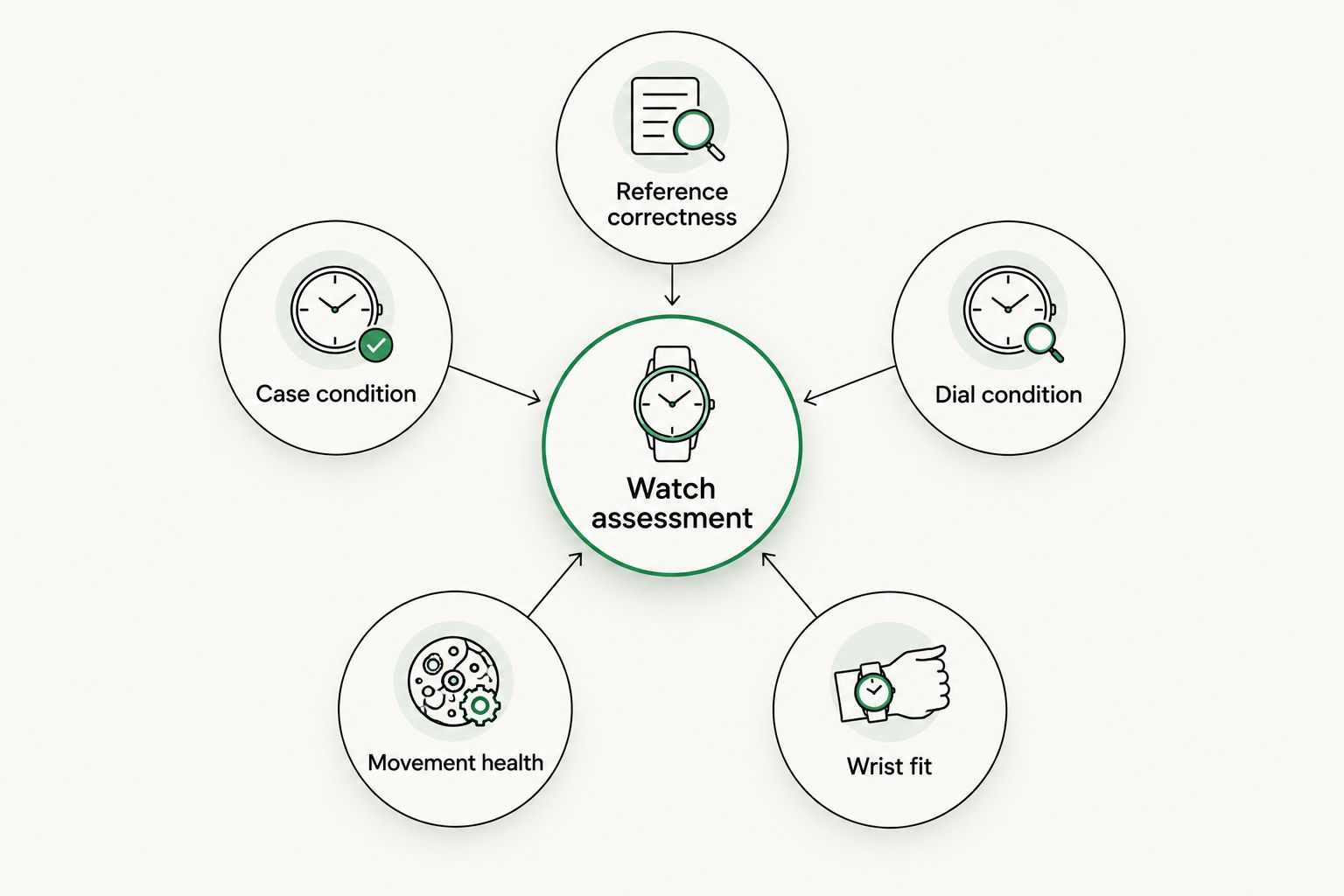
Before committing, assess these five areas together:
- Reference correctness: Match the components to the exact model.
- Case condition: Examine geometry and finishing, not just scratches.
- Dial condition: Look for damage, staining and inconsistent components.
- Movement health: Obtain testing appropriate to the calibre.
- Wrist fit: Confirm comfort, bracelet adjustment and everyday legibility.
Service evidence helps explain previous work, but its usefulness depends on what it records. Read the details: parts replaced, findings and the watch identified. Independent authentication addresses identity and component correctness; it does not replace movement-health assessment.
Which Grand Seiko should you choose in 2026?
Choose the SBGA211 Snowflake if you are undecided and want Grand Seiko’s distinctive combination of dial texture, titanium and Spring Drive. It is the clearest default here, provided the case fits your wrist.
Choose the SLGH005 for mechanical architecture, the SBGA413 for dial character, the SBGW231 for compact dress wear or the SBGX261 for quartz precision. Do not buy two similar references merely because their nicknames are different. Decide what the next watch contributes before inspecting examples.
In 2026, assess desirability through the watch itself: correct components, preserved finishing, movement health and wearability. Original packaging cannot establish any of those qualities.
FAQ
What’s the best Grand Seiko watch for a first collector purchase?
The Grand Seiko SBGA211 Snowflake is the default choice in this comparison because it combines a textured dial, titanium construction and Spring Drive. Choose it only after confirming that its 41 mm case suits your wrist and the individual watch passes condition checks.
Is the Grand Seiko Snowflake better than the Shunbun?
The SBGA211 Snowflake is better for buyers wanting a neutral white dial; the SBGA413 Shunbun is better for buyers prioritising subtle pink dial character. Both use calibre 9R65, so the decision centres on dial appearance, case design and fit rather than a different movement family.
Is Spring Drive a mechanical or quartz movement?
Spring Drive combines mainspring power with quartz regulation. It does not use a conventional mechanical escapement, and its continuously gliding seconds hand distinguishes it from the mechanical Hi-Beat and quartz references here.
Which Grand Seiko is best for a smaller wrist?
The SBGX261 and SBGW231 are the compact starting points in this list, with case diameters of 37 mm and 37.3 mm respectively. Confirm lug span, thickness and strap or bracelet fit rather than choosing by diameter alone.
Does a pre-owned Grand Seiko need its original box and papers?
No, original packaging is not required for a Grand Seiko to be desirable. Assess reference correctness, originality, condition, movement health, service evidence where available and independent authentication.
What should I check before buying a used Grand Seiko online?
Check detailed photographs, component correctness and movement-health evidence before buying a pre-owned Grand Seiko online. Request clear views of the case facets, dial, hands, crown, bracelet and identifying markings, and confirm the seller’s current terms directly.
Are Grand Seiko watches guaranteed to rise in value?
No, future appreciation is not guaranteed. Choose a reference for its collecting and wearing merits, then assess the individual watch rather than treating dial popularity as evidence of future returns.
One last thing
Before choosing between the Snowflake and Shunbun, ask whether your collection needs another calibre 9R65 watch. Their dials differ, but their movement experience overlaps. An SBGW231 or SBGX261 creates a more distinct ownership experience if Spring Drive is already represented.
James Patten Fine Watches’ recommendation is to buy the reference you will wear, then insist on evidence about the actual example. A box cannot compensate for lost case geometry or an unhealthy movement.


