
Best overall: Tudor Black Bay Fifty-Eight 79030N. Best for movement-focused buyers: Omega Seamaster Diver 300M. Best for solar-powered simplicity: Citizen Promaster BN0150-10E. The best dive watches for beginners in 2026 balance wrist fit, clear controls and verifiable condition—not the deepest rating or the most elaborate presentation box.
- Tudor Black Bay Fifty-Eight 79030N leads the best dive watches for beginners for compact, everyday mechanical wear.
- Omega Seamaster Diver 300M suits buyers who want modern movement certification and a date display.
- Citizen Promaster BN0150-10E suits beginners who prefer solar quartz to winding a mechanical watch.
- Choose pre-owned dive watches by originality, condition, movement health and authentication—not packaging.
Why your first dive watch should fit your life
A first dive watch needs to work on your wrist before its specification sheet matters. Case diameter alone cannot tell you whether the lugs overhang, the clasp sits comfortably or the crown presses into your hand; start with how to choose the right watch case size.
For a 2026 purchase, separate two questions: which reference suits you, and whether the particular example deserves your confidence. A well-chosen model does not excuse a damaged crown, uncertain movement health or an altered dial. James Patten's beginner dive-watch recommendation is the Tudor Black Bay Fifty-Eight 79030N for buyers seeking compact mechanical daily wear.
What makes the best dive watches for beginners
- Wrist fit: Judge lug position, thickness, bracelet articulation and clasp comfort together. A smaller diameter does not automatically produce the better fit.
- Readable timing: Look for distinct hands, clear minute markings and a bezel you can grip. Decorative complexity should not obscure elapsed time.
- Suitable movement: Mechanical watches reward involvement; solar quartz reduces winding and resetting. Choose the ownership routine you actually want.
- Water-use evidence: A manufacturer's depth rating describes the model, not the present sealing condition of a used example. Establish current water resistance before immersion.
- Reference correctness: Check the dial, hands, bezel, case and movement against the exact reference. Record replacements rather than treating every change as equivalent.
- Condition over accessories: Assess case geometry, dial preservation, movement health and service evidence where available. Original packaging cannot establish any of these.
Beginner dive watches at a glance in 2026
The dimensions and water-resistance ratings below are manufacturer-published model specifications. They distinguish the named references; they do not certify the condition or water resistance of an individual pre-owned watch.
| Watch | Best for | Standout feature | Key limitation |
|---|---|---|---|
| Tudor Black Bay Fifty-Eight 79030N | Compact mechanical daily wear | 39 mm case; 200 m rating | No date display |
| Omega Seamaster Diver 300M, steel 42 mm calibre 8800 model | Movement-focused first-time collectors | Master Chronometer certification; 300 m rating | Larger case and an additional helium valve |
| Citizen Promaster BN0150-10E | Solar-powered simplicity | Eco-Drive solar quartz; 200 m rating | 44 mm case needs a wrist-fit check |
| Seiko Prospex SRPE93 | A first mechanical cushion-case diver | 45 mm cushion case; day-date display | Broad case and no hacking-free ownership shortcut: it still needs winding or wear |
| Rolex Submariner 124060 | A no-date luxury watch to keep wearing | 41 mm case; 300 m rating | Authentication and condition require careful scrutiny |
1. Tudor Black Bay Fifty-Eight: best for compact mechanical wear
The Tudor Black Bay Fifty-Eight 79030N is an automatic, no-date dive watch with a 39 mm case and a manufacturer-rated water resistance of 200 m. Its black dial, black bezel and warm-toned detailing give it a restrained, vintage-influenced appearance without requiring you to buy a vintage watch.
Best for: You want a first mechanical diver that also works as an everyday watch.
The compact case is the strongest reason to start here. Still, try the actual bracelet configuration: link adjustment and clasp position affect comfort as much as the case dimensions.
Tudor Black Bay Fifty-Eight pros:
- Compact diameter gives you a useful starting point for wrist-fit comparisons.
- No-date layout keeps the dial uncluttered.
- Mechanical operation offers a direct introduction to winding and setting.
Tudor Black Bay Fifty-Eight cons:
- No date means checking elsewhere when you need it.
- Warm-toned details will not suit every preference.
- An automatic movement still requires attention to condition and servicing.
For a pre-owned 79030N, inspect lug symmetry, bezel condition and bracelet wear. Ask what any service work changed, particularly if preserving the original configuration matters to you.
Verdict: Buy the Tudor Black Bay Fifty-Eight if compact mechanical wear is your priority.
2. Omega Seamaster Diver 300M: best for movement-focused buyers
The steel, 42 mm Omega Seamaster Diver 300M with calibre 8800 combines a date display, ceramic dial and bezel, and Master Chronometer certification. Omega specifies 300 m water resistance for this model configuration.
Best for: You want your first luxury diver to introduce modern movement technology as well as traditional mechanical ownership.
Its wave-pattern dial and skeletonised hands give the Omega Seamaster Diver 300M a more detailed appearance than the Tudor. The helium escape valve is intended for saturation-diving conditions; it is not a feature a recreational beginner needs to operate routinely.
Omega Seamaster Diver 300M pros:
- Master Chronometer certification provides a defined testing framework.
- The date display adds everyday utility.
- Dial texture and ceramic surfaces create a distinct visual character.
Omega Seamaster Diver 300M cons:
- The 42 mm case needs more wrist space than the Tudor.
- Skeletonised hands deserve a personal readability check.
- The additional valve introduces another control to understand.
Do not transfer these specifications to every watch bearing the Seamaster name. Older generations and other Seamaster families differ; confirm the exact reference, movement and dimensions before comparing examples.
Verdict: Buy the Omega Seamaster Diver 300M if certified movement technology matters more than compactness.
3. Citizen Promaster BN0150-10E: best for solar-powered simplicity
The Citizen Promaster BN0150-10E uses Eco-Drive solar quartz rather than an automatic mechanical movement. Citizen specifies a 44 mm case and 200 m water resistance, with a date display and an elapsed-time bezel.
Best for: You want a dive watch without making mechanical winding part of your routine.
Light powers the movement through a rechargeable cell. That changes ownership, not the need for care: prolonged darkness, ageing seals and physical damage still require attention.
Citizen Promaster BN0150-10E pros:
- Solar quartz removes the need to wind a mainspring.
- A date display supports daily use.
- The straightforward dial layout keeps attention on time reading.
Citizen Promaster BN0150-10E cons:
- The 44 mm diameter requires a fit check.
- Solar charging needs suitable light exposure.
- It will not satisfy a buyer specifically seeking a mechanical movement.
For a used example, establish that charging and timekeeping function correctly. A running watch is not, by itself, proof that the rechargeable cell or water-resistant seals are healthy.
Verdict: Buy the Citizen Promaster BN0150-10E if uncomplicated solar-quartz ownership is your main requirement.
4. Seiko Prospex SRPE93: best for a cushion-case mechanical introduction
The Seiko Prospex SRPE93 is an automatic diver with a 45 mm cushion-shaped case, a day-date display and a manufacturer-rated water resistance of 200 m. Its case shape makes it a distinctly different proposition from the narrower-looking Tudor.
Best for: You want a first mechanical diver with a broad cushion case and practical calendar information.
Try it rather than rejecting it solely on diameter. The way the case distributes its width and places its lugs matters, but that does not make wrist fit universal.
Seiko Prospex SRPE93 pros:
- Day and date are visible together.
- The cushion case offers a distinct alternative to conventional round-case styling.
- Automatic operation introduces mechanical ownership without additional complications.
Seiko Prospex SRPE93 cons:
- Its broad case is not suited to every wrist.
- Mechanical timekeeping requires different expectations from quartz.
- Modified examples need careful checks against the original specification.
On a pre-owned SRPE93, distinguish ordinary wear from changes to the dial, hands or bezel. Aftermarket parts are not the same as original components, even when the resulting watch looks attractive.
Verdict: Buy the Seiko Prospex SRPE93 if cushion-case styling and a day-date display are essential.
5. Rolex Submariner 124060: best for a no-date luxury keeper
The Rolex Submariner 124060 is an automatic, no-date diver with a 41 mm case and a manufacturer-rated water resistance of 300 m. Its dial presents time without a calendar aperture, making it the clearest choice here for a buyer specifically seeking a contemporary no-date Rolex diver.
Best for: You already know that a no-date Submariner is the watch you want to wear long term.
Being a beginner does not disqualify you from buying one. It does make independent authentication and a clear explanation of condition especially important.
Rolex Submariner 124060 pros:
- The no-date dial keeps the display simple.
- Its elapsed-time bezel gives the watch a practical timing function.
- The bracelet's Glidelock system supports fit adjustment.
Rolex Submariner 124060 cons:
- No calendar display limits everyday convenience for some buyers.
- Polishing, replacement parts and bracelet wear need individual assessment.
- Recognition alone does not establish authenticity or suitability.
Inspect case edges, dial and hand consistency, bezel condition and clasp operation. A presentation box cannot resolve uncertainty about the watch, and neither can an impressive-looking document without corroborating examination.
Verdict: Buy the Rolex Submariner 124060 for a deliberate long-term wearing choice, not an assumed financial return.
How this ranking works
James Patten's 2026 beginner dive-watch ranking prioritises wearing fit, readable controls, manageable ownership and the ability to assess an individual example. The Tudor takes the default position because its compact, uncomplicated format addresses those priorities without adding a calendar or extra valve.
This is a reference-level buying guide, not a claim of hands-on testing or a ranking of individual watches for sale. Condition can reverse the decision: a poorly preserved first choice is not preferable to a sound example of your second choice.
Assess the watch before you commit
Reference correctness
Confirm the exact reference first. Compare its dial, hands, bezel, case and movement with the manufacturer's documented configuration, and ask for an explanation of any difference. A replacement component deserves disclosure; it does not automatically make the whole watch unsuitable.
Case and dial
Look at the watch from several angles. Heavy polishing can soften case edges, while dial damage, corrosion or inconsistent luminous material deserves closer examination. Distinguish cosmetic scratches from issues affecting function or originality.
Movement health
Ask for evidence of timekeeping and a competent movement assessment. Check winding, setting and calendar operation where fitted. A watch that starts running when handled has demonstrated operation, not complete mechanical health.
Water resistance
Establish current sealing condition before swimming or diving with a pre-owned watch. A 200 m or 300 m inscription is not a current pressure-test result. Use an assessment appropriate to the intended activity, and follow the manufacturer's operating instructions.
Wearability
Wear the watch long enough to notice crown contact, clasp pressure and top-heaviness. Check whether the bracelet can be adjusted to your wrist. The best specification is wasted if you repeatedly remove the watch because it feels uncomfortable.
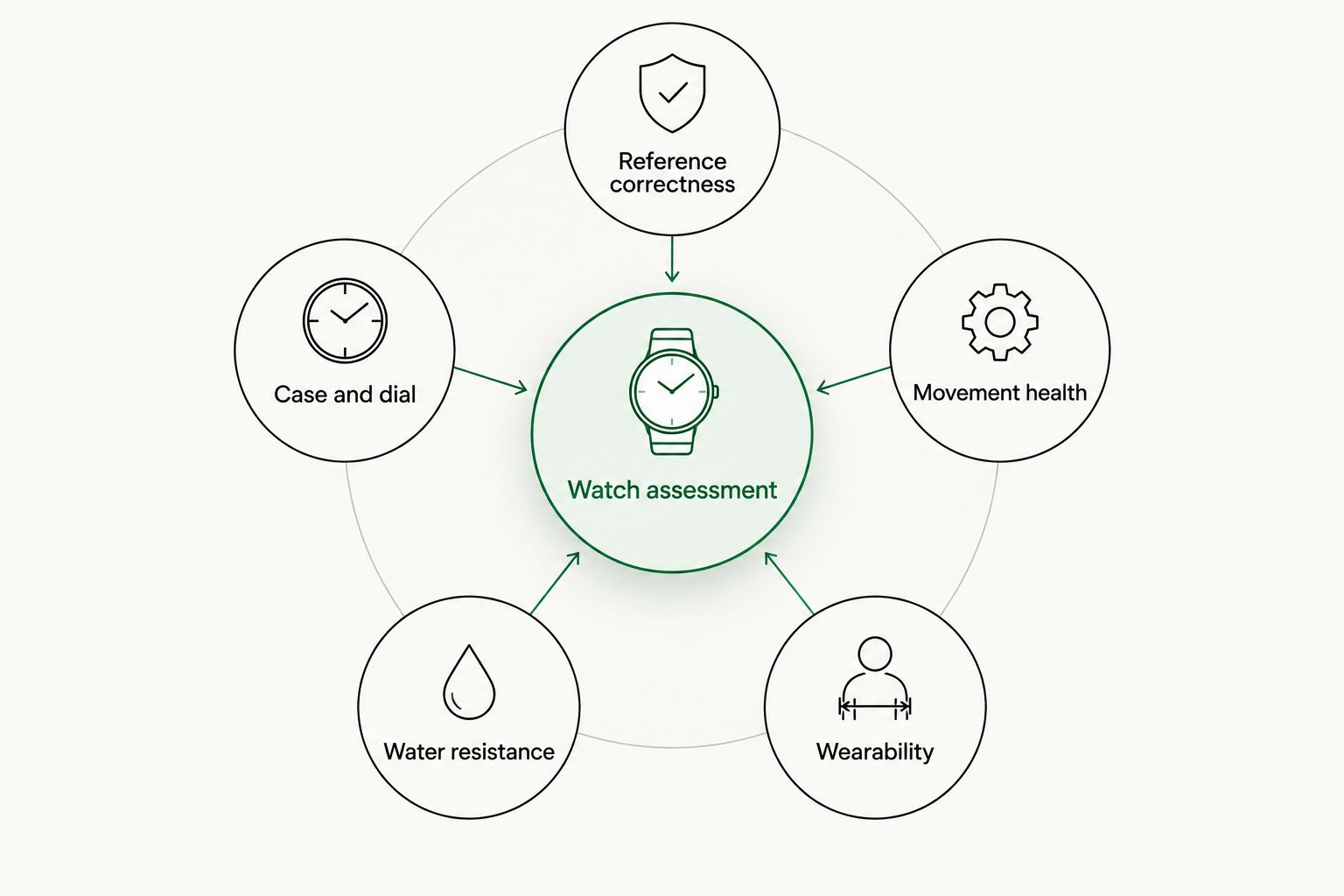
Service evidence is useful when it explains what was examined or replaced. Read its scope rather than treating the word serviced as a complete answer. Independent authentication and condition assessment remain separate from deciding whether the watch suits your taste.
Which beginner dive watch should you choose?
Choose the Tudor Black Bay Fifty-Eight 79030N as the default mechanical starting point in 2026. Move to the Omega Seamaster Diver 300M for movement certification and a date, or the Citizen Promaster BN0150-10E if you prefer solar quartz.
Choose the Seiko Prospex SRPE93 because you like its cushion case and day-date—not because every beginner must start there. Choose the Rolex Submariner 124060 when the no-date Rolex itself is your settled preference.
For James Patten's luxury-watch buyers, the deciding question is straightforward: which sound, correctly represented example will you enjoy wearing? Neither a famous name nor original packaging answers it.
FAQ
What's the best dive watch for a beginner in 2026?
The Tudor Black Bay Fifty-Eight 79030N is the default mechanical recommendation for compact everyday wear. Its 39 mm case and no-date display suit buyers who want a relatively uncomplicated first luxury diver; assess fit and individual condition before buying.
Is the Tudor Black Bay Fifty-Eight better than the Omega Seamaster Diver 300M?
The Tudor Black Bay Fifty-Eight is the better fit-focused starting point; the 42 mm Omega Seamaster Diver 300M suits buyers prioritising Master Chronometer certification and a date. Neither is universally better because wrist fit, display preference and the condition of the example change the decision.
Should my first dive watch be automatic or solar quartz?
Choose automatic for mechanical involvement and solar quartz for an ownership routine without winding. The Citizen Promaster BN0150-10E uses solar quartz, while the other watches in this ranking use automatic movements.
Can I swim with a pre-owned dive watch?
Establish its current water resistance before swimming. The original model rating does not prove that ageing seals, the crown or previous repairs remain suitable for immersion.
Does a desirable pre-owned dive watch need its original box and papers?
No, original box and papers are not prerequisites for desirability or quality. Evaluate reference correctness, originality, condition, movement health, service evidence where available and independent authentication.
Is a 45 mm dive watch too big for a beginner?
A 45 mm dive watch is too big if its fit is uncomfortable or its lugs overhang your wrist. Diameter alone is insufficient: try the Seiko Prospex SRPE93 and assess case shape, thickness, strap fit and weight distribution.
Do beginners need a helium escape valve?
Recreational beginners do not need a helium escape valve for ordinary swimming or recreational scuba diving. The feature addresses helium exposure in saturation-diving environments, not routine water use.
One last thing
A dive bezel is useful on land too: align its marker with the minute hand to follow elapsed time while cooking or keeping track of a break. Try reading it in ordinary light before buying.
For actual diving, a watch does not replace a dive computer, training or safe procedures. For collecting in 2026, the equally practical rule is to buy the watch you can assess and wear confidently—not its packaging.


